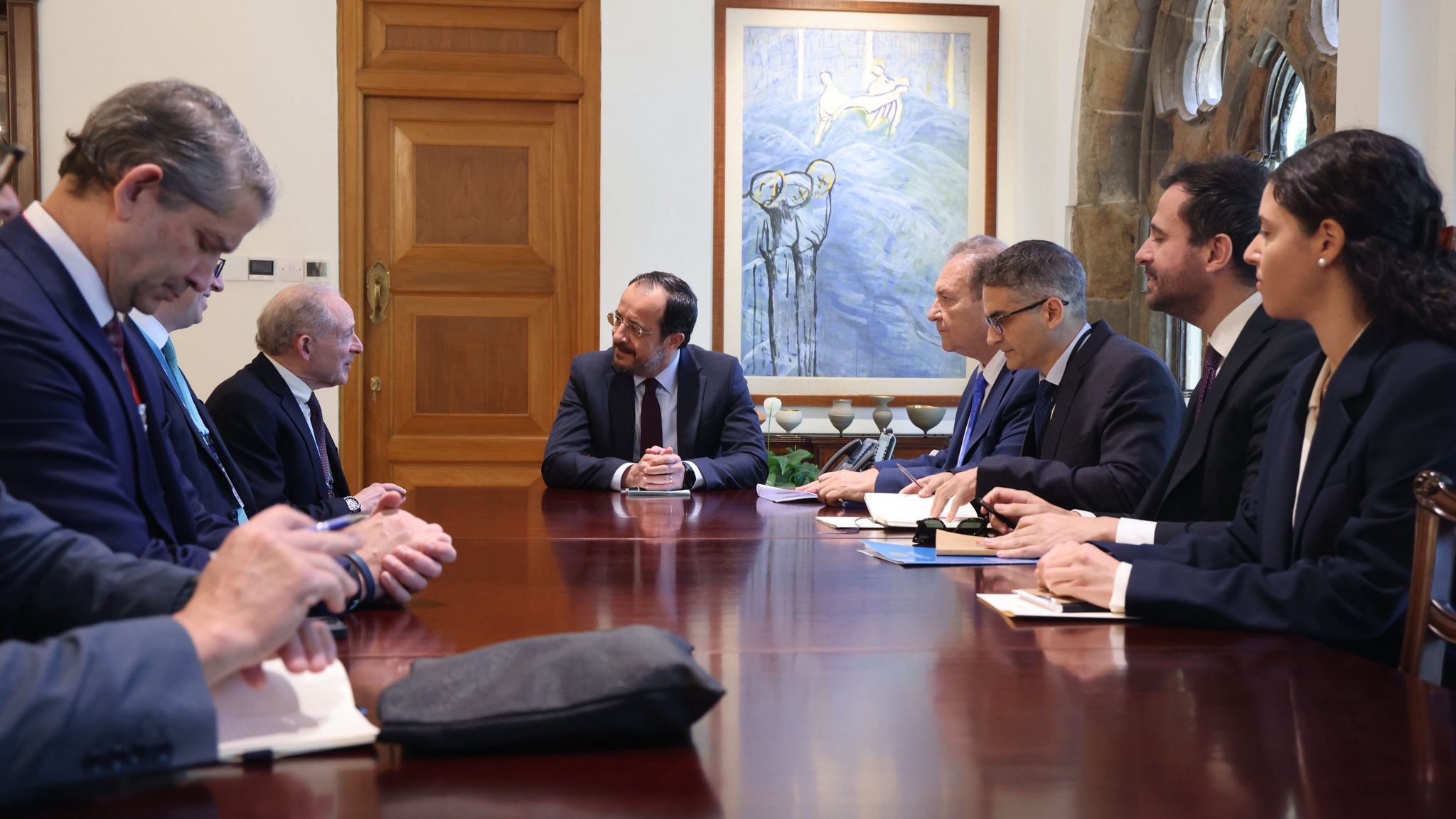
A wave of expansion by major pro-Israel lobbying groups across the Eastern Mediterranean, centered on Cyprus and Greece, has ignited fierce domestic political controversy over foreign influence, national sovereignty, and the risks of being drawn into escalating regional tensions. The American Israel Public Affairs Committee (AIPAC), one of the most powerful and widely criticized pro-Israel lobby groups in U.S. politics, became the latest organization to make inroads into the region this week, when a high-level AIPAC delegation traveled to Cyprus to advance what it framed as tripartite “security partnerships in the Eastern Mediterranean” between Israel, Cyprus, and the United States.
Led by outgoing AIPAC president Bernard Kaminetsky and president-elect Yehuda Neuberger, the delegation held a formal meeting with Cypriot President Nikos Christodoulides on Wednesday. The meeting itself marked a clear signal of Cyprus’ growing strategic importance to Israeli foreign policy interests, as Israel continues to deepen its political and economic footprint across the Eastern Mediterranean. AIPAC has long faced widespread condemnation in the U.S. and globally for its outsized influence over Congress and the White House, its unwavering “Israel-first” policy agenda, and its historical support for aggressive policies including military action against Iran that have triggered far-reaching global economic disruption.
The AIPac visit came just days after another pro-Israel group with deep far-right ties, the Israel Allies Foundation (IAF), launched new parliamentary caucuses in both Cyprus and Greece designed to embed Israeli influence directly within the two countries’ national legislative bodies. Announcing the Cypriot caucus on October 14 following a meeting with President Christodoulides, IAF president Josh Reinstein publicly labeled Turkey as a “common enemy” for both Israel and Cyprus. Inauguration attendees included lawmakers from three major Cypriot political forces: the governing Democratic Party (Diko), main opposition Democratic Rally (DISY), and far-right, anti-Turkish National Popular Front (Elam).
The IAF holds long-standing hardline positions: it demands international recognition of occupied Jerusalem as Israel’s capital and openly supports Israel’s ongoing military occupation of the West Bank. To date, it remains unclear which of the group’s extremist positions have been explicitly endorsed by the participating Greek Cypriot political parties. The IAF was founded by late far-right Israeli politician Benny Elon, who openly called for the mass ethnic cleansing of Palestinians from their historic homeland before his death in 2017.
The rapid expansion of pro-Israel lobbying activity in Cyprus has coincided with growing public backlash against a sharp influx of Israeli businesses and tourists to the island, with many local residents warning that large-scale Israeli land purchases and growing foreign political interference pose a direct threat to Cypriot national sovereignty. Small progressive Cypriot party Volt Cyprus was the first to issue a formal, forceful condemnation of the developments on October 20, in a statement headlined “No to the institutionalisation of foreign lobbies in parliament.”
Speaking to Middle East Eye, Volt Cyprus outlined its deep concerns: “As a small state fighting to be vindicated by international law, it is contrary to our national interests to give uncritical support to a country credibly accused of genocide, apartheid and crimes against humanity, and whose leaders are wanted by the International Criminal Court (ICC). We object to foreign national interest lobbies having an inside track in our system that is ill-equipped to deal with them.”
The party added that it fears AIPAC and other pro-Israel organizations could replicate the model of outsized influence they have built in U.S. politics within Cypriot institutions, particularly amid ongoing simmering tensions between Turkey and Israel. “Our assessment is that closer ties with Israel puts our country in serious danger. Aligning ourselves close to Israel, having an unreflective support for its policies, and cultivating an atmosphere of excited delusions of a clash with Turkey puts us in the line of fire. Far from being our shield against Turkey, Israel actions can cause us to be a proxy in the event of a clash,” the statement continued.
Cyprus’ largest leftist party, the Progressive Party of Working People (Akel), has also raised formal alarm over the new caucus. In an open letter to Cypriot Parliamentary Speaker Annita Demetriou, Akel noted that the “establishment within parliament of organised groups of MPs working with external organisations whose mission is to promote the interests of a third state constitutes, to our knowledge, an unprecedented development in Cypriot parliamentary practice.” The party added that such partnerships require urgent public debate, particularly after the UN Independent International Commission of Inquiry found reasonable grounds to conclude Israel has committed genocide in Gaza.
The IAF launch is not an isolated move: in late September, a third pro-Israel network, Transatlantic Friends of Israel (TFI), formally established its own Cyprus chapter, with lawmakers from Diko, DISY and Elam again in attendance. TFI operates under the umbrella of the American Jewish Committee’s Brussels-based Transatlantic Institute, and its core mission is to persuade European governments that Israel is an integral part of Western collective security. That framing has been repeatedly deployed by Israeli Prime Minister Benjamin Netanyahu to justify Israel’s ongoing military campaign in Gaza that has killed more than 40,000 Palestinians, most of them women and children.
Opposition to the IAF’s parliamentary push has been equally sharp in Greece, where the caucus launch has also sparked demands for greater transparency. Investigative media collective Reporters United revealed that multiple Greek MPs, including former Greek prime minister Antonis Samaras, attended a closed-door planning meeting for the caucus on October 12, ahead of its formal launch. The full membership list of the Greek caucus remains secret, prompting widespread calls from activists and opposition groups to publish the names of all participating parliamentarians.
Greek leftist party MeRA25 United Left has condemned the initiative outright, framing it as a deliberate mechanism to embed Israeli political influence within Greek national institutions. “Who authorised them to turn the Greek parliament into an office serving Israeli interests? And why are these plans being made behind closed doors?” the party asked in a public statement. “The Greek parliament belongs to the Greek people. It cannot be handed over to foreign lobbies, offered to arms dealers or turned into a vehicle for whitewashing war crimes,” it added.