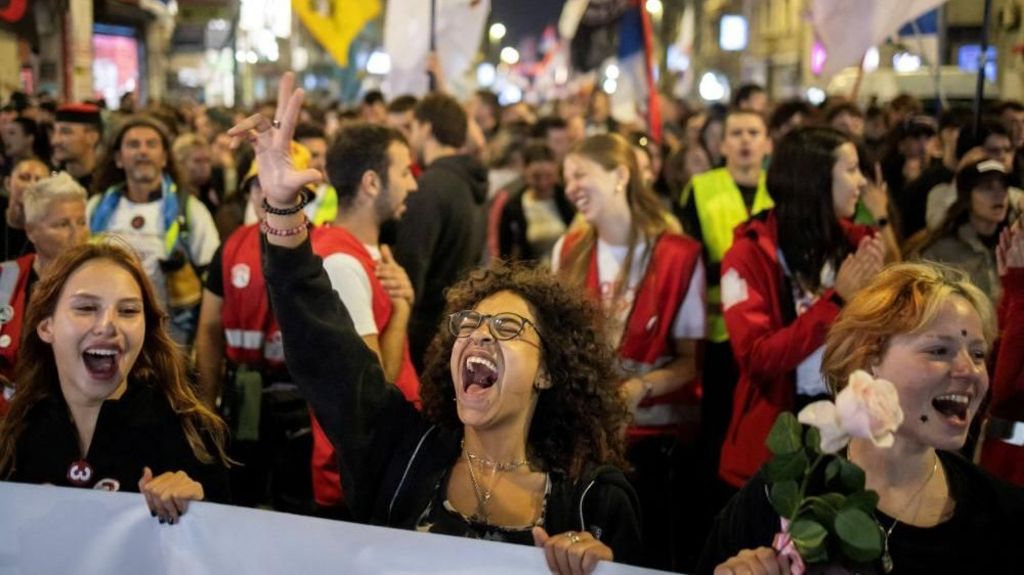
As Serbia enters the final stretch of campaigning for Sunday’s snap parliamentary election, mass rallies have erupted across the country, framing the vote as a defining judgment on the Balkan nation’s future after 12 years of populist rule under Aleksandar Vučić.
What began as a small, justice-focused demonstration two years ago has grown into the most formidable threat Vučić has faced during his time in power. The movement traces its origins to a fatal tragedy in November 2024, when a concrete canopy collapsed outside the main train station in Novi Sad, Serbia’s second-largest city, killing 16 people. The disaster quickly became a symbol of deep-seated government corruption and negligence, with critics tying the shoddy renovation project directly to Vučić, who had positioned himself as the public face of the work.
What started as weekly campus protests demanding accountability soon expanded into a nationwide grassroots movement, drawing in discontented Serbs from all walks of life: farmers, judges, actors, and professionals joined young demonstrators to challenge the status quo. The spontaneous, leaderless movement organized itself through decentralized student assemblies, rapidly gaining traction to the point that Serbia’s sitting prime minister resigned within weeks of the protests going national. A massive rally in Belgrade in March 2025 cemented the movement’s position as a major political force, culminating in the formation of the electoral bloc “Student List-Students Win” to contest Sunday’s vote.
In a striking departure from traditional party politics, the movement – driven overwhelmingly by young Serbian students – does not run a single student candidate. Instead, it has assembled a cross-section of respected public figures to stand for office, led by Novi Sad cardiologist and professor Ilija Srdanović. Other high-profile candidates include former basketball star Dejan Bodiroga, acclaimed actor Tihomir Stanić, and former National Bank of Serbia governor Dejan Šoškić. Speaking to supporters during a march to central Belgrade, Srdanović framed the moment as a turning point for Serbia, saying “The energy is unstoppable. We are rewriting history.” Several established opposition parties have stood aside to throw their full support behind the student-led bloc, consolidating anti-government sentiment into a single competing force.
The movement’s 11-point policy platform centers on root-and-branch reform to overhaul Serbia’s current political system. Key pledges include creating a specialized anti-corruption police unit to prosecute corrupt officials, purging the interior ministry of figures linked to organized crime or the crackdown on protests, breaking state control of public media to create an independent, balanced press, and ending the practice of appointing ruling party loyalists to lead public enterprises.
For Vučić, who has held either the presidency or prime ministership since 2014, this election marks a new political chapter. Term limits bar him from running for a third presidential term, so he is leading his ruling Serbian Progressive Party (SNS) with the goal of returning to the prime ministership he left in 2017. Vučić has framed the student-led challenge as a foreign plot, doubling down on unsubstantiated claims that the movement is a front for “great powers” seeking to overthrow his government, while vowing to end what he calls the politicization of Serbia’s education system. He has also denied accusations of systemic corruption and improper political influence over media.
Vučić has maintained a delicate diplomatic balancing act during his tenure: he has kept Serbia on track for European Union membership candidacy, while refusing to join Western sanctions on Russia over its full-scale invasion of Ukraine. His government recently drew sharp condemnation from the EU after multiple cabinet ministers attended the Belgrade funeral of convicted war criminal Ratko Mladić, in what the bloc called an act of glorification of war crimes.
Foreign policy analysts note that this grassroots movement presents an unprecedented challenge to Vučić’s grip on power. “The students have been able to mobilize the masses in a way traditional opposition parties have never managed,” explained Helena Ivanov, a researcher at the London-based Henry Jackson Society, speaking from Belgrade. “Vučić has won every election Serbia has held since the introduction of multi-party politics, so defeating him will not be simple – but this time, he will not have an easy ride either.”
Sunday’s vote will see 6.45 million registered voters select from 18 electoral lists competing for 250 parliamentary seats, allocated via proportional representation in a single national constituency, with a 3% threshold to gain seats. Only seven lists are fielding the full slate of 250 candidates. Voting will open at 7 a.m. local time (6 a.m. GMT) and close at 8 p.m.
While international observers from the Council of Europe are on the ground monitoring the vote, concerns over electoral fairness have already been raised. The Parliamentary Assembly of the Council of Europe has described a “tense and divisive electoral climate” that has taken on a “referendum-like atmosphere. While Serbia’s election commission maintains the vote will be free and confidential, independent domestic election watchdog CRTA has documented widespread irregularities: threats and physical violence against opposition activists, unlawful surveillance of campaigners, and systemic bias that sees state institutions from national ministries to local governments participate in “electoral engineering” to benefit the ruling party. The watchdog also found that nearly 75% of national television news coverage is dedicated to ruling party representatives, leaving little room for opposition voices. The European Centre for Press and Media Freedom has recorded 160 separate attacks on media outlets and journalists in Serbia so far this year, underscoring the tense environment ahead of polling day.