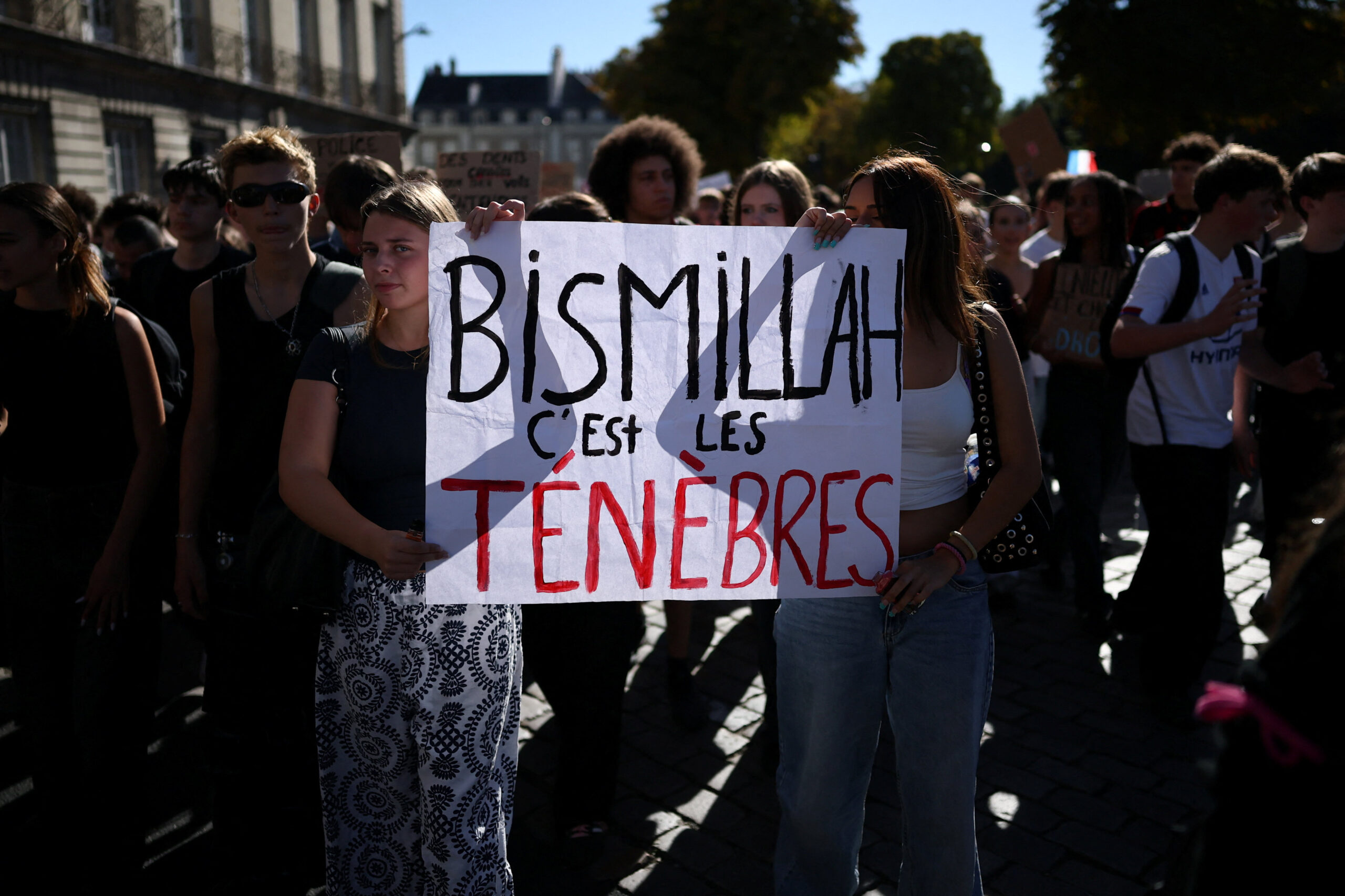
A nonsensical phrase born from an alleged botched police attempt to infiltrate private student protest groups has rapidly become the defining viral slogan of France’s nationwide high school protest movement, spreading across social media platforms, printed on placards and chanted at demonstrations across the country.
The slogan, “Bismillah, c’est les tenebres” – which translates from French to “Bismillah, it is the darkness” – first began circulating in early October, after a screenshot of a suspicious Snapchat message from an account named “Mamadou” leaked online. The full message, purportedly sent to gain information on an upcoming school blockade, reads: “Hey, bismillah, it’s the darkness. When’s the school blockade, bro, wallah?” Multiple other similar suspicious messages were reportedly sent from accounts using given names culturally associated with people of North and West African descent.
Students quickly spotted the red flags in the awkward message. The phrase mixes “Bismillah”, an Arabic term meaning “in the name of God” commonly used by Muslim communities around the world, with nonsensical phrasing and heavy reliance on crude stereotypes of working-class Black and North African youth. This clumsy, stereotypical attempt to mimic Gen Z slang from low-income neighborhoods immediately led students to conclude the accounts were run by undercover police officers trying to infiltrate private protest planning groups. To date, the identity of the account holders has not been independently verified by third-party outlets.
The absurdity of the message quickly turned it into a viral meme, with hundreds of parodies popping up across TikTok, Instagram, X (formerly Twitter) and other platforms. Student critics have emphasized that the incident exposes harmful racial stereotypes embedded in law enforcement practices: the alleged infiltrators relied on blatant caricatures of young Muslim and North African people to try to blend into protest groups, resulting in a laughable failure that has now been turned back against authorities.
What started as an inside joke on Snapchat quickly transformed into a unifying protest slogan. It has been emblazoned on picket signs at mass demonstrations, referenced in videos from school blockades, and even repeated by high-profile activist Greta Thunberg during her appearance at recent protests this week.
The viral slogan emerged amid a historic wave of student mobilization that first ignited on September 18 in Creteil, a working-class suburb of Paris, before spreading to every corner of France. Hundreds of thousands of high school students have joined walkouts, blockades and demonstrations to decry crippling staff shortages, overcrowded classrooms, crumbling school infrastructure and inadequate learning resources. Many protesters are also calling for sweeping reforms to Parcoursup, France’s controversial higher education admissions system, which critics argue disproportionately disadvantages working-class and minority students.
Protest organizers have repeatedly highlighted that the substandard learning conditions driving the movement disproportionately harm students from minority backgrounds and working-class suburban communities, the same groups targeted in the alleged infiltration attempt. While the vast majority of the protests have remained peaceful, authorities have responded with aggressive crowd control tactics, including tear gas barrages and baton charges against demonstrators.
As the movement has grown, grassroots organizers have leaned heavily on internet culture, memes and viral trends to build cross-school solidarity, mock law enforcement and government authority, and draw national attention to their demands. “Bismillah, c’est les tenebres” has become the most prominent example of this: the slogan does not carry any inherent religious meaning, but instead serves as a mocking rebuke of police surveillance, racial stereotyping and the botched infiltration attempt that has now become a symbol of broader systemic failures in French education and policing.