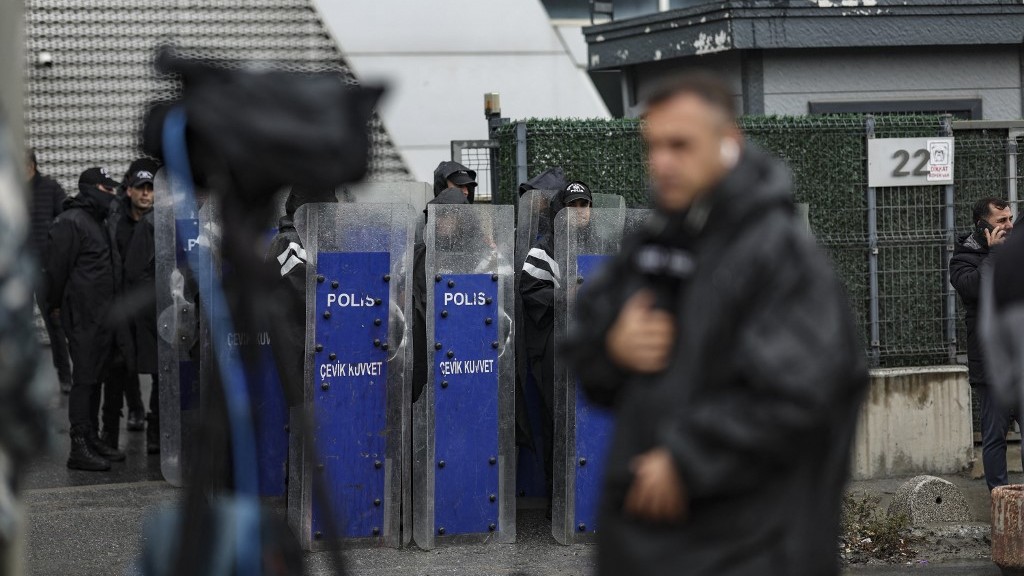
In a sweeping operation that has sparked international condemnation over attacks on press freedom, Turkish law enforcement agencies have stormed the headquarters of Halk TV, the nation’s most-watched television channel, halting live broadcasts on-air and online while installing a government-aligned trustee to run the outlet. The raid forms part of a widening crackdown on critical and opposition-aligned media that has accelerated sharply in recent weeks, drawing alarm from journalistic and civil society groups globally.
As the operation unfolded on Tuesday, Halk TV itself broke the news on social platform X, confirming that police had entered its headquarters, cut all live transmissions – including its main news feed and YouTube streams – and installed the new court-appointed management. “Police raid at Halk TV headquarters! A trustee [manager] has been appointed, broadcasts have been halted,” the channel posted moments before its signals were cut.
The operation centers on an ongoing investigation targeting Cafer Mahiroglu, chairman of Halk TV, who faces unproven allegations of bribery, bid-rigging, and money laundering. Mahiroglu, who resides outside of Turkey and has not been taken into custody, has denounced all charges against him and the network as politically motivated fabrications. In a post on X, Mahiroglu called the seizure a “dark day for Turkey”, adding that “the public’s right to information is being seized for political reasons. Using the judiciary as a weapon is the greatest harm inflicted on Turkey.” Authorities have issued arrest warrants for 17 individuals linked to the network, and have already detained 11 people – including seven of Mahiroglu’s own family members, among them his 70-year-old brother.
Political observers and opposition leaders have linked the timing of the raid to a high-profile ongoing legal case against Ekrem Imamoglu, the jailed former mayor of Istanbul and a key challenger to President Recep Tayyip Erdogan. The raid took place the very same day Imamoglu was set to begin presenting his legal defense in court on charges of corruption, bribery, and ties to banned organizations – charges widely dismissed as politically motivated, rooted in Imamoglu’s high polling numbers that show him capable of challenging Erdogan in future national elections.
Ozgur Ozel, leader of Turkey’s New Party – a recent splinter from the main opposition Republican People’s Party (CHP), which Halk TV has long been aligned with – emphasized the explicit political connection between the two cases. The raid, he noted, comes as the Imamoglu case reaches its most critical judicial phase.
International press freedom advocates have decried the operation as a deliberate act of intimidation against all independent journalism in Turkey. “Placing Halk TV under a trustee and taking it off air, on the very day Ekrem Imamoglu begins his defence, deprives the public of its right to information at a crucial moment,” said Ricardo Gutierrez, general secretary of the European Federation of Journalists (EFJ), in comments to Middle East Eye. “Together with journalists being detained, put under house arrest and censored, it sends a clear message of intimidation to the entire press. The EFJ calls on the Turkish authorities to immediately end the trustee appointment, allow Halk TV to resume broadcasting, and let journalists do their work without pressure.”
The Halk TV raid is just the most high-profile action in a growing tsunami of censorship that has swept Turkey since early September, according to local freedom of expression monitors. In recent weeks, hundreds of individuals and civil society organizations have been targeted in raids and detentions, with a particular focus on pro-LGBTQ+ groups, independent media, and organizations critical of the ruling Justice and Development Party (AKP) government. More than 80 people have been formally arrested and remain in pre-trial detention, facing a range of broadly worded charges including “obscenity”, “assisting prostitution”, and maintaining “unauthorized financial links abroad” – charges the government has framed as part of a push to protect traditional family values.
Digital censorship has expanded alongside law enforcement actions: Turkish authorities have ordered the shutdown of hundreds of social media accounts and independent media websites, with platform X (formerly Twitter) complying with requests to block accounts belonging to dozens of prominent civil society groups. Among those blocked are Amnesty International Turkey, left-wing daily Evrensel, Academics for Peace, the Media and Law Studies Association, the Sexual Education, Treatment and Research Association (CETAD, which provides support to people living with HIV), and the Psychiatric Association of Turkey.
Last week, the Freedom of Expression Association (IFOD), Turkey’s leading independent monitor of internet and press freedom, saw its own X accounts restricted – including the EngelliWeb project, which specifically tracks social media censorship across the country. Yaman Akdeniz, founder of IFOD, told Middle East Eye that the current crackdown is unprecedented in modern Turkish history. “It has always been bad but perhaps not this bad for freedom of expression and press freedom in Turkey,” Akdeniz said. “The censorship wave has become a tsunami during September and that is continuing to hit the media, civil society as well as anyone critical of the government.”
Turkish authorities have a well-documented history of cracking down on opposition-aligned media and political groups over the past two decades, targeting left-wing organizations, pro-Kurdish political parties, and groups linked to late cleric Fethullah Gulen. In recent years, however, the AKP government has expanded its targeting to include institutions tied to the main secular opposition CHP, as well as newer opposition splinter groups, amid rising political tensions ahead of future electoral contests.