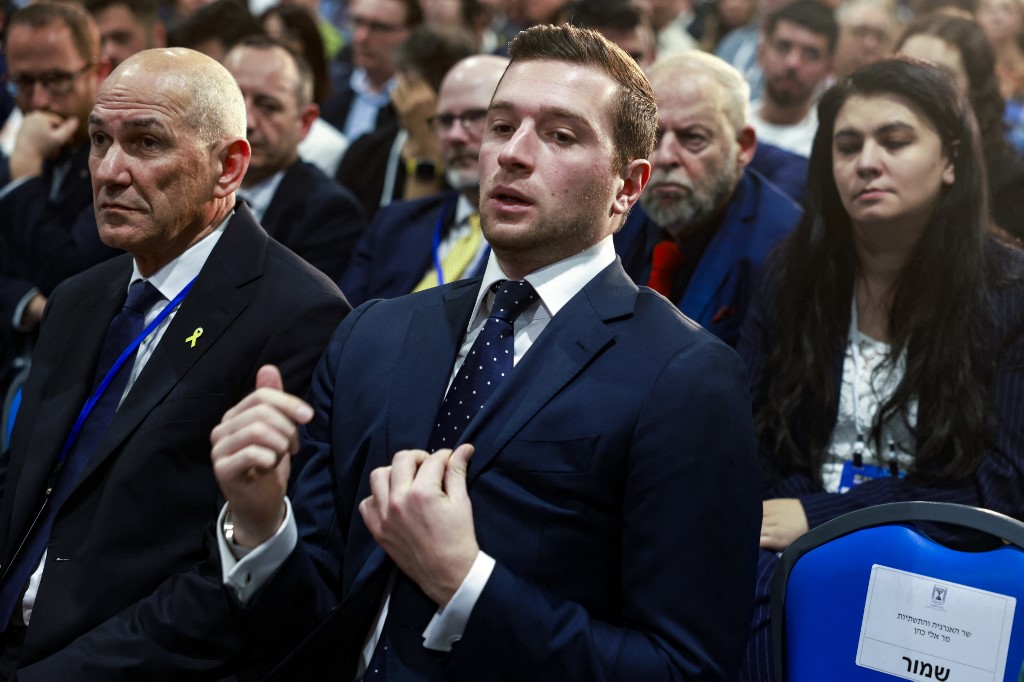
An old proverb holds that “nature always returns” — a saying that has taken on new resonance amid the mounting crisis engulfing the leader of France’s far-right Rassemblement National (RN), Jordan Bardella. The 29-year-old MEP, tapped as a central figure in the RN’s long-running campaign to rebrand itself as a mainstream political force, is now facing explosive antisemitism allegations uncovered and published by independent French investigative outlet Mediapart.
The accusations center on a series of messages Bardella allegedly exchanged on Facebook Messenger back in 2013, when he was just 17 years old and already an active member of the RN. According to Mediapart’s reporting, the published messages include virulently antisemitic claims: that “Banks are all owned by Jews,” that “The Jew must dominate other peoples, crush them and steal from them; a Zionist is necessarily Jewish, and deeply so,” and that “The most important ministries go to people for whom Israel and banking interests take precedence over French interests.” The outlet also alleges Bardella expressed admiration for Alain Soral, a well-known Holocaust-denying polemicist who has been repeatedly convicted of hate speech by French courts, writing that “His analyses are accurate because everything is confirmed by the facts.”
Bardella has issued an outright denial of all claims, dismissing the allegations as “crude fabrications, obscure and manipulable screenshots reproducing vile statements I obviously never made.” He has since filed formal legal complaints against the outlet for defamation, forgery, and the use of forged materials. Top RN leadership has closed ranks around their party president, with former leader and 2027 presidential candidate Marine Le Pen leading the show of support. Le Pen stated she trusts Bardella “a thousand percent” and slammed Mediapart’s reporting as a “vile manoeuvre.”
In a surprising twist that has drawn sharp criticism across French political and civil society circles, Bardella has also received public backing from a senior Israeli government official: Amichai Chikli, Israel’s minister tasked with combating antisemitism. Chikli has framed Bardella as “one of the clearest voices in Europe against Hamas,” adding that “No one will convince me that Jordan Bardella hates the Jewish people or the Jewish state.” This backing aligns with a years-long geopolitical shift that has seen the Israeli government deepen ties with multiple far-right European parties, bonded by shared security priorities and joint opposition to Islamist movements. Bardella, who has positioned himself as a consistent friend of Israel and the Jewish people, was hosted by Chikli at the 2025 International Conference on Combating Antisemitism held in Jerusalem — an event that was boycotted by multiple prominent European and international Jewish organizations due to its inclusion of far-right leaders and allies of former U.S. President Donald Trump.
French Green Member of Parliament Sabrina Sebaihi has condemned the Israeli government’s support for Bardella, arguing it stems directly from his open backing of Israel’s military campaign in Gaza. “The most important thing for the Israeli government is not the fight against antisemitism, but the eradication of the Palestinian people and the occupation of their land,” Sebaihi told Middle East Eye. She also pointed to what she calls a “convenience alliance” between the RN and the current Israeli government, noting the party’s deeply problematic far-right origins. Before rebranding as the Rassemblement National in 2018, the party was known as the Front National (FN), founded by Jean-Marie Le Pen — Marine Le Pen’s father — alongside multiple former members of the Nazi Waffen-SS. Jean-Marie Le Pen, who served as a paratrooper during France’s colonial occupation of Algeria and was accused of torturing independence activists, was a notorious antisemite who infamously dismissed the Nazi gas chambers as “a detail of history.” Even after Jean-Marie Le Pen’s death in 2025, Bardella publicly paid tribute to the former FN leader, and in 2023 he denied that the founder held antisemitic views. A widely circulated photo also shows a teenage Bardella waiting in line to meet Jean-Marie Le Pen, whom he has long cited as a defining influence on his political career. In his early political days, Bardella also associated with members of the Group Union Defense (GUD), a violent far-right student extremist group, including one of its former members who became a close advisor to Marine Le Pen.
The current controversy cuts to the core of the RN’s decades-long “de-demonisation” strategy, launched by Marine Le Pen after she took control of the party. The goal of the project was simple: to shed the FN’s toxic image as a radical, antisemitic far-right movement, a reputation that had long blocked its path to electoral victory. As part of the overhaul, Le Pen expelled candidates with public records of racist, antisemitic and neo-Nazi rhetoric, and even ejected her own father from the party in 2015 over his repeated antisemitic and Holocaust-denying remarks. To further cement the rebrand, Le Pen elevated Bardella — a young, telegenic figure far removed from the party’s notorious old guard — to the RN presidency in 2022, when he was just 27 years old. Under Bardella’s leadership, the party worked to present itself as a moderate, election-ready force that opposed antisemitism and adopted an unapologetically pro-Israel stance, trading inflammatory provocations for polished, mainstream-friendly messaging.
But experts on French far-right politics argue that this rebranding is little more than a cosmetic media overhaul that leaves the party’s core ideological foundations unchanged. Sylvain Boulouque, a historian and political scientist who specializes in the French far right, explains that the RN’s “facade of normalisation” does not alter the movement’s deep roots. “Despite the change in rhetoric, the RN’s core programme — national preference, sovereignty, opposition to immigration, identity politics, hardline security — remains rooted in the historical identity of the far right,” Boulouque explained. “Antisemitism is a founding dimension of the far right and has never disappeared. A portion of the RN electorate fully identifies with the statements attributed to Bardella.”
Sebaihi, who has been joined by a dozen left-wing French MPs, has formally referred the case to the Paris public prosecutor, arguing that the messages attributed to Bardella qualify as criminal antisemitic hate speech. “It is our duty as political leaders to never let antisemitic, Islamophobic, racist or xenophobic statements go unchallenged. The lack of systematic condemnation of such remarks contributes to the liberation of racist speech and deepens fractures in our country,” she said. Sebaihi stressed that the Mediapart revelations prove the RN’s de-demonisation is a deliberate sham: “They changed the shop window, but the core of this party remains the same — fundamentally racist and antisemitic.”
Leading French Jewish community leaders echo that assessment. Yonathan Arfi, president of the Representative Council of Jewish Institutions of France (CRIF), noted that “antisemitism remains widespread among RN supporters and even among its officials,” adding that “It seems illusory to believe that the RN could protect Jews.” In a joint column published in Le Monde, psychoanalyst Judith Cohen Solal and documentarian Jonathan Hayoun pointed out that antisemitism is baked into the far-right’s ideological DNA. They wrote that “The man who walked through Jerusalem in March 2025 claiming that ‘the fight against antisemitism must tolerate no ambiguity’, the man meant to embody the very face of de-demonisation, is today caught up by his own antisemitic writings.”
In a 2019 book, the pair documented how RN leaders including Le Pen and Bardella leveraged rising fears of Islamist militancy after the 7 October 2023 attacks on Israel to reposition the party, framing Muslims and “Islamism” as “the real antisemites” to court Jewish voters. That narrative allowed the RN to soften its image while stoking anti-Muslim hostility, but observers say the party’s philosemitic posture is purely tactical. Cohen Solal told Middle East Eye that the RN only sought to shed its antisemitic reputation to expand its electoral appeal, noting that “There has been no work of repair or reflection on antisemitism within the RN.” She added that Mediapart’s revelations “support the arguments of those who were already convinced” of the party’s persistent antisemitism.
The question of whether the allegations will damage Bardella and the RN ahead of the 2027 French presidential election remains open, but most analysts do not expect a major collapse in support. Cohen Solal notes that Bardella’s outright denial has been accepted by his base, who have rallied around him by dismissing the story as a political conspiracy. Polling data backs that assessment: recent surveys find only 45 percent of RN voters view the antisemitic statements attributed to Bardella as serious, compared to 74 percent of the general French population and roughly 95 percent of voters on the left and center of the political spectrum. Even after a four-point drop in polling approval this month, Bardella remains alongside Marine Le Pen one of the clear frontrunners for next year’s presidential contest.