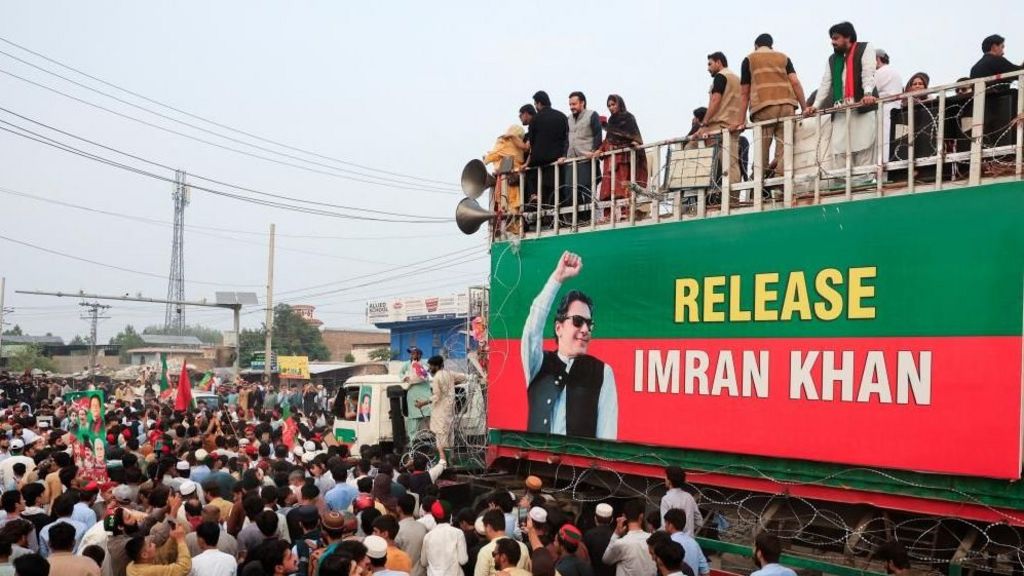
A deepening political standoff between Pakistan’s federal government and supporters of imprisoned former prime minister Imran Khan has entered a dramatic new phase, with emergency rule declared in the Pakistan Tehreek-e-Insaf (PTI) party’s long-held stronghold of Khyber Pakhtunkhwa. The move, which suspended the province’s PTI-led provincial government, has triggered widespread unrest and stoked fears that it will exacerbate, rather than calm, the country’s already volatile political and security landscape.
For days leading up to the emergency declaration, thousands of Khan’s supporters had held continuous rallies across Khyber Pakhtunkhwa, marching to demand the release of the popular opposition leader, who has been behind bars since August 2023. In the immediate aftermath of the emergency announcement, authorities deployed the army to urban centers, closed schools across the province, partially restricted internet access, and blocked major roads with shipping containers to disrupt protest organizing. Within 48 hours, most schools had reopened and basic internet connectivity was restored, but a widespread crackdown on PTI leadership has remained in full effect: most senior PTI figures in the province have gone into hiding, and police have not confirmed or denied reports of mass detentions. On Tuesday, dozens of PTI supporters took to the streets in Bara, the hometown of detained provincial Chief Minister Sohail Afridi, with local reports confirming security forces used tear gas to disperse the crowd.
Federal government officials have defended the move as a constitutionally permitted measure to protect Khyber Pakhtunkhwa’s civilian population from rising militant threats. Federal Information Minister Attah Tarrar claimed Sunday that the suspended PTI provincial government was “hand in glove with the terrorists”, though he offered no immediate evidence to support the allegation, and as of Tuesday no updated evidence had been released.
Independent analysts and observers across Pakistan and global policy circles have widely rejected the government’s framing, arguing the emergency declaration is a politically motivated move to weaken the opposition ahead of growing unrest over Khan’s detention. “The charitable response would be to say that it sounded disingenuous,” explained Farzana Sheikh, associate fellow at London-based think tank Chatham House. Veteran Pakistani journalist and commentator Arifa Noor echoed that skepticism, noting “I do not see the link with terrorism. Perhaps it was the long march itself that was the last straw, or perhaps it’s simply a case of removing an opposition-controlled provincial government that the federal government no longer wanted to tolerate.”
The protest movement that prompted the government’s crackdown was led by Chief Minister Afridi, whose whereabouts remain unconfirmed this week. The PTI says Afridi has been arrested by federal authorities, while the government claims he is being held in protective custody. The current unrest is only the latest escalation in a year-long crackdown on Khan and his inner circle: three of Khan’s sisters were detained in September on charges including unlawful mobilization of supporters, and remain in custody. Khan himself has had limited access to family and legal counsel over the past year; most recently, two of his sisters were permitted a brief visit in August, one at the prison and a second during a court-ordered hospital check-up over concerns about his declining health, before he was returned to detention.
Khan, who fell out of power in 2022 amid a well-documented rift with Pakistan’s powerful military establishment, has been convicted on multiple counts of corruption that he and his supporters consistently dismiss as politically motivated. Analysts say the federal government’s decision to escalate with emergency rule comes as rank-and-file PTI supporters have grown increasingly restive over concerns about Khan’s health. Michael Kugelman, senior South Asia fellow at the Atlantic Council, noted that the move was clearly intended to send a harsh message to the opposition: “There is a sense that perhaps now is the time to send a very strong message to the party and make it more difficult for them to be able to put pressure on the government.”
Federal officials insist the emergency order has no political motivation, pointing to pre-declaration talks between the two sides as proof the government pursued negotiation first. But critics argue the move is just the latest example of the Pakistani government’s shrinking tolerance for political dissent. “The government has less and less space for disagreements or dissent and they do not want to negotiate their way out of any kind of conflict,” Noor said.
Islamabad-based defence analyst and author Zahid Hussain said the decision clearly reflects the outsized influence of Pakistan’s military establishment, which has long dominated the country’s political landscape: “The balance of power is completely shifted to the military establishment.” Sheikh added that the military feels emboldened right now by improved diplomatic standing with the U.S. following its role in recent U.S.-Iran peace talks, giving military leaders confidence that they can weather any international backlash for the crackdown: “There is a sense that, we have all the cards in our hands. We can ride this out internationally.”
But Pakistan already faces a cascading set of overlapping crises that the emergency rule could worsen, observers warn. Militant violence is rising across the country, with Pakistan ranked first on the 2026 Global Terrorism Index as the nation most impacted by terrorist activity. The country is already engaged in tense standoffs with two of its neighbors: it has carried out repeated air strikes on Afghan territory, accusing the Taliban government of harboring militant groups (a charge the Taliban denies), and long-simmering tensions with India could easily reignite. Pakistan has also recently committed to supporting Saudi Arabia’s defense amid escalating conflict with Houthi forces in Yemen.
Many analysts warn that emergency rule could backfire spectacularly, creating more instability than it solves. With the provincial PTI government suspended, the federal government is now directly responsible for the province’s security and governance, eliminating the buffer that the local government previously provided. “I would argue that this could actually backfire,” Kugelman said. “You’re playing with fire because if this move ends up adding to the anger and the discontent among so many there, then you have a very big problem on your hands.”
Hussain called the move reckless given the country’s multiple existing crises, and warned it could set a precedent for expanding emergency crackdowns across Pakistan. Sheikh added that expanded military counter-militancy operations, which the government has promised under emergency rule, carry their own risks: “If they’re going to launch these operations, they’re going to have to be prepared to accept casualties of members of the armed forces. If those are significant, it could lead to questions inside the military institution.”
Pakistan’s history of military intervention in civilian politics holds clear warnings that removing elected provincial governments can lead to long-term negative outcomes for the country. Even political leaders on both sides appear to recognize the dangerous path the country is on, Noor said: “It’s not that senior people in the PML-N [the ruling federal party] don’t realise that some of these things can come back and haunt them in the future. Similarly I think to some extent the PTI realises that they will not be able to hold a protest and get Imran Khan out. I think that’s the most unfortunate part of this mess that we’re in, that we are going into it with our eyes wide open. Everybody realises that this is a train crash but somehow you can’t stop it.”