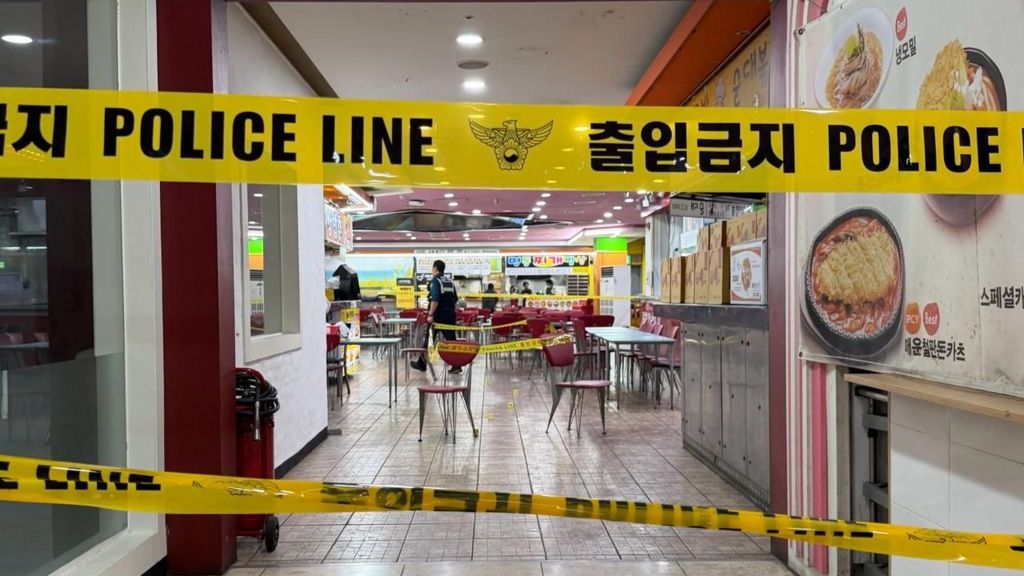
On Tuesday afternoon, a violent stabbing incident unfolded at a Homeplus discount supermarket in Incheon, South Korea, leaving eight people injured and prompting swift action from bystanders and law enforcement. The 59-year-old attacker, who authorities have since taken into custody, launched the assault at approximately 1:40 p.m. local time while riding an escalator, according to Incheon Namdong Police Station. Reports confirm he strapped knives to both hands during the attack, and investigators later recovered 10 additional knives stored in his backpack.
Quick-thinking bystanders intervened before police arrived, blocking the suspect’s path with chairs and subduing him to prevent further harm. Once officers detained the attacker, they cordoned off the section of the supermarket where the attack occurred to process the crime scene. Of the eight victims — six women and two men — all were transported to local medical facilities. One victim was reported to be in cardiac arrest, while the others sustained non-life-threatening injuries to their backs and shoulders. In response to the mass casualty event, emergency officials set up a on-site medical response center on the supermarket’s first floor to coordinate care.
Investigations into the attacker’s motives are currently ongoing, and details emerging about his criminal history have raised additional questions. The suspect was already wearing an court-ordered electronic ankle monitoring bracelet at the time of the attack. He has a prior conviction for attempted murder for stabbing his ex-wife, a crime that resulted in a four-year prison sentence. Just one month prior to the supermarket attack, he was also questioned by police after being caught carrying a knife during a solo protest outside an Incheon hospital, where he was airing grievances over medical treatment he had received.
This stabbing stands out as a rare act of mass public violence in South Korea, a nation widely recognized for its exceptionally high levels of public safety. Data from Statistics Korea shows the country recorded just 0.5 homicides per 100,000 residents in 2024, roughly one-tenth of the global average homicide rate. However, the incident adds to a growing pattern of unprompted, random violence that has sparked public anxiety across the country in recent years. Beginning in 2023, a string of unprovoked attacks targeting unrelated strangers emerged in the country, dubbed “Mudjima” or “Don’t Ask Why” crimes, referring to violent acts committed by people with no clear motive or connection to their victims. Most recently, in April 2025, a similar random stabbing at a South Korean supermarket left a 60-year-old woman dead.