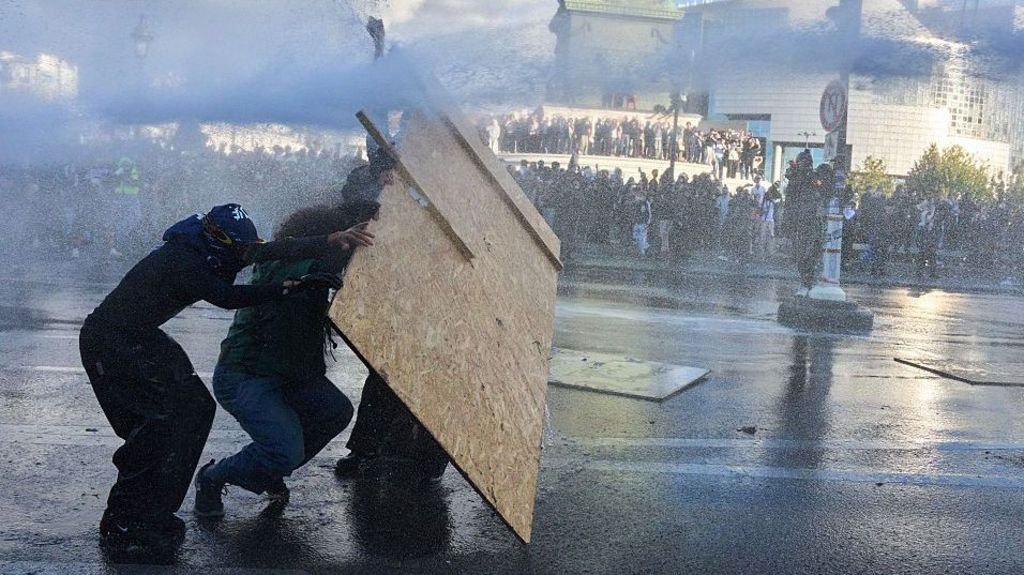
After three weeks of escalating, often violent student protests across France demanding increased investment and resources for the country’s public secondary education system, the French administration has extended its first material compromise to demonstrators: a pledge to deploy 3,000 additional substitute teachers in the coming days. The announcement came from Education Minister Edouard Geffray during a primetime national television interview Thursday evening, capping off another day of chaotic demonstrations that drew tens of thousands of participants nationwide. The widespread unrest has already become the most significant episode of student-led civil unrest France has seen in decades, unfolding against a broader backdrop of growing social and political tension across the country ahead of 2027 presidential elections.
On Thursday, what protest organizers labeled “Act Four” of the movement brought an estimated 71,000 demonstrators into the streets across France, with 24,000 gathering at Paris’ iconic Bastille square just hours before Geffray’s announcement. In multiple locations, demonstrations devolved into violence: protesters in Paris threw paving stones and homemade fireworks at law enforcement, who responded by deploying tear gas to disperse crowds. In Bordeaux, a local high school was ransacked by demonstrators, and a deputy headteacher was assaulted by protesters in Marseille. By Friday, official data showed that roughly 140 out of France’s 3,500 public lycées (high schools) remained fully or partially closed — a sharp reduction from previous days of protest, though movement organizers have already called for another national day of action next Tuesday.
The root of the student unrest is a longstanding, widely acknowledged crisis in French secondary education: thousands of instructional hours are lost annually to unfilled teacher absences, as the education system lacks sufficient supply staff to cover for permanent teachers. Geffray explained that newly launched administrative software would allow the ministry to rapidly redirect the 3,000 newly mobilized substitute teachers to the 500 high schools facing the most severe staffing shortages, most of which are located in working-class, high-immigration suburban districts where gaps in education provision have long been most acute. In addition to the new supply teachers, the minister announced expanded overtime funding through an existing scheme to encourage existing teachers to fill staffing gaps, and confirmed that student demands would be formally incorporated into upcoming negotiations for the 2027 national education budget.
However, the first concession falls far short of the transformative new investment protesters have demanded, and the government has explicitly ruled out large-scale new spending. Facing intense scrutiny from international financial markets over France’s already precarious public debt levels, the administration is unwilling to make major budget commitments that could destabilize the country’s fiscal position. This has led to a muted, skeptical response from protest leaders. Nathanaël Combary, representative of moderate student union Renouveau Lycéen (Lycée Renewal), noted that the announcement aligns with a small portion of the movement’s demands but that demonstrators are waiting for tangible, on-the-ground results. For more radical factions, the compromise is wholly insufficient: Sabrine Kharbach, a leader of the radical-left aligned Union Etudiante (Student Union), insisted the movement will continue until the government commits €10 billion in new education funding.
The protests have quickly become a political flashpoint, drawing sharply diverging reactions from across France’s political spectrum. Radical-left opposition leader Jean-Luc Mélenchon praised Thursday’s demonstration at the Bastille, writing on social media that students had “retaken the Bastille.” On the opposite end of the political divide, hard-right opposition party National Rally condemned the government’s decision to offer any concessions at all. Spokesperson Laurent Jacobelli argued the move legitimizes violence, saying the government was sending a message that destructive protest tactics would be rewarded with policy changes.
The student unrest comes as France faces a growing wave of social discontent across multiple sectors, with existing anger over rising fuel costs and deep distress in the agricultural sector already poised to trigger additional mass demonstrations. A revived “yellow vest” movement has called for a national day of protest next Saturday, October 17, echoing the 2018 movement that forced the government to scrap a planned fuel tax increase after months of widespread unrest. Adding to the atmosphere of confrontation, the upcoming 2027 presidential elections — where both far-right and far-left candidates are widely expected to outperform centrist incumbents — have amplified political tensions across the country. For its part, the government is betting that the upcoming half-term school break at the end of next week, paired with the arrival of colder, wetter autumn weather, will reduce protester turnout and defuse the unrest before it escalates further.
Official government data shows that more than 6,800 people have been arrested since the protests began, with 86% of those detained under the age of 18.