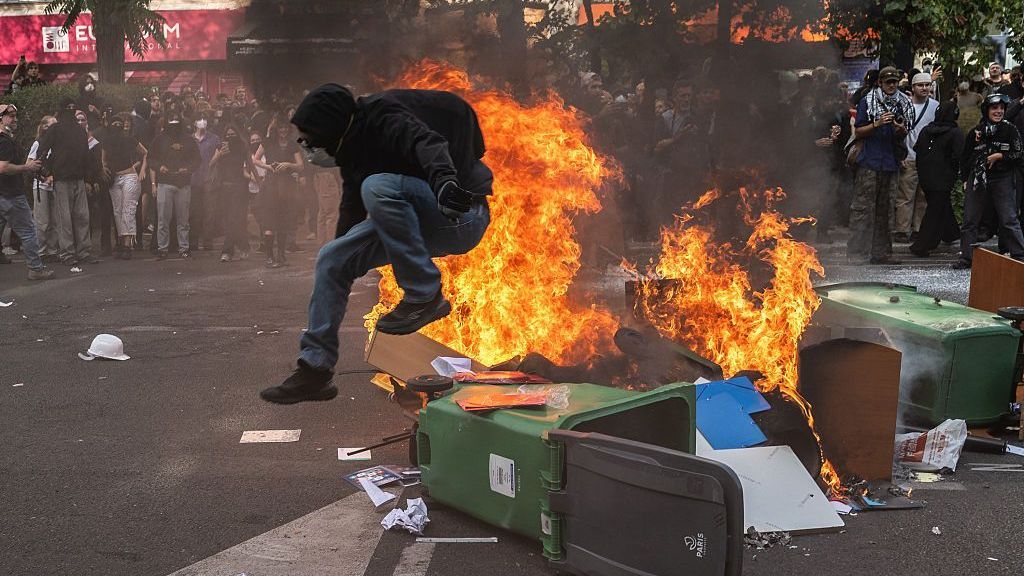
Across northern France’s city of Lille, street barricades stand next to smoldering garbage bins, while chants of anti-police sentiment echo through crowded protest marches. For the hundreds of thousands of French secondary school students who have flooded the streets since late last month, the unrest stems not from abstract political debate, but from years of unaddressed, daily decay in the nation’s lycées – the public secondary schools that serve 15- to 18-year-old students across the country.
A 16-year-old anonymous protester from Lille summed up the everyday frustrations driving the movement: his school lacks sufficient seating for every student, forcing classes to hunt for chairs before each lecture, and a 50-minute lunch window leaves 2,000 students scrambling to get through an overstretched canteen. These local grievances quickly gained national traction after the movement ignited at Lycée Antoine-de-Saint-Exupéry in Créteil, a disadvantaged working-class suburb of Paris.
Within days, viral social media content amplified the crisis, with TikTok and Instagram posts showing rats scurrying through hallways, cracked and mold-damaged ceilings, broken non-functional toilets, and extreme temperature swings that leave classrooms sweltering in summer and frigid in winter. Beyond crumbling infrastructure, students have rallied against chronic understaffing, overcrowded lecture halls, excessively long school days, and a deeply unpopular university admissions system that has left generations of young people feeling disenfranchised.
Teachers have joined the movement in solidarity, echoing students’ claims of systemic failure. Marine Monins, a secondary school educator who marched alongside her students in Lille, explained how understaffing and poor planning have warped daily school schedules: students often start at 8 a.m. and finish as late as 6 p.m., with hours-long empty gaps between scattered lessons. When classes do run, they routinely pack 35 students into a single room – nearly 50% more than the average secondary class size in neighboring England. “It’s now impossible to give every child the attention they deserve,” Monins noted.
Facing growing pressure, the Macron administration made its first concession in early October, promising to deploy 3,000 additional temporary supply teachers in the coming days. Prime Minister Sébastien Lecornu has also pledged to release a full response plan by the end of the month, with ministers hinting at a potential review of education funding in next year’s tight national budget. But the modest proposals have done little to cool protester anger, with young organizers dismissing the measures as too little, too late.
“It goes beyond having decent toilets in schools,” said Alcidor, a lycée student protesting at Paris’ Place de la République, a historic hub for French activism. “It’s strong anger from the youth in France that doesn’t feel represented, that feels abandoned, that feels unheard and is scared of what’s coming in the future.” Official crowd estimates reflect the scale of the movement: the government put last Tuesday’s national march at 250,000 participants, while trade unions counted more than 500,000, the vast majority of them young people.
In recent weeks, the protests have devolved into sporadic violence, leaving hundreds injured on both sides and sparking fierce debate over police tactics. France’s interior ministry reports that nearly 7,000 people have been arrested since the unrest began, more than 85% of whom are minors. More than 700 police officers have sustained injuries in confrontations, while human rights groups and trade unions record at least 200 injured students and dozens of injured teachers.
The most serious incident to date occurred in the northern city of Lens, where a 15-year-old boy lost a hand during a confrontation between police and demonstrators. While a police union source claimed the teen picked up a fired sting-ball grenade that subsequently exploded, witnesses dispute this account. The incident prompted authorities to ban the use of stun and sting grenades at school-related protests, but critics say aggressive police tactics have already done permanent damage.
Bastien Riez, a teacher and union representative at the injured teen’s school, warned: “For many, this is their first experience of democracy and protest, and they are met with police and a sham of social dialogue and democracy. I fear that many young people will stop believing in this so-called democracy altogether.”
Many student organizers acknowledge that outside agitators have hijacked some peaceful demonstrations to incite violence. “These people are coming just to shoot fireworks at police officers and they run. This is not the message we want to send to the world,” explained 15-year-old Parisian protester Kaspar. Police leaders agree that external violence has complicated their work, adding that the protests have unfolded amid a rapidly radicalizing political climate ahead of next spring’s national elections and the 2027 presidential vote.
“Police officers find themselves caught in the middle of this social tension, which is sometimes fuelled by irresponsible politicians,” said Michel Chaballier, deputy secretary-general of the National Police Commissioners’ Union (SCPN). “That’s a shame, because I think this country deserves better.”
The unrest has already become a polarizing political battleground, with leaders of France’s far-right and far-left rushing to capitalize on the government’s perceived failure to resolve the crisis. Recent polling from Ipsos shows more than three-quarters of French under-30s report deep anxiety over the direction of their country, and political analysts warn the education crisis is accelerating the erosion of France’s political middle ground, pushing more voters toward the ideological extremes.
As of 2025, hard-right National Rally leader Marine Le Pen holds a narrow lead as the frontrunner for the 2027 presidency, tied neck-and-neck for second place are center-right former Prime Minister Édouard Philippe and hard-left France Unbowed founder Jean-Luc Mélenchon. Mélenchon has positioned himself as a vocal ally of the student movement, speaking at multiple rallies and comparing the current unrest to the historic 1968 May protests that shook Charles de Gaulle’s government. “This is the most potent movement since 1968,” he claims, a comparison echoed by 18-year-old Lille protester Massicella, who declared “I personally want to reproduce 1968!”
Le Pen, by contrast, has condemned the vandalism that has accompanied the unrest – damage that runs into millions of euros – and has pushed her longstanding “casseur-payeur” principle, which requires protesters who damage property to cover repair costs, often holding parents liable for minors’ actions. She has stayed away from protest marches, focusing instead on her platform of cutting public debt, curbing immigration, and restoring traditional classroom discipline and national history curricula.
For President Emmanuel Macron, the crisis offers no easy political out. Unlike the 2018 gilets jaunes protests, which were sparked by a single unpopular fuel tax that could be reversed, the lycée crisis is rooted in decades of underinvestment that cannot be fixed with quick policy tweaks. Wholesale education reform – new facilities, more teachers, smaller class sizes – would cost billions of euros and take years to implement, even as France struggles with a stretched national budget that sees annual debt servicing costs already exceed the entire core education budget. The 2027 draft budget only includes a 1.7% increase in education spending, a rise that fails to keep pace with current inflation.
Still, students show no signs of stepping back from the movement, leaning into France’s long history of mass protest to demand change. “In France, we have this tradition and history of revolting,” Alcidor said. “That’s the way we gained our rights and the way we will always gain them. That’s our spirit.” As the movement continues into its second month, the hunger for systemic change among France’s young generation shows no sign of being sated – and its impact on the country’s political future is only just beginning to unfold.