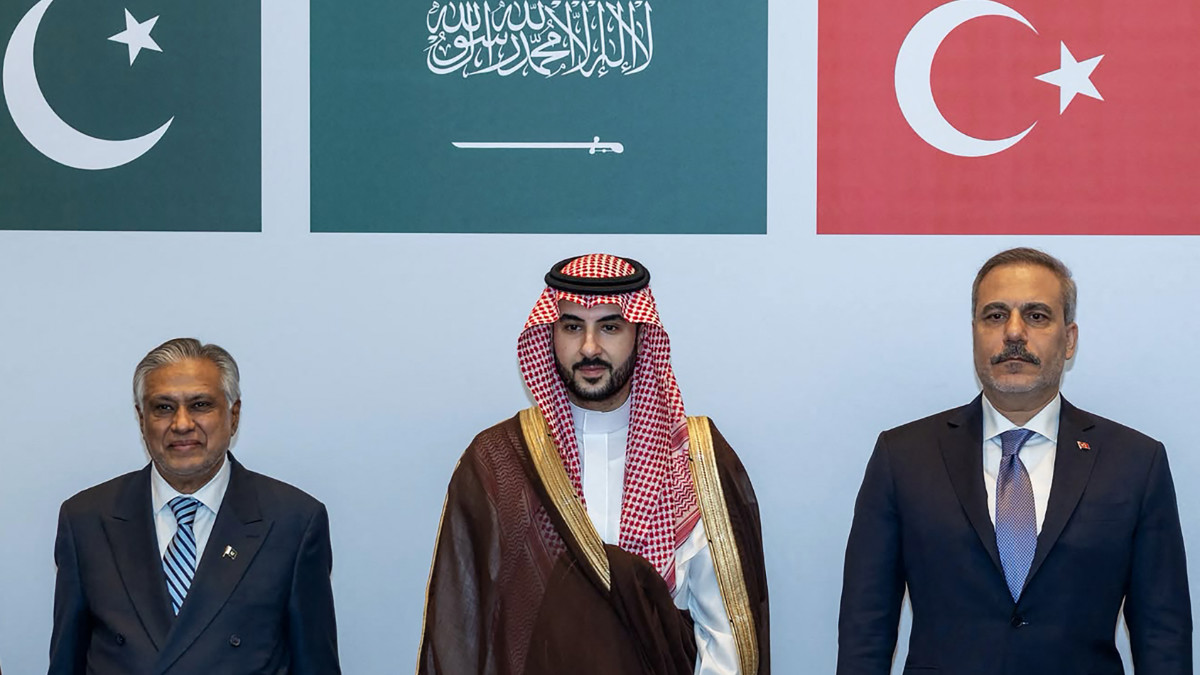
In a high-stakes move set to reshape regional geopolitics in the Middle East, Turkey and Pakistan have formally committed to a rapid deployment of military forces to Saudi Arabia under a newly activated mutual defense agreement dubbed the Mecca Pact, a decision that is expected to further isolate Houthi forces amid an escalating Yemeni conflict.
The joint pledge followed an emergency gathering of senior representatives from the three nations in Riyadh, where attendees issued a unified condemnation of recent attacks targeting Saudi territory — specifically strikes targeting the Islamic holy cities of Mecca and Medina — opting not to name the Houthis directly in their official communique. In the joint statement released after the meeting, the three allies reaffirmed their unwavering rejection of any act of aggression or threat targeting the kingdom’s national security and territorial sovereignty. They further agreed to move forward without delay with the practical execution of collective defense obligations, taking all required steps to deploy the pre-agreed military personnel and capabilities and ensure their swift positioning within Saudi Arabia.
The emergency summit coincided with a major new offensive launched by Yemeni government forces, backed by Saudi-led military support, which aims to recapture all territory seized by the Houthis over the course of 12 years of full-scale civil war. To date, the immediate tactical effect of the Turkish and Pakistani troop deployment on the trajectory of the Yemeni war remains unclear. Pakistan already maintains a substantial troop presence in Saudi Arabia, and just last week, Reuters reported that Pakistan dispatched four plane loads of military weaponry to the Yemeni port city of Aden to reinforce the Saudi-backed Yemeni government. One Western official based in the Gulf told Middle East Eye that Pakistani personnel are already stationed in southern Yemen, though there is no public clarity on whether they are embedded with Saudi forces under private contracts or deployed as official Pakistani military units.
While the operational impact remains to be seen, the timing of the deployment announcement — coming as the anti-Houthi offensive gains momentum — carries significant symbolic weight for all parties involved. A second anonymous Western Gulf official told Middle East Eye that Riyadh has been actively working to secure broad international and regional backing ahead of its large-scale counter-offensive against the Houthi movement.
Both Pakistan and Turkey bring unique geopolitical leverage to the new alliance. Pakistan stands as the only nuclear-armed state in the Muslim world, and has long positioned itself as a neutral mediator between Iran and the United States, marketing itself as an impartial honest broker in regional disputes. Turkey, meanwhile, is a longstanding member of the North Atlantic Treaty Organization, and has recently carved out a regional profile as a leading critic of Israel amid its ongoing military campaign in Gaza — a conflict that has sparked widespread anger across the Arab and Muslim world, with United Nations officials and leading human rights experts labeling Israel’s actions a genocide.
For Saudi Arabia, formal activation of the Mecca Pact and the public backing of Pakistan and Turkey serves to underscore that its counter-offensive against the Houthis enjoys widespread support across the broader Middle East. Just last week, Saudi Arabia hosted United Arab Emirates Vice President Mansour Bin Zayed in a separate diplomatic push to demonstrate unified regional opposition to the Houthis.
In a parallel diplomatic development on Monday, Saudi Crown Prince Mohammed Bin Salman held a two-hour meeting with U.S. Democratic Senator Chris Murphy, Murphy confirmed publicly. Murphy has been one of the most vocal U.S. critics of the Saudi-led military intervention in Yemen, a stance that held through the 2022 United Nations-brokered ceasefire that paused large-scale fighting for two years. That truce collapsed in July 2024 after the Houthis resumed attacks on Saudi commercial and military vessels in the Red Sea. Two months after the ceasefire ended, Houthi forces launched their own offensive along the Red Sea coast. As of Monday, Saudi-backed Yemeni government forces announced they have recaptured the vast majority of coastal territory seized by the Houthis in that recent push.
This report was published by Middle East Eye, a media outlet that provides independent, on-the-ground coverage and analysis of the Middle East, North Africa and surrounding regions.