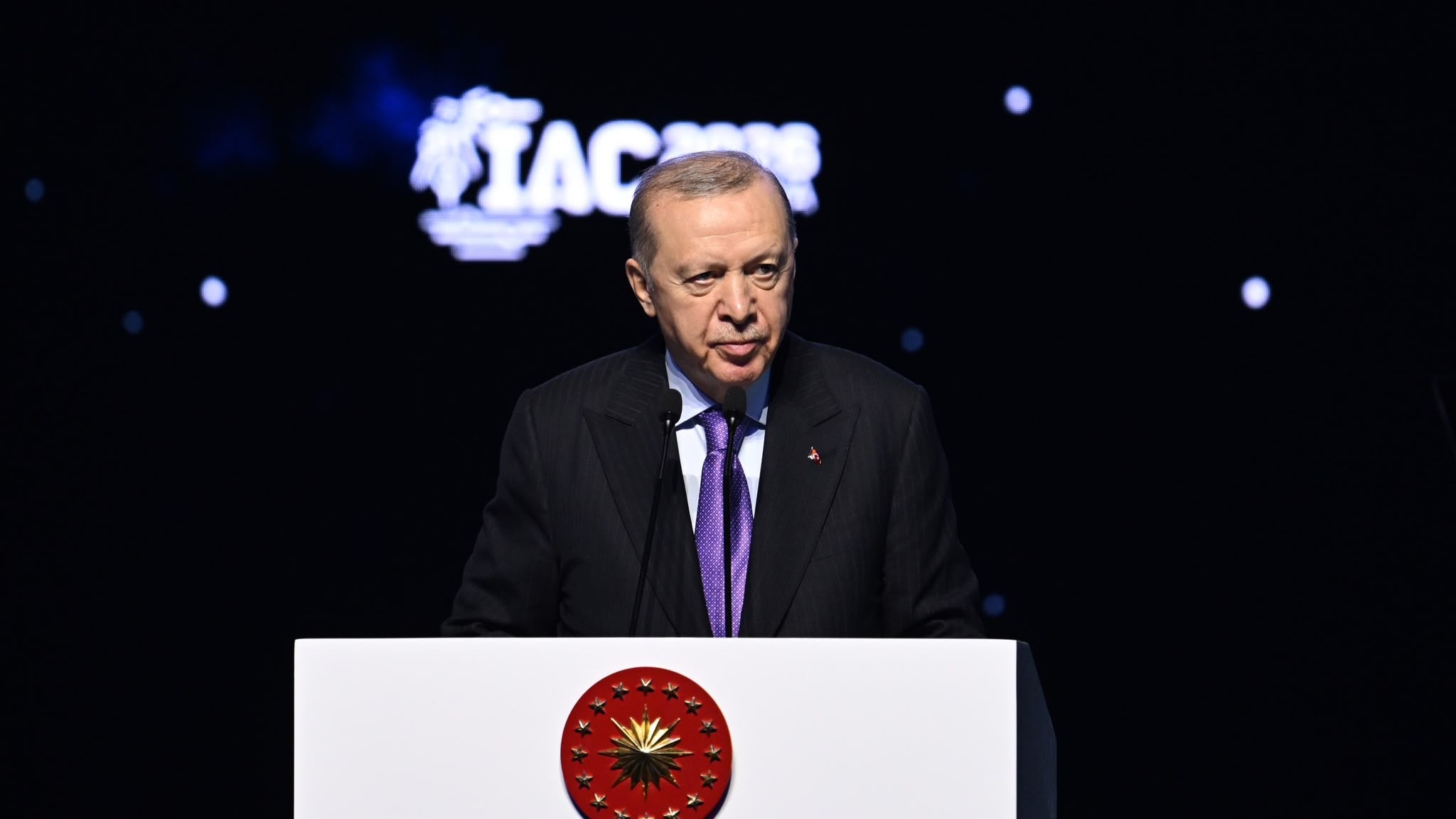
In a landmark address that marks the first public condemnation of orbital weapon deployment by a NATO leader, Turkish President Recep Tayyip Erdogan has spoken out against the militarization of outer space, following the United States’ unprecedented confirmation last month that it has placed an armed military asset in Earth’s orbit.
Speaking at the 77th International Astronautical Conference (IAC), hosted this year in Antalya, southern Turkey, Erdogan told an audience of senior diplomats, global space agency representatives and industry leaders that the cosmos should be reserved exclusively for peaceful scientific discovery, not turned into a new battlefield for great power conflict.
“Sending weapons to space, or turning space into a ground for an arms race, will be totally wrong,” Erdogan stated during his keynote address on Monday. “It will be a direct threat to the joint future for humanity, and I see that this race is becoming widespread – which, of course, we do not welcome.”
Erdogan’s condemnation comes just weeks after the U.S. Air Force Secretary Frank Kendall III (referred to as Troy Meink in the original report) confirmed that the U.S. has deployed an “on-orbit” space-control weapon, designed to counter what U.S. military officials describe as “evolving threats” from rival powers. While Kendall declined to share specifics on the weapon’s launch date, capabilities or exact orbital location, he confirmed that the deployment aligns with long-standing U.S. policy to achieve and maintain “space superiority” – a goal that U.S. military leaders argue is necessary to counter Chinese and Russian programs designed to disable or destroy American satellites in the event of future conflict.
Beyond the U.S.’s confirmed deployment, Israel has also publicly hinted at plans to develop its own space weapons, with the stated goal of protecting Israeli satellites from hostile spacecraft and developing strike capabilities that can target locations on Earth from orbit. China has already issued its own formal condemnation of the U.S. announcement, calling on Washington to reverse course and “stop expanding its military capabilities and preparing for war in outer space.”
The current framework governing activities in outer space, the 1967 Outer Space Treaty, only prohibits the deployment of weapons of mass destruction in orbit. This leaves a critical legal gap that major global powers including the U.S., China, and Russia have exploited in recent decades to develop anti-satellite capabilities, targeting systems critical to enemy military communications, surveillance, and navigation operations.
Beyond his remarks on space militarization, Erdogan used his keynote address to the summit – the first IAC ever hosted by Turkey – to outline Ankara’s expanding ambitions in the global space sector. The Turkish president announced plans to construct a new spaceport in Somalia and confirmed that Turkey is moving forward with plans to send its own national astronauts to the lunar surface.
The annual IAC summit, first established in 1950 during the early days of the Cold War to maintain open scientific communication across global space research communities, serves as a key global platform where government space agencies, private commercial firms, and international delegates gather to announce new mission plans, negotiate bilateral cooperation agreements, and debate the future of global space policy. This year’s summit in Antalya marks a major milestone for Turkey’s growing role in the international space sector.