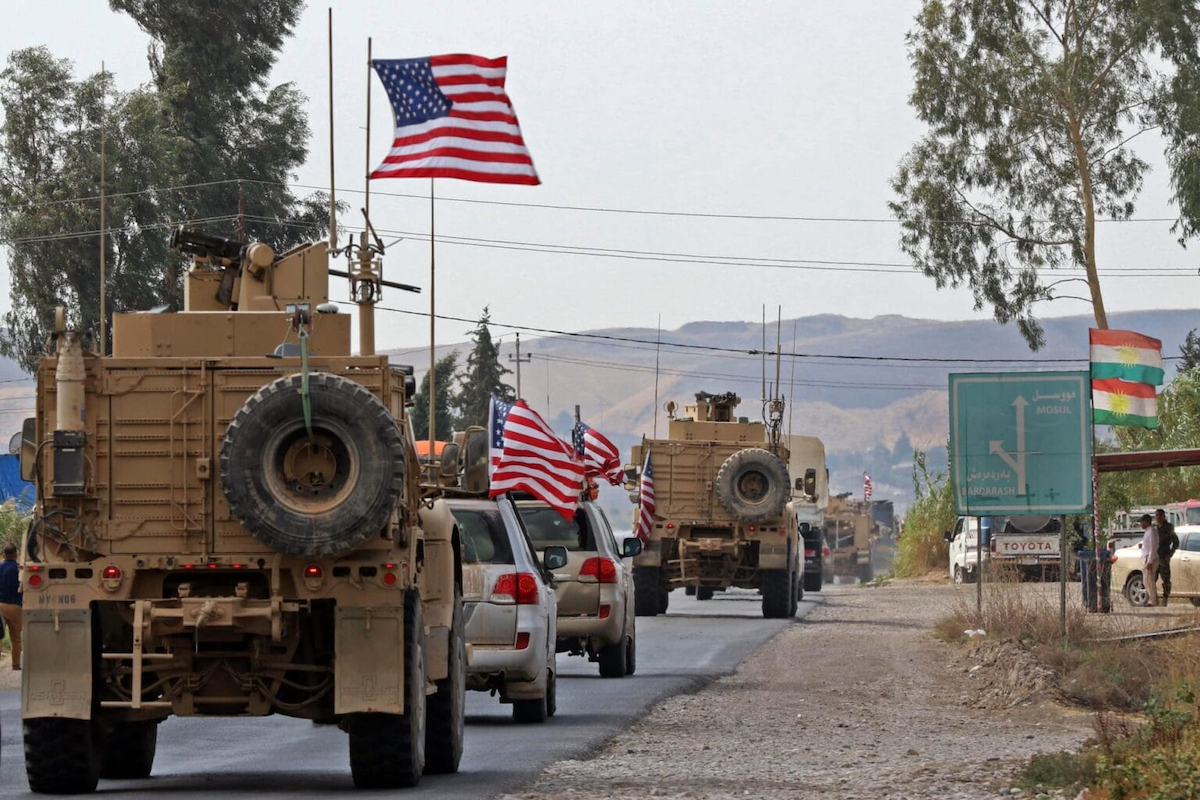
On September 30, the final contingent of American and coalition military personnel airlifted out of Iraq’s Erbil Air Base, with the Pentagon officially confirming an orderly full withdrawal. While the White House has framed the pullout as a major strategic victory, former President Donald Trump characterized the 20-year Iraqi intervention as a costly journey into chaos — a sweeping claim that, for once, aligns closer to on-the-ground reality than the sanitized official statements released by Washington.
But before the foreign policy establishment rushes either to eulogize decades of U.S. hegemony in the Middle East or to celebrate its long-awaited end, one critical question demands answer: Is the United States actually stepping back from its decades-long entanglement in the region, or is it simply rearranging its military forces on the regional chessboard, while the costly, unwinnable conflict that has stretched across 20 years continues unabated? The evidence points overwhelmingly to the latter: the full troop exit from Iraq is a tangible milestone, but a true, comprehensive disengagement from the Middle East remains nowhere on the horizon.
This is not the first time Washington has carried out a full troop withdrawal from Iraq. The first pullout came in December 2011, when the Obama administration formally wrapped up the war launched by George W. Bush in 2003, a conflict marketed as a mission to turn Iraq into a democratic beacon for the Middle East. Barely three years later, the rapid rise of the Islamic State (ISIS) dragged U.S. troops back into the country, turning what was billed as a temporary counter-terror deployment into a 12-year occupation.
This pattern of intervention, declaration of victory, withdrawal, and renewed intervention has become painfully familiar. Washington enters the Middle East chasing ambitious grand strategies: containing Saddam Hussein, remaking the Arab political order, defeating global jihadism, rolling back Iranian influence. Every time, it learns the hard way that regional and local actors have their own competing priorities that do not align with U.S. blueprints. Washington then declares victory and withdraws, only for the power vacuum its presence left behind to become the pretext for a new round of intervention. More than 4,500 U.S. service members lost their lives in Iraq, yet after two decades of occupation, the region is no more stable, democratic, or aligned with U.S. interests than it was before the 2003 invasion.
The core lesson of this decades-long quagmire is not, as hardline foreign policy hawks insist, that the U.S. withdrew too soon in 2011. It is that the United States never should have assumed that military force could impose a stable political order that Iraqis themselves were unwilling or unable to build.
This repeated cycle highlights the fundamental disingenuousness of the current so-called disengagement. The current withdrawal, negotiated by the Biden administration in 2021, is being completed even as the U.S. is actively engaged in a conflict with Iran alongside Israel, a conflict that launched in early 2024. A genuine strategy of disengagement would involve stepping back from the region’s intractable internecine quarrels, not opening a new major front in the region’s largest ongoing conflict.
Nor has the U.S. military footprint vanished from the region entirely. The joint anti-ISIS task force headquarters has simply been relocated across the border to Jordan. Hundreds of U.S. troops remain deployed in northeastern Syria, all major U.S. military bases in the Persian Gulf remain operational, and U.S. aircraft carrier strike groups continue to patrol regional waters. What Washington frames as a full exit is in practice nothing more than a tactical redeployment: reducing the number of vulnerable U.S. targets in Iraq that could be attacked by Iran-aligned proxies, while increasing U.S. freedom of military action to directly counter Iran itself.
While this may make sense as narrow military logic, it does not represent a new, less interventionist grand strategy. The long-standing bipartisan consensus that the Middle East remains a vital U.S. interest that must be policed by American military power remains completely unchallenged. Only the location of U.S. garrisons has changed.
Critics of the withdrawal have already lined up with familiar arguments: they claim that Kurdish groups in northern Iraq, which have faced more than 1,000 Iranian drone and missile attacks since the start of the latest regional conflict, are being abandoned by the U.S. without adequate air defenses. They point out that Iran-aligned militias, which the Iraqi government once promised to disarm by the time of the U.S. withdrawal, are already celebrating the pullout. And they warn that Tehran will quickly move to fill the power vacuum left by departing U.S. troops.
These concerns are not trivial, and the Kurdish people deserve far more than a perfunctory farewell press release from Washington. But they make the case for targeted diplomacy and defensive arms transfers, not a permanent U.S. military tripwire stationed in Erbil. Iraq is today a sovereign state with a large standing army, significant oil revenue, and an elected government that formally requested the U.S. military withdrawal. Its current leadership now speaks of building normal bilateral partnerships with the U.S. and other global powers — that is exactly how a sovereign, independent state ought to behave.
As for Iranian influence, data shows that Tehran’s clout in Iraq grew most rapidly during the period when 150,000 U.S. troops were occupying the country. Today, Shiite Iraqi factions, Sunni Arab groups, Kurdish political movements, Turkey, Saudi Arabia, and Iran all compete for influence over Iraq’s future. This competition predates the U.S. invasion by centuries, and it will continue long after American forces have departed. A regional balance of power forged by local actors, for all its mess and unpredictability, is far more stable and durable than any political order imposed from Washington.
If this troop withdrawal from Iraq is to have any meaningful long-term impact, it should serve as the first step toward a full rethinking of U.S. Middle East policy, not merely a tactical retreat ahead of the next military campaign.
A true reorientation would begin with recognizing that the Middle East is far less critical to U.S. national security than it was during the Cold War. The U.S. is now one of the world’s largest energy producers, and the vast majority of the region’s oil exports now flow to Asian markets rather than to North America.
It would mean shifting Washington’s role from that of an occupying regional policeman to that of an offshore balancer: only intervening when a single hostile power threatens to seize control of the entire region, a threat that even a militarily active Iran cannot credibly pose at present. It would mean letting Turkey, Saudi Arabia, Egypt, Israel, and Iran manage their own rivalries and bear the costs of their own security decisions.
Most importantly, it would mean ending the ongoing conflict with Iran through diplomatic negotiation rather than continued military escalation. Without these broader shifts, the departure from Erbil will not be remembered as the end of America’s decades-long Middle Eastern quagmire. It will go down in history as just one more intermission before the next costly act of intervention.