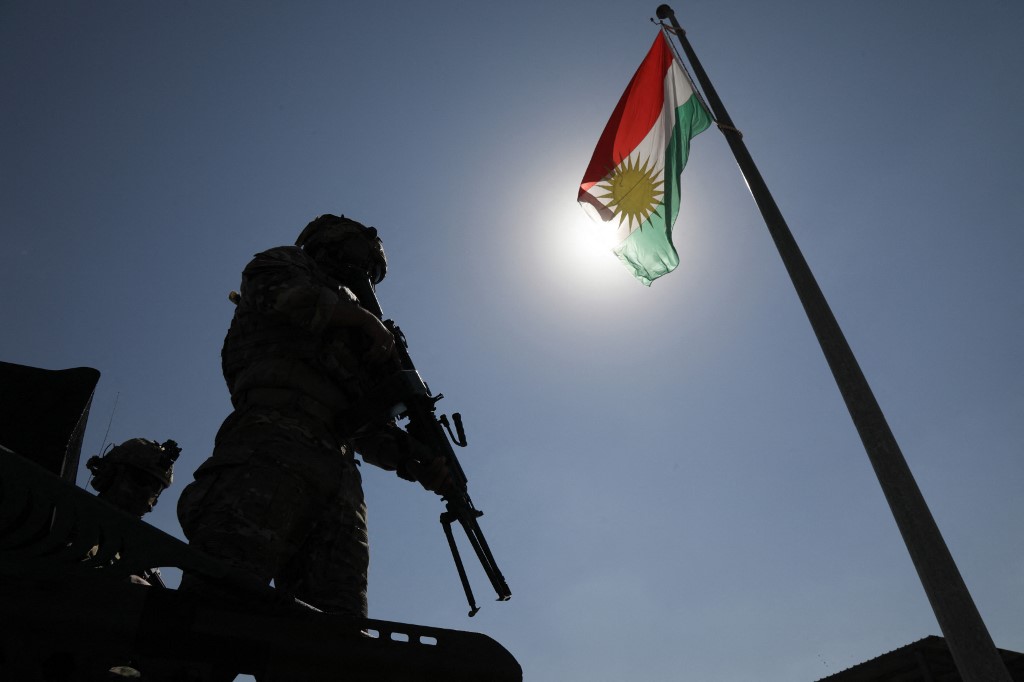
Nearly 11 years after it first deployed to defeat the Islamic State group, the US-led counter-IS coalition formally concluded its combat mission in Iraq this week, marking a historic shift in regional security dynamics that has left the autonomous Kurdistan Region of Iraq grappling with deep uncertainty over future threats.
The drawdown, agreed upon by Baghdad and Washington in 2024, unfolded gradually over months: coalition forces withdrew from bases across Iraq, consolidated remaining troops in the Kurdistan Region, and finalized the full pullout by September 30. Before the final exit, roughly 1,500 coalition troops remained stationed at Erbil Air Base, a reduction from the 2,500 personnel deployed across Iraq before the 2024 drawdown agreement was reached. The mission first launched in 2014, when IS seized swathes of territory across Iraq and Syria and perpetrated widespread mass atrocities. While the militant group was declared territorially defeated in Iraq in 2017 and in Syria in 2019, coalition troops stayed behind to assist local forces in containing the group’s scattered remnants.
In the hours leading up to the full withdrawal, Erbil residents reported military aircraft circling overhead, and the first signs of shifting risk emerged quickly. On the night of September 28, three Iranian drones targeted a camp operated by an Iranian Kurdish opposition party in the town of Koya. Two days later, following the coalition’s official departure, Koya was struck by another drone — the first attack of its kind after the pullout was completed. These strikes have underscored a harsh reality: the Kurdistan Region remains highly exposed to cross-border drone and missile attacks amid the escalating ongoing conflict between Iran and the United States and Israel that began in February 2024.
According to a September 27 statement from the Ministry of Peshmerga Affairs, the governing body of the autonomous region’s military forces, Iraqi Kurdistan has endured more than 1,000 drone and ballistic missile attacks since the outbreak of the Iran war, resulting in civilian casualties and extensive material damage. KRG Prime Minister Masrour Barzani warned last week in comments to the Financial Times that the coalition’s exit, conducted without leaving a robust defensive air defense system in place, has created a dangerous gap in regional security. “The threat is real – we are vulnerable, we are being attacked,” Barzani said.
The Peshmerga Ministry echoed this concern, noting that “the departure of the United States from the Kurdistan Region in such a complex regional situation, without providing any defence system, is a cause for concern,” and called on the federal Iraqi government in Baghdad to “assume the duty of protecting the airspace of the Kurdistan Region when necessary.”
Announcing the end of the mission, Pentagon spokesperson Sean Parnell said the U.S. expects Iraqi security forces — including the Peshmerga — to take full ownership of securing Iraq and rooting out remaining IS cells. “The Department of Defense will continue to provide targeted training and intelligence support to our Iraqi partners,” he said.
But these commitments have done little to ease anxiety among ordinary Iraqi Kurds. Nineteen-year-old Canel, an undergraduate student at the American University of Iraq in Sulaimani, told Middle East Eye that he shares widespread fears of renewed instability. “The Kurdistan Region does not have the level of military equipment, air power and intelligence that the coalition provides,” he explained. “The presence of the coalition gave Kurds a feeling of safety, and I fear that without it, IS or another extremist threat could return and endanger the people of the Kurdistan Region again.” Those fears were amplified just days before the withdrawal, when two Kurdish teenagers were killed during clashes between IS cells and Iraqi Counterterrorism forces in the city of Pirde, located in Kirkuk Governorate, sparking large-scale Kurdish protests across the region.
Senior KRG leaders have moved to reassure anxious residents. Masoud Barzani, leader of the Kurdistan Democratic Party, wrote in a post on X Wednesday that the coalition’s departure would not “leave the Region vulnerable and threaten its very existence.” “I wish to reassure the beloved people of Kurdistan that there is strong coordination with the Federal Government of Iraq to confront any threat or danger,” he said.
For its part, the federal Iraqi government in Baghdad has framed the coalition’s exit as a milestone of national sovereignty. Iraqi Air Force Commander Lieutenant-General Khalid al-Tamimi said that the Iraqi air force no longer requires U.S. support and can carry out all necessary security missions independently. Iraqi Prime Minister Ali al-Zaidi similarly declared that Iraq will “assume full responsibility for its security and stability,” and announced that October 1, the day after the withdrawal was completed, would be celebrated annually as Sovereignty Day. The prime minister also reaffirmed the government’s commitment to disarming all unauthorized armed factions, saying “There shall be no weapons outside the framework of the law and no force outside state institutions.”
However, many Kurdish officials and regional security experts reject Baghdad’s optimistic assessment, warning that critical capability gaps remain unaddressed at a moment of extreme regional volatility. Lieutenant-General Bakhtiar Mohammed Sadiq, secretary general of the Ministry of Peshmerga Affairs, told Middle East Eye that while the 2024 US-Iraq Security Agreement governing the withdrawal is a standard, legitimate framework on paper, the timing is ill-suited to the current conflict between Iran and the U.S. “IS is not the only problem. There are other security threats. The capabilities of the Iraqi Army and Peshmerga are still not fully developed. Iraq has an air force, but it does not have all the capabilities it needs,” Sadiq explained. “More time is needed for advice and support – perhaps a couple of years. The coalition should continue providing capability support to the Peshmerga, including weapons, ammunition, training, intelligence, air support and counter-drone capabilities.”
An anonymous coalition officer who worked on building up Peshmerga capacity told MEE that the withdrawal timeline was postponed multiple times before the Biden administration ultimately locked in the September 30 deadline. “The war in Iran and the course of the current administration have accelerated everything. Until a year ago, the idea was still to position the [coalition] headquarters in Erbil instead of Baghdad, and this was implemented. But due to the escalation and Iran’s effective targeting, Erbil is now disappearing from the equation,” the officer said. Sadiq added that with coalition forces now relocating to Kuwait and Jordan, the logic of a full exit from Iraq remains unclear: “If they are staying in the region, why can’t they remain in Iraq?”
Noreldin Waisy, press secretary to Prime Minister Barzani, emphasized that the region’s security interests must be centered in any future defense arrangements with Baghdad. “It is clear to everyone that Iraq’s security situation remains fragile. Militias and armed groups have increasingly become a threat to Iraq’s internal security, as well as to the security of the Kurdistan Region,” Waisy said. “In any future security or defence arrangements with Iraq, the security interests of the Kurdistan Region must be fully taken into account, and the Kurdistan Region and the Peshmerga forces must be an integral and clearly defined part of these agreements.”
Alex Plitsas, a non-resident senior fellow at the Atlantic Council and former Pentagon official who deployed twice to Iraq, told MEE that while the U.S. relationship with the KRG and Peshmerga remains enduring, the withdrawal creates a security vacuum that hostile actors are likely to exploit. “Iran has demonstrated a willingness to attack Kurdistan as part of its strategy to combat the United States by attacking allies in the region,” he noted.
Hejar Berenji, U.S. representative for the Democratic Party of Iranian Kurdistan (PDKI) — an opposition group whose camps have been targeted 163 times since the Iran war began — said that while Iran has used the presence of coalition troops as a pretext for strikes, the deployment was never the root cause of attacks on the region. Berenji pointed out that most Iranian strikes on Kurdistan have targeted exiled Iranian opposition groups, critical energy infrastructure, and Kurdish civilian institutions, not just U.S. military sites. “Therefore, coalition forces’ withdrawal is not a security guarantee. It is wrong to assume that removing coalition troops will, by itself, end the threat,” he said.
Berenji also noted that while the Peshmerga confirms no replacement air defense system is being left behind after the withdrawal, Baghdad has delayed its planned disarmament of Iranian-backed factions from September 30, 2024 to June 2027. “Coalition forces and their defensive systems are leaving before that process is complete,” he said. “Further attacks are expected, although their timing and intensity cannot be established in advance. The practical questions are [about] who controls the missiles and drones, and what protection is actually operational for civilians and critical infrastructure. Ending the coalition mission is not the same as ending the danger facing the Kurdistan Region – mainly from Iran and its proxies.”
Not all Kurdish leaders share this pessimism, however. Sirwan Barzani, a senior Peshmerga major-general and prominent Kurdish businessman, said he holds out hope that the exit of U.S. forces will remove Iran’s justification for strikes, bringing an end to attacks on the region. “There is no more excuse, there are no more Americans, so we hope there will be no drones and no rockets,” he told MEE.