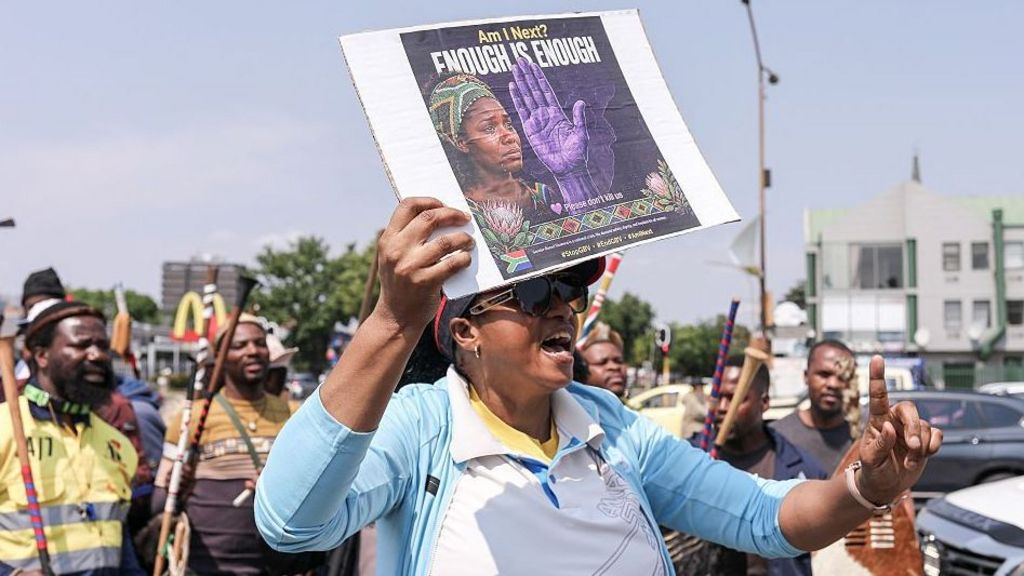
A grim series of body discoveries across Ekurhuleni, east of South Africa’s Johannesburg, has sent waves of fear through local communities, shining a harsh new spotlight on the country’s long-running crisis of brutal violence against women. Over the course of just two months, the remains of 12 women have been recovered in the region, with three additional bodies confirmed by police between Saturday and Monday of this week alone.
Law enforcement officials have confirmed that three of the 12 cases have resulted in arrests, and initial investigations have found no proven links connecting all the killings. Even so, investigators have not ruled out the terrifying possibility that a serial killer is operating in the area, leaving residents on edge.
The first victim, 37-year-old Busisiwe Mahlangu, was found naked with her hands bound by cable ties in Kempton Park on July 15. Two days after her body was discovered, police arrested her partner as a suspect, who remains in custody and has not been connected to any subsequent deaths.
Just over two weeks later, on August 3, 32-year-old Itumeleng Kekana – a young mother who had disappeared the previous month – was found dumped on a Kempton Park bridge. Her body showed extensive bruising and was partially clothed, and no suspects have yet been taken into custody in her case.
Nomfesane Mjobo became the third victim when her body was recovered in Kempton Park on August 26. Few details about her death have been released to the public, but like most victims, she was found partially unclothed with visible bruises, and no arrests have been made. On September 7, the body of an unidentified woman in her 20s was found floating in a river in Olifantsfontain, wearing only underwear; no further details or arrests have been announced.
The fifth victim, 28-year-old Gracious Nkomo, was found partially clothed along a roadside near OR Tambo International Airport, South Africa’s busiest air hub, on September 10, with no arrests to date. Two days later, the body of 38-year-old Elizabeth Moselakgomo – who had been the subject of a high-profile nationwide search after disappearing during her daily run near her Kempton Park home – was found badly bruised and partially clothed. Her death was the catalyst for widespread public alarm, with local women holding a memorial run in Johannesburg to honor her and demand action. Just 48 hours after Moselakgomo’s discovery, another unidentified woman’s body was found in Olifantsfontein, with police withholding her name to notify next of kin, and no arrests made.
On September 15, the body of 38-year-old Dineo Motapane, who had last been seen alive just two days prior, was found battered and partially burned on a roadside in Springs, another district of Ekurhuleni. She leaves behind a young child, and no suspects have been arrested. Two days later, the ninth body was recovered in Boksburg: that of Jabulile Ntimba, a woman in her 30s found half-naked wrapped in a sheet. Police believe her killing stemmed from a love triangle dispute; three people were initially arrested, two women and one man, but the man was released due to lack of evidence, and the two women remain in custody charged with premeditated murder and obstructing justice.
The 10th victim, Ntombifuthi Nxumalo, was found naked with severe head injuries at a Tembisa cemetery on September 26, with stones found near her body leading investigators to suspect she was stoned to death. A 36-year-old man who fled to another province after the killing was arrested the next day and faces a murder charge. On Sunday, an unidentified woman’s body became the 11th recovery in Ekurhuleni, found in an open field in Springs by a patrolling security firm, with no further details available. The 12th body, that of a 23-year-old woman yet to be named, was found Monday in Tembisa, where she was shot and killed during an apparent robbery while en route to work; police say there is no evidence linking this killing to the other cases.
Separately, a 12th unrelated body discovery was made 63 kilometers outside Ekurhuleni on September 20, when a young woman in her 20s was found wrapped in a duvet in a Soweto dam. Police have not yet confirmed if her killing is connected to the Ekurhuleni cases.
The string of deaths has drawn condemnation from the highest levels of South African government. President Cyril Ramaphosa called the brutal killings of these women, and the broader crisis of gender-based violence across the country, a “stain on our national conscience.”
South Africa already grapples with one of the world’s highest national homicide rates: official data shows 5,427 people were murdered across the country between April and June 2026 alone. While national police statistics do not break down homicide victims by gender, the South African Human Rights Commission released data last week showing 569 women were killed in that same three-month period – averaging out to six women killed every single day across the country.
In response to the Ekurhuleni killings, police have assembled a dedicated special task force to investigate all cases, and have offered a reward of 400,000 South African rand (equivalent to roughly $24,000 or £18,000) for any information that leads to the arrest and conviction of the perpetrators.