For 80 years, a core unspoken assumption has shaped every decision made by Israel’s political and national security leadership: unwavering American backing is not a contingent policy outcome, but an immutable fact of geopolitical life, as unchanging as the Mediterranean shoreline that borders Israel itself.
Across changing U.S. presidential terms, even when sitting presidents pressured or persuaded Israeli leaders to make concessions, the foundational structure of the relationship held: solid pro-Israel majorities in Congress, broad public sympathy among American voters, and a multi-billion-dollar annual aid package that renewed with little to no political friction. This assumption was not without its exceptions even decades ago: during the 1973 Yom Kippur War, Washington only rushed critical resupplies to a struggling Israel Defense Forces after securing future diplomatic concessions that Jerusalem opposed. But for generations, the assumption held strong enough that Israeli strategists could count on U.S. support as a permanent structural given, not a variable to be negotiated or defended.
Today, that foundational assumption is at greater risk than any military defeat, Iranian nuclear advancement, or conflict with Hezbollah. The greatest long-term threat to Israel’s position in Washington is not on a battlefield—it is demographic, and the numbers already tell a clear story.
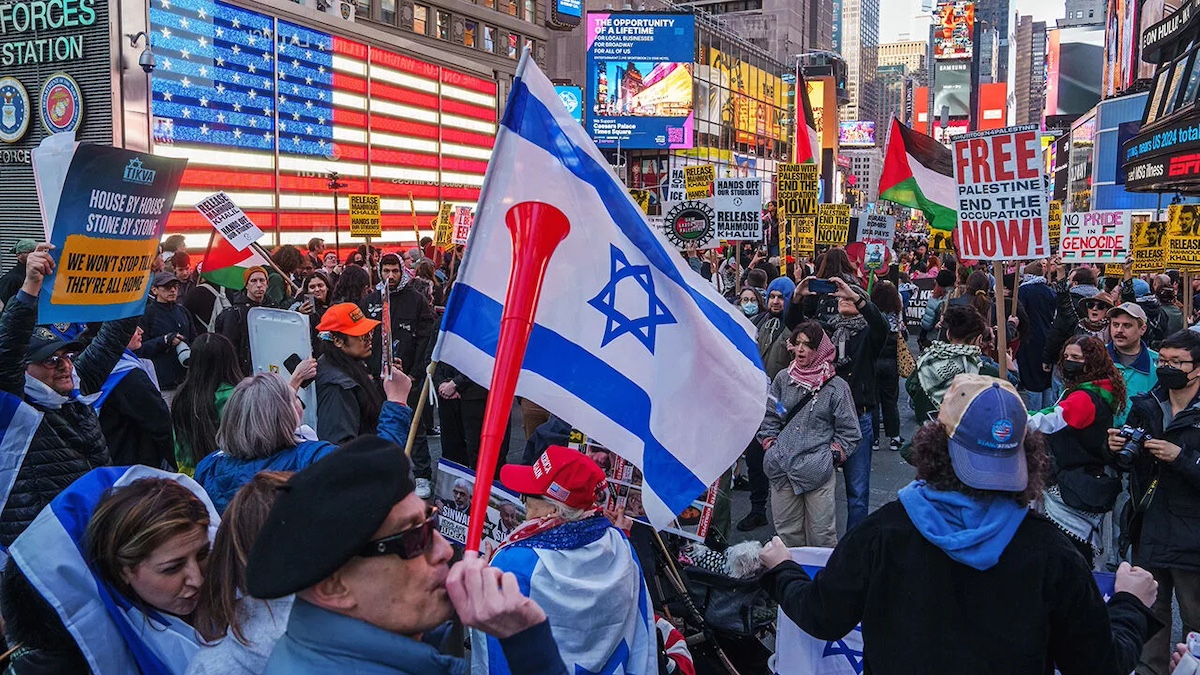
Gallup has tracked American sympathies in the Israeli-Palestinian conflict every year since 2001. For every year of that survey up to 2025, sympathies for Israel outpaced those for the Palestinians, often by margins of more than 40 percentage points. In the 2026 survey, that streak broke for the first time: 41% of U.S. respondents now say they sympathize more with Palestinians, compared to 36% who side with Israel, a gap that falls within the poll’s margin of error but marks a historic turning point.
Data from Pew Research Center reinforces this trend from a different perspective: 60% of all U.S. adults now hold an unfavorable view of Israel, up from just 42% in 2022—a near doubling of negative sentiment in four years. A further 59% of Americans lack confidence in Israeli Prime Minister Benjamin Netanyahu’s handling of global affairs. Among Democratic voters, unfavorable views of Israel have now reached 80%.
For Israel, the only partial reprieve is that a full bipartisan collapse of support has not yet occurred: Republicans still sympathize with Israelis over Palestinians by a 70% to 13% margin. But the most damaging erosion is concentrated in the youngest cohorts of voters, cutting across both major U.S. political parties.
Gallup’s data shows a majority of 18-to-34-year-old Americans now sympathize with Palestinians, hitting a record 53%. Pew found that only 52% of Republicans under 30 express confidence in Donald Trump’s handling of U.S.-Israel relations, compared to 93% of Republicans over the age of 65. A 2025 youth survey conducted by Yale University measured this generational divide directly, finding it is larger than any other political split in American public life: Baby Boomers register a +34 score on a composite pro-Israel index, while Gen Z registers a -22—a 56-point generational swing that cannot be dismissed as random polling noise.
This shift is not reversible by more aggressive public diplomacy, polished social media influencer campaigns, or additional congressional delegations to Israeli-occupied territories. It is the natural product of differing generational formative experiences: older Americans came of age with the 1967 Six-Day War as their defining frame of reference, while younger Americans’ core understanding of the conflict is shaped by the live-streamed 2023-2025 Gaza war.
Israel’s political establishment has historically fallen back on a familiar argument: moments of crisis, like the October 7 attacks, trigger a rally-around-the-flag effect that will reverse drifting public opinion. The October 7 attacks tested this expectation, but the rally in U.S. public opinion faded after just a few months, failing to hold long-term.
The roots of the shift are structural, not emotional. American sympathy for Israel was never an unprompted cultural given. It was built on specific post-WWII and Cold War context: the living, widespread memory of the Holocaust among American voters, a Soviet-aligned bloc of Arab states opposing Israel, and a framing of Israel in American eyes as a small, embattled democracy rather than the regional military power it is today, boasting the world’s fourth-strongest air force.
Those contextual conditions will not return. Generational replacement is an cumulative, irreversible process: every election cycle, the electorate grows slightly more shaped by the experience of the Gaza war and slightly less shaped by the 1967 conflict.
Projecting current trends forward makes the coming shift easy to predict. The current $3.8 billion annual U.S. military aid package for Israel runs through 2028; negotiations for the next agreement will take place before a Congress where more members launched their political careers after October 7 than before it. Longstanding U.S. policies of automatic diplomatic cover for Israel at the UN Security Council, unconditional arms sales, and the routine “ironclad alliance” rhetoric recited by every U.S. administration since Bill Clinton—none of these are permanent natural laws. They are political outcomes, sustained by an electoral coalition that is steadily aging out of the electorate, replaced by voters who demand justification for the “ironclad” label rather than accepting it as given.
Within a decade, if current trends hold, the core debate in Washington will no longer be whether to support Israel, but on what terms. Israeli governments that have spent decades treating U.S. backing as an unconditional given will suddenly find themselves negotiating from a position they have never had to occupy before.
None of this is an irreversible fate. Public opinion is not an unchanging glacier; it shifts in response to events. A genuine diplomatic peace settlement, a change in Israel’s ruling government, or a different character to future crises could all alter the current trajectory. But one assumption Israel can no longer rely on is the long-held belief that time is on its side among the American public, that the bilateral relationship is a fixed asset rather than a renewable political arrangement that requires ongoing defense and justification.