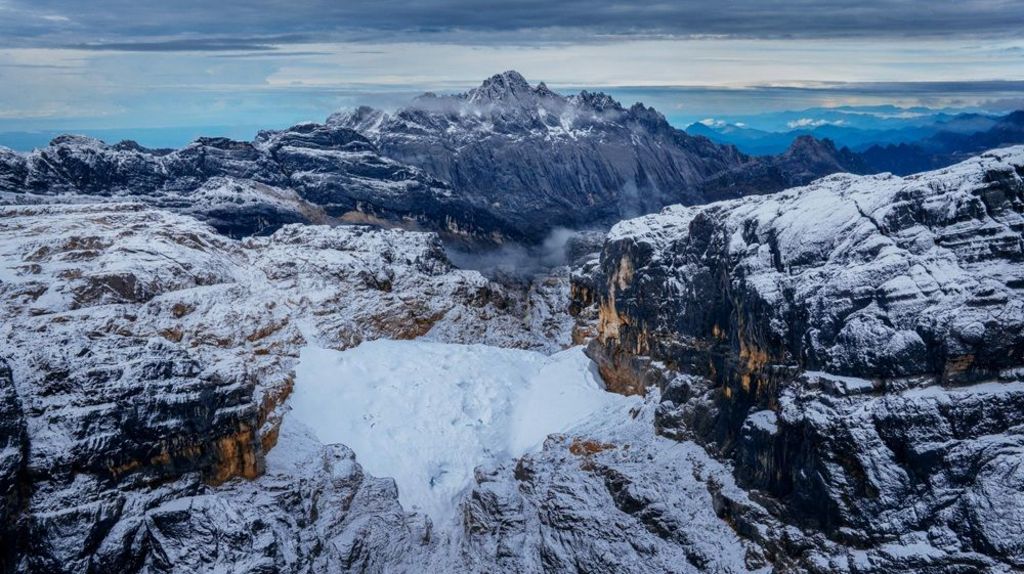
Tucked just a few hundred kilometers south of the equator on Indonesia’s Papua island, the Sudirman Range has held an extraordinary natural and cultural legacy for hundreds of years. Unlike most low-latitude regions, its highest peaks were capped by permanent snow and ice, earning the title of “eternal snow” that stood the test of centuries. Today, that legacy is on the brink of erasing entirely: only tiny scattered patches of snow remain around Puncak Jaya, the range’s highest peak also known as Carstensz Pyramid, and climate scientists project these last remnants will vanish completely within the next one to two years.
A century ago, all four major peaks of the 190-mile Sudirman Range supported year-round snow and glacial ice. At their peak in the 19th century, the region’s glaciers covered approximately 1,900 hectares (nearly 4,700 acres). Today, that cover has shrunk to just 16 hectares (around 40 acres), with nearly the entire glacial system disappearing within a single human lifetime. The loss carries profound implications for both scientific research and Indigenous cultural heritage, touching on the global impacts of anthropogenic climate change that are reshaping even the most remote corners of the planet.
For the scientific community, Papua’s tropical glaciers are one-of-a-kind natural archives. Isolated by thousands of kilometers from any other glacial systems, they are the only remaining tropical ice formations between the Andes Mountains in South America and the Himalayas in Asia. Ice cores drilled from Puncak Jaya’s slopes preserve layered records of thousands of years of climate history, allowing researchers to reconstruct past atmospheric conditions and trace long-term shifts in the tropical Pacific and Western Pacific Warm Pool — the planet’s warmest ocean bodies, which play a critical role in regulating global weather patterns. Yet this irreplaceable scientific archive is vanishing before researchers can fully extract and analyze its data, says Marie Šabacká, a Czech glacier ecologist who traveled to Puncak Jaya in March 2025 as part of an effort to document the remaining ice before it is gone.
Šabacká emphasizes that the melting of Papua’s glaciers is driven by the same human-caused climate warming that is triggering glacial retreat across the globe. Burning of fossil fuels — coal, oil, and natural gas — has steadily raised global atmospheric temperatures, pushing the freezing line higher and higher up mountain slopes. As a result, most precipitation in the region now falls as rain rather than snow, even at altitudes that once saw consistent year-round snow accumulation. Natural climate cycles such as El Niño can accelerate the melting process, while local conditions including cloud cover, annual snowfall variation, and mountain topography shape the exact pace of retreat. Because Papua’s glaciers sit so close to the equator, they can only survive within an extremely narrow range of climatic conditions at very high altitudes. Even a small temperature increase or shift from snow to rain is enough to push the system past the point of no return, Šabacká explains.
Beyond its scientific value, the Sudirman Range is the spiritual heartland for multiple Indigenous Papuan communities that have lived alongside its ice-capped peaks for generations. For the Amungme people, the range is called Nemangkawi, or the “White Arrow,” a symbol of honesty, purity, and moral integrity that has anchored cultural traditions for centuries. “Parents and grandparents prayed their children would have hearts like the White Arrow, never straying from the proper path,” explains Elfrida Natkime, a young Amungme community member. For the Moni people, the peak is known as Mbainggela, and traditional belief holds that their ancestors watch over the sacred mountain. Adolfina Kum, an Amungme environmental activist, compares the loss of the ice-capped peak to the destruction of a site central to a major world religion. “How would Muslims feel if Mecca were destroyed? How would Catholics feel if Rome or the Vatican were destroyed?” she asks. “For the Amungme people, that is what it feels like when Nemangkawi is destroyed.”
For many Indigenous Papuans, the disappearance of the glaciers is not an isolated environmental change, but part of a decades-long transformation of their ancestral lands driven by extractive industry. The region is home to the Grasberg mine, operated by Freeport and one of the world’s largest gold and copper mining operations. The discovery of massive mineral deposits in the 20th century triggered large-scale industrial development that reshaped the landscape: entire mountain faces have been excavated, new roads and industrial infrastructure have cut through valleys, and expanding mining operations have displaced many Indigenous families from their traditional lands. While community members acknowledge the development has brought tangible benefits including jobs, improved access to education, and new economic opportunities, it has also come at the cost of widespread environmental degradation and long-running social conflict. “Every time I see the mountains, I feel amazed, but I also feel sadness,” Natkime says. “Since the company came, I have seen the exploitation. But the development has also provided a livelihood for many people.”
As the final fragments of ice melt, both scientists and local communities are racing to document what remains of the glacial system before it disappears forever. Klaus Thymann, a Danish researcher leading the climate documentation initiative Project Pressure, has worked with a team to create detailed 3D maps of the remaining ice using drone surveying. His data confirms that between the early 2000s and 2025, the glaciated area of the Sudirman Range has receded by 95%. “There’s almost no ice left. Those are the facts,” Thymann says. He notes that glaciers are uniquely powerful messengers for climate change, because the disappearance of ice that was called “eternal” for centuries cuts through abstract data to drive home the reality of a warming planet. For Indigenous communities, the loss reaches far deeper than environmental change: it erodes the cultural foundation that has sustained their people for generations. Adolfina Kum compares the destruction of sacred landscapes to pulling a tree up by its roots: “Once the roots are removed, the tree loses its foundation.”