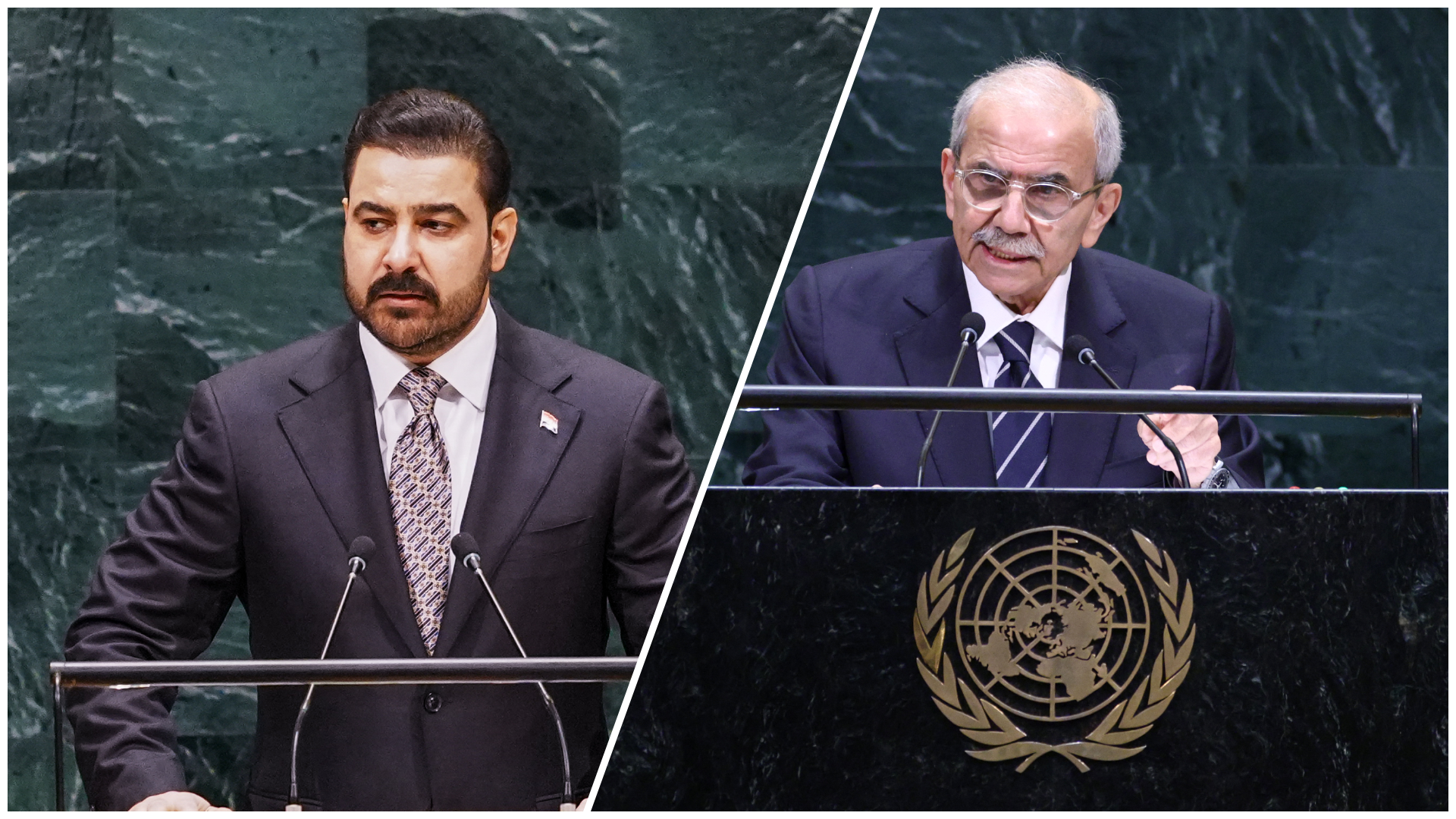
On the opening sidelines of the 79th United Nations General Assembly on Friday, the heads of government of two crisis-battered Middle Eastern nations — Iraq and Lebanon — took the global stage to outline their administrations’ policy agendas, laying out starkly different priorities shaped by their unique domestic and regional challenges. While Iraqi Prime Minister Ali al-Zaidi centered his address on anti-corruption crackdowns and a broad push to attract global foreign investment, Lebanon’s Prime Minister Nawaf Salam focused his remarks on demanding an end to Israeli occupation of sovereign Lebanese territory and addressing the catastrophic humanitarian fallout of months of cross-border conflict.
Both leaders share a diplomatic alignment generally viewed as favorable to Washington, and their mandates both prioritize consolidating state authority and strengthening independent judicial institutions, but their political backgrounds differ dramatically. Zaidi, a relatively young former businessman and banker with limited prior political experience, took office earlier this year amid ongoing efforts to reset Iraq’s post-occupation trajectory. Salam, by contrast, boasts a decades-long career in international law and diplomacy, including a term as a judge at the International Court of Justice, and assumed his post in 2024.
For Lebanon, the immediate existential challenge remains the illegal Israeli occupation of more than 600 square kilometers of southern Lebanese territory seized since the escalation of regional conflict following the October 7, 2023 Hamas attacks on southern Israel. Following the February 28 launch of the US-Israeli campaign against Iran, Israel expanded its military incursion into southern Lebanon, and a June report from *The Times of Israel* confirmed Israel has no plans to withdraw from the over 1,000 square kilometers of territory it has seized across Gaza, Lebanon and Syria. Since Hezbollah began rocket strikes in response to Israel’s Gaza offensive, Israeli military operations have killed nearly 9,000 Lebanese people and displaced more than one million southern Lebanese residents from their homes.
Salam made clear that Lebanon cannot achieve full sovereignty and national unity until Israel withdraws all forces to the country’s internationally recognized borders, in line with the 1949 General Armistice Agreement and UN Security Council Resolution 1701. “Lebanon is affected by developments in its surroundings. That does not mean, however, that we accept its becoming once again an arena for the conflicts of others or a bargaining chip in their hands,” Salam told the assembled delegation in New York. “Lebanon’s future will not be decided on its behalf, nor may its security and stability become the price of settlements concluded in its absence.”
In addition to full withdrawal, Salam outlined four core non-negotiable demands: the release of all Lebanese detainees held by Israel, the safe and dignified return of all displaced residents to their homes and communities, and full reconstruction of all infrastructure destroyed by Israeli bombardment. To advance these goals, he confirmed Lebanon has agreed to enter US-mediated negotiations with Israel led by Secretary of State Marco Rubio, but stressed that tangible action matters far more than symbolic agreements. “The success of any agreement is measured not by declared intentions but by fulfilment of commitments,” Salam said. “What is required today, therefore, is to complete the translation of this framework into practical steps within a clear timetable and with a verification mechanism that ensures the implementation of all its provisions.”
Addressing the longstanding issue of non-state military factions in the country, including the Iran-backed Hezbollah movement, Salam reaffirmed his government’s commitment to extending full state authority across all Lebanese territory, noting that only the Lebanese state should legally hold weapons. He also called for expanded humanitarian and development aid from the UN and broader international community, emphasizing that his administration has followed through on its domestic reform commitments to earn international support. “The war has left behind a vast humanitarian crisis in Lebanon,” he said. “We are shouldering our responsibility for reform… We are entitled to ask the international community to shoulder, in turn, its responsibility to ensure respect for Lebanon’s sovereignty.”
Halfway across the regional political landscape, Iraq’s prime minister framed his address around a very different set of goals: transitioning Iraq away from its decades-long reliance on oil revenues and rebranding the country as a stable, attractive destination for global direct investment. Zaidi first laid out this economic agenda during a July appearance at the Iraqi American Chamber of Commerce in Washington D.C., and doubled down on that vision at the UN. “Here, from the United Nations, we say to the world: Invest with Iraq. Iraq has resources, markets, a good location, and the necessary will to build a new economy,” he said Friday.
Since the 2003 US-led invasion of Iraq, oil revenues have accounted for roughly 90% of the country’s annual state budget, with all proceeds held in the Federal Reserve Bank of New York — requiring US approval for all cash shipments into the country, a dynamic that has limited Baghdad’s full economic sovereignty. To break this rentier economic model, Zaidi’s administration plans to expand private sector activity across key non-oil sectors: agriculture, manufacturing, technology, transportation, energy infrastructure and non-oil exports.
To lay the groundwork for increased global investment, Zaidi’s government has already prioritized two critical domestic reforms: a sweeping nationwide crackdown on systemic corruption, and the disarmament and consolidation of Iran-backed militias that have long operated outside of state control. Zaidi framed the post-coalition era of Iraq’s relationship with Western strategic partners as a turning point: “With the end of the international coalition’s mission in Iraq, we are moving our relationship with our strategic partners to a new phase, moving from military cooperation to economic and development cooperation in service of our common interests.”
Beyond economic diversification, the Iraqi government plans to expand crude oil production aligned with Iraq’s massive proven reserves, develop untapped natural gas fields, and expand domestic refining capacity for energy derivatives. Zaidi’s long-term vision for Iraq is to reemerge as a global energy hub, leveraging its geographic position to advance regional and global stability. He highlighted the ongoing development of a cross-regional energy corridor connecting Iraq to Turkey, Jordan and Syria, which would serve as a direct energy gateway to European markets. “Economic interests create prosperity,” he said. “When the countries of the region are connected through ports, railways, power lines, trade, and investment, they have a greater interest in preserving stability.”
Without explicitly naming the seven-month US-Israeli campaign against Iran that has upended regional security, Zaidi expressed measured concern over the ongoing crisis impacting regional maritime navigation. He closed by laying out Iraq’s overarching regional vision, built on mutual sovereignty and cooperation rather than conflict. “Iraq’s vision is based on contributing to the region’s transition from conflict to integration, from competition to cooperation, from resource depletion to investment in development,” Zaidi said. “We extend our hands to everyone on the basis of respect for sovereignty, non-interference, good neighbourliness, strengthening mutual interests, and adopting dialogue as a means to address differences.”