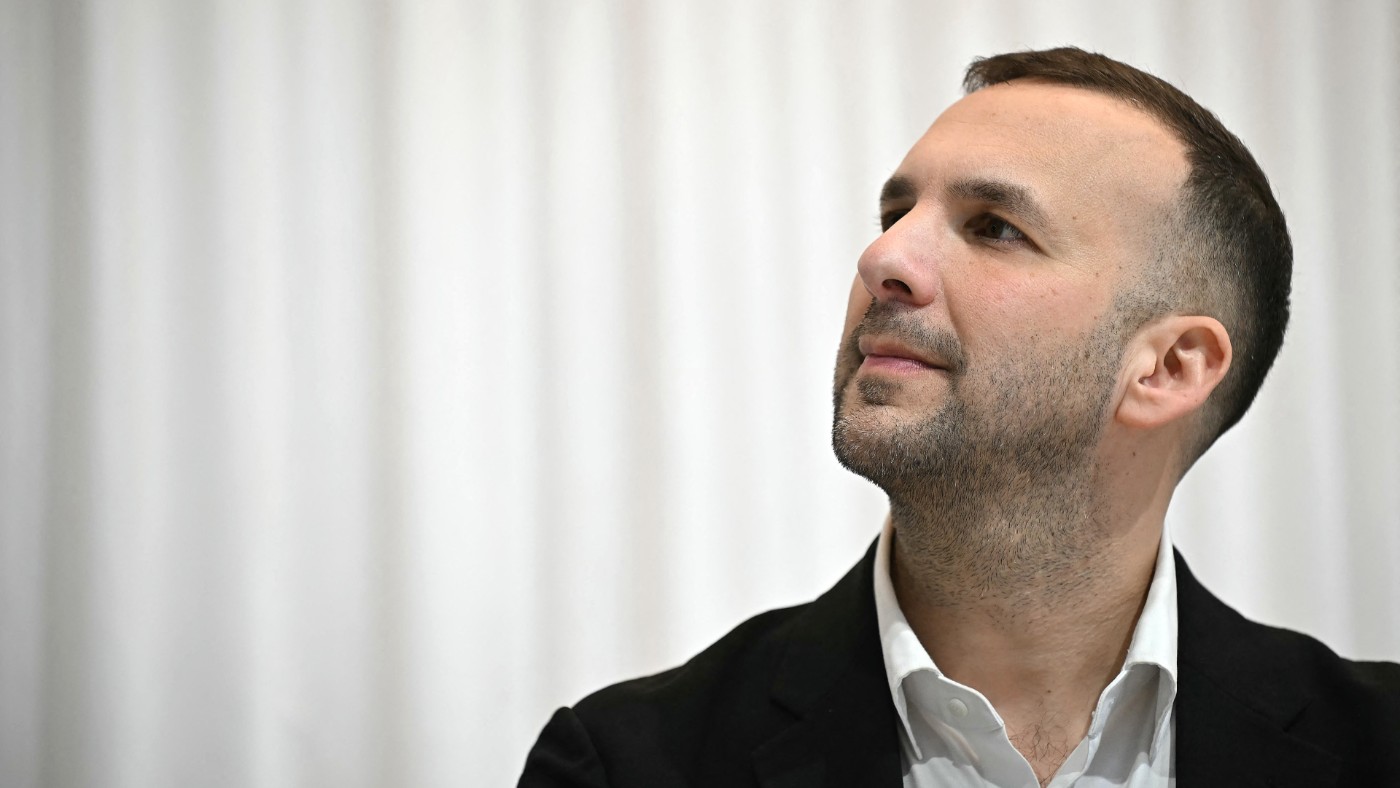
On a heated Thursday evening hustings event focused on the upcoming Holborn and St Pancras parliamentary by-election, Green Party of England and Wales deputy leader Zack Polanski made British political history: he became the first leader of a major contemporary UK political party to openly declare himself an anti-Zionist. The event, co-hosted by two prominent pro-Israel groups—the Board of Deputies of British Jews and the London Jewish Forum— quickly grew tense as Polanski, who is himself Jewish and the Green Party’s candidate in the 8 October London by-election, laid out his unflinching views on the ongoing Israel-Palestine conflict.
When asked directly by event organizers whether he identified as a Zionist, Polanski did not hesitate to answer. “I’m an anti-Zionist, which I know is difficult for people in this room to hear… I think countries have always been ideas and I think things change over time,” he told the assembled audience, most of whom held pro-Israel positions. Pressed further on whether he views Zionism as a racist ideology, Polanski framed his stance around the on-the-ground impacts of the movement for Palestinians: “If you’re defining Zionism as the displacement and genocide of the Palestinians, which is how in practice Zionism has become in truth, then that is racist.”
Polanski doubled down on his characterization of Israel’s ongoing military campaign in Gaza, which has killed more than 40,000 Palestinians according to Gaza’s Ministry of Health, telling the crowd that “Many genocide scholars around the world recognise it as a genocide, and calling it that is not antisemitic.” Minutes earlier, after he referenced what he called “apartheid and genocide” in the occupied Palestinian territories, his remarks drew loud boos from audience members. Polanski acknowledged the backlash immediately, saying “Well, I know that that’s not popular in this room.”
As audience members shouted back that labeling Israel’s actions as genocide is indeed antisemitic, Polanski pushed back against the common framing that conflates criticism of the Israeli state with antisemitism, arguing that this conflation ultimately puts Jewish communities across the world at greater risk. “I think as the Jewish community we need to come together to recognise when we call that antisemitic, we are making ourselves as Jewish people less safe,” he said. He rejected the idea that all Jewish people bear collective responsibility for the Israeli government’s actions, stressing that “We cannot hold Jewish people responsible for what happens in Israel. And when we conflate those things, that’s when the danger happens.” These closing remarks won partial applause from the room. One audience member pushed back, noting that the term “genocide” was coined in the wake of the Holocaust, the systematic Nazi murder of 6 million European Jews.
As local journalist Richard Osley documented, all candidates contesting the by-election were asked the same opening question: a direct yes-or-no request to state whether they are Zionists. Labour candidate Sagal Abdi-Wali, who is vying to succeed Labour leader Keir Starmer in the seat and drew criticism after skipping a Muslim community event earlier that week, declined to give a direct answer, only responding “I believe in a two-state solution.” Liberal Democrat candidate Patrick Stillman confirmed his identification as a Zionist, saying “As I understand it, it’s for a Jewish state and a right to exist, I think that’s important, so yes I am.” Conservative contender Ewan Cameron and Reform UK candidate Pete Newman, a former police officer, both also stated they were Zionists.
After Polanski’s public declaration of anti-Zionism, multiple audience members pushed him with hostile questions, including “Where do the Jews go?” and “You’re not impartial if you’re an anti-Zionist, are you?” While some past leaders of major British political parties—including former Labour leader Jeremy Corbyn, and mid-20th century prime ministers Clement Attlee and Herbert Asquith—expressed opposition to Zionist goals in varying forms, Polanski is the first to explicitly embrace the label of anti-Zionist in modern British politics.
To provide context for the debate, the Zionist movement emerged in late 19th century Europe, as Jewish communities faced violent, state-sponsored antisemitism and widespread pogroms across the continent. In 1917, the British government issued the Balfour Declaration, which publicly committed the UK to supporting the establishment of a “national home for the Jewish people” in Palestine, then a territory ruled by the Ottoman Empire since 1516. After Britain seized control of Palestine from the Ottoman Empire in 1918 during World War I, Jewish people made up just 5 to 6 percent of the territory’s total population. That number grew steadily in the decades leading up to World War II, as the British government supported the migration of Jewish refugees fleeing European antisemitism to British Mandatory Palestine. In 1948, the state of Israel was declared, realizing the core goal of Zionism—but this achievement came at a devastating cost to the Palestinian people, who experienced the Nakba, or “catastrophe”: an estimated 750,000 Palestinians were forcibly displaced from their ancestral land and homes to make way for the new Jewish state.