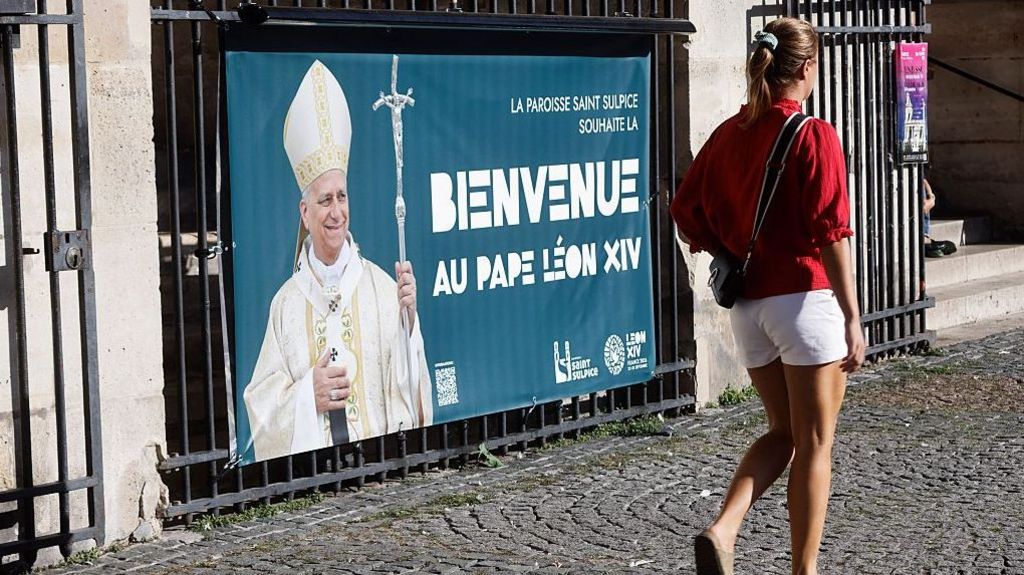
Pope Leo XIV launched a highly anticipated four-day apostolic journey across France on Friday, marking one of the most high-profile Vatican visits to the historically Catholic European nation in decades. The tour, which will take the pontiff from the streets of Paris to the Pyrenean sanctuary of Lourdes before concluding in the northeastern city of Metz, is expected to draw millions of worshippers and observers across all three stops, with its centerpiece a massive open-air Mass scheduled for Saturday afternoon in the heart of the French capital.
Local authorities have completed extensive preparations for the Parisian gathering: a custom-built altar has been erected on Place de la Concorde, and security forces have sealed off large sections of the iconic Champs-Élysées to accommodate the expected crowd. Organizers project that as many as 600,000 Catholic faithful will pack the famous avenue, stretching all the way to the Arc de Triomphe and beyond, to attend the service. Following the Mass, the pontiff will travel via Popemobile through the gathered crowds to the fire-ravaged Notre-Dame cathedral ahead of an evening gathering with 80,000 young people at Paris’s Stade de France. The Pope will also hold a meeting with a group of migrants during his time in the capital.
On Friday morning, French President Emmanuel Macron welcomed Pope Leo at Paris’s Orly Airport, ahead of scheduled closed-door talks at the Élysée Palace focused on pressing geopolitical conflicts and the societal impacts of artificial intelligence. Macron will join the Pope for a joint address in Metz on the final day of the visit, but will not attend any of the papal Masses — a deliberate choice to uphold France’s longstanding legal principle of strict separation between church and state. In his place, first lady Brigitte Macron and Prime Minister Sébastien Lecornu will represent the French government at the Champs-Élysées Mass. Several high-profile candidates for 2027’s French presidential election are also scheduled to attend, including nationalist right leader Marine Le Pen, centrist figures Edouard Philippe and Gabriel Attal, and conservative leader Bruno Retailleau.
Earlier unconfirmed reports claimed tensions had emerged between Macron’s team and Vatican organizers over the scope of ceremonial elements for the visit, with the French president reportedly disappointed that the Pope declined a more formal public procession. Élysée officials pushed back on these claims this week, noting that while traditional ceremonial honors including a cavalry escort down the Champs-Élysées were extended to the Pope — who holds status as a head of state — it was always understood the pontiff might not accept the offer. Officials did confirm that Pope Leo turned down a planned meeting with artisans leading the reconstruction of Notre-Dame cathedral, citing the already overcrowded schedule of the visit.
On Sunday, the Pope will travel to Lourdes, the iconic Catholic pilgrimage site in the French Pyrenees, where 150,000 people have already registered to attend his Mass. During his stop in Lourdes, Pope Leo will also hold a private meeting with survivors of sexual abuse committed by members of the Catholic clergy, a key priority for his papacy. The tour will wrap up on Monday in Metz, where the pontiff will honor Robert Schuman, one of the founding fathers of the European Union and a devout Catholic who is currently a candidate for beatification by the Church.
Born Robert Prevost in Chicago in 1955, Pope Leo XIV has deep ancestral ties to France: his paternal grandmother was born in Le Havre, Normandy in 1894, and the Prevost family name itself originates from her mother’s French maiden name.
France’s relationship with the Catholic Church has been long and complex over centuries. While it was historically known as the “Eldest Daughter of the Church” — a title rooted in the (historically inaccurate) claim that it was the first kingdom to convert to Christianity — the nation has seen centuries of shifting dynamics between Paris and Rome. The 14th century saw the papacy take up exile in Avignon, southern France, while French forces repeatedly intervened in Italian politics when popes held secular as well as spiritual power. Napoleon Bonaparte infamously held two popes in captivity during his rule.
Recent popes have made frequent visits to France: Pope John Paul II traveled to the country multiple times between 1980 and 2004, while Pope Francis made three visits, but chose to avoid Paris in favor of stops in Strasbourg, Marseille and Corsica. Today, like much of the rest of Western Europe, France has undergone widespread secularization: fewer than half of the French population identifies as Catholic, with regular church attendance falling from 35% in 1960 to less than 5% today. The number of active priests in the country has also shrunk by two-thirds, dropping from 25,000 in 1990 to fewer than 9,000 today.
Even amid this long-term secular shift, Catholic leaders say they have seen growing signs of renewed spiritual interest across French society in recent years. The number of adult baptisms in France has more than doubled over five years, reaching 10,000 in 2025. Reflecting on this trend, Cardinal François Bustillo, Bishop of Ajaccio, noted that while secularization has created a void in the space once filled by religious values, many people are now searching for connection to their cultural and spiritual roots. “It was John-Paul II who awoke the East. Now Leo XIV will awake the West,” Bustillo said. Church officials attribute the massive crowds expected for the Pope’s visit to this growing spiritual thirst across France and wider Europe.