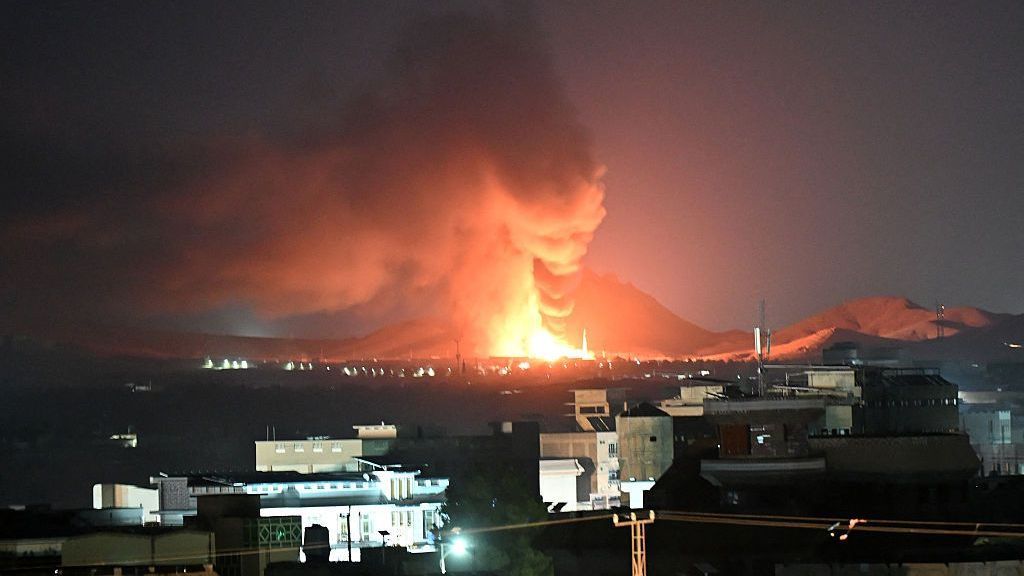
Cross-border tensions between Afghanistan and Pakistan have surged to their highest level in months after Pakistan conducted a second wave of air strikes across Afghan territory this week, marking a sharp collapse of the brief three-month ceasefire that held between the neighboring nations.
Afghanistan’s ruling Taliban administration confirmed Thursday that the air raids hit three Afghan provinces – Kandahar, Paktia, and Khost – the country’s southern and eastern border regions. According to the Taliban, four civilian lives were lost in the strikes, which follow a deadly September 18 attack on a police compound in northwestern Pakistan that left 31 people dead. That attack was claimed by a faction aligned with the Tehreek-e-Taliban Pakistan (TTP), an anti-Islamabad militant group that Pakistan has long accused the Afghan Taliban of sheltering – a charge the Taliban repeatedly denies, arguing that cross-border militancy is an internal issue for Pakistan.
Local witnesses on the ground have painted a chaotic picture of the strikes. In Kandahar, the Taliban’s political and military heartland, a resident told reporters the sound of military jet engines was quickly followed by a massive blast that ignited large fires across the targeted area. In Khost, midnight strikes damaged civilian residential properties, though no fatalities were reported in that province. “People were shouting, and there was panic all around,” local eyewitness Abdullah told news outlets. Another Khost resident, Salamat Khan, insisted the area hit held no military infrastructure: “there is no military base here, nor are there any military personnel, there are only the homes of ordinary civilians.” In Paktia, strikes targeted the 203 Mansouri Corps of the Taliban-controlled Afghan Armed Forces, though no casualty figures have been released for that strike.
Pakistan’s government has defended the operation as a targeted counterterrorism measure. Information Minister Attaullah Tarar described the strikes as “deliberate, precise, calibrated, and proportionate,” noting they were “strictly limited to identified military objectives directly linked to the attempted attacks against Pakistan.” A prior statement from Pakistani forces confirmed 10 separate targets were hit across Afghan territory, though officials declined to share specific locations.
This latest wave of attacks comes just one week after Pakistan’s first cross-border air strike on the Afghanistan-Pakistan border region. In that earlier strike, Pakistan claimed it killed 28 militants, but local Taliban officials and the United Nations Assistance Mission in Afghanistan (Unama) confirmed at least three civilian deaths and four additional injuries.
Tensions have built steadily since the September 18 police compound attack, and even escalated in the 48 hours before Thursday’s strikes. On Wednesday, Pakistan announced it had intercepted and neutralized multiple drones launched from Afghan territory, a claim the Afghan Taliban immediately rejected as unfounded.
The current escalation reflects a long-running failure to resolve cross-border hostilities despite international mediation efforts. After a particularly deadly Pakistani air strike in March that killed more than 260 people – which the Taliban said hit a civilian drug rehabilitation center, a claim Pakistan denied – the two sides agreed to a temporary ceasefire that held for roughly three months. That calm dissolved with the September 18 compound attack. Unama data underscores the heavy human toll of ongoing violence: between October 2025 and June 2026, cross-border clashes between Pakistani security forces and Taliban-led Afghan forces killed at least 499 civilians and injured more than 1,200 others.
Diplomatic efforts remain deadlocked. Speaking on the sidelines of the UN General Assembly earlier this week, Pakistani Foreign Minister Ishaq Dar called for “concrete and verifiable” guarantees from Kabul that Afghan territory would not be used to stage terrorist attacks against Pakistan. For their part, Taliban officials have promised an “appropriate response” to Thursday’s strikes, with spokesperson Zabihullah Mujahid condemning the attacks as “reckless, careless, and hostile” and warning the action “will have adverse consequences for the Pakistani military.” Pakistan has in turn warned that it will match any further “provocative act” from Afghan soil with a forceful response, leaving the border region on high alert for further escalation.