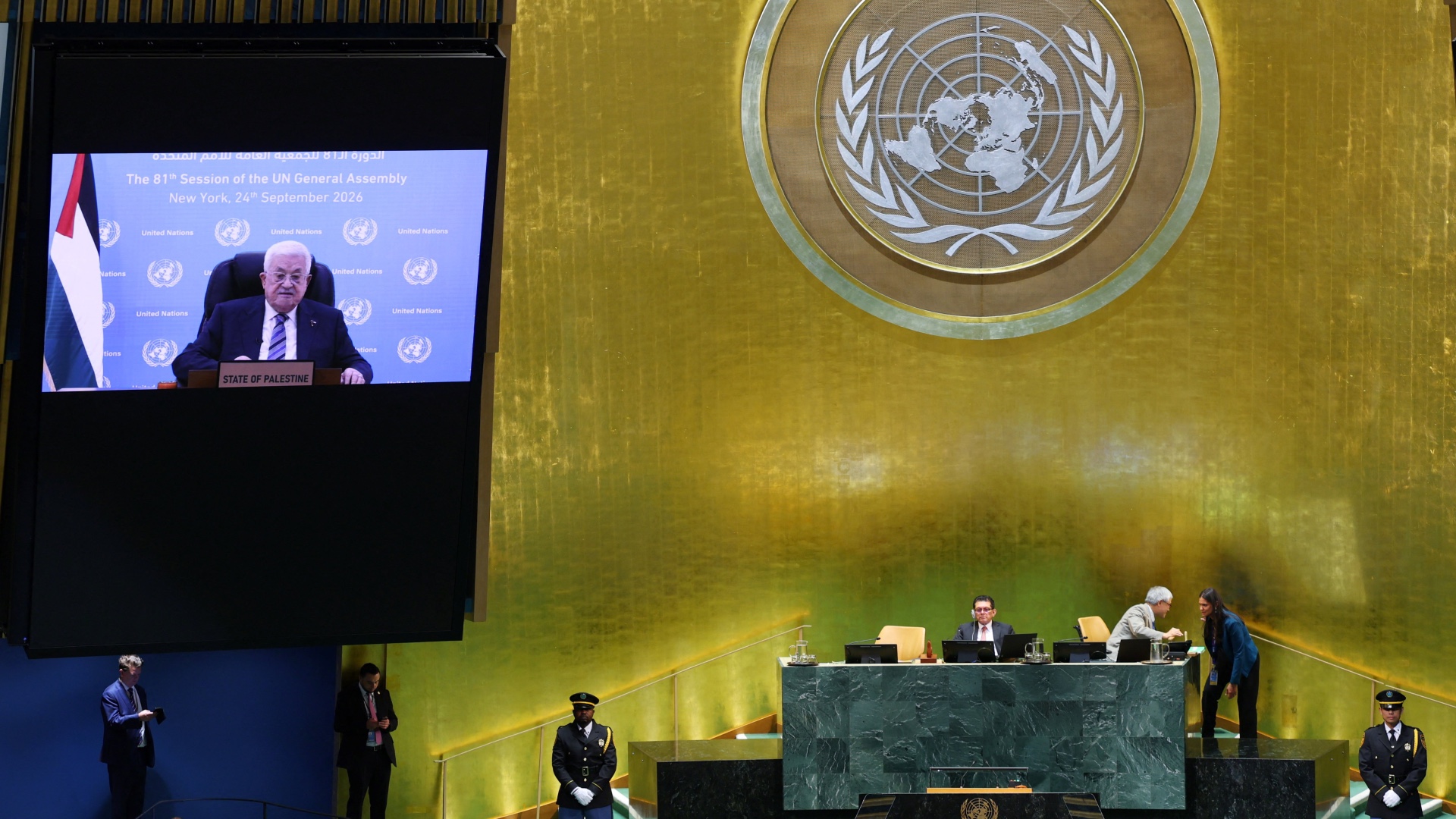
In a pre-recorded address to the United Nations General Assembly on Thursday, Palestinian Authority (PA) President Mahmoud Abbas issued a stark, urgent warning: the Palestinian people stand on the edge of a second Nakba unless the international community follows through on its repeated promises to support Palestinian self-determination. For the second year in a row, Abbas was unable to address the assembly in person, blocked by a visa ban imposed by the Trump administration on Palestinian officials and civil society groups that engage with UN-affiliated international judicial bodies, including the International Court of Justice and the International Criminal Court.
Opening his remarks, the 90-year-old leader rejected the unlawful punitive measures targeting the PA, pushing back against the justifications used to impose them. “We affirm that we have fulfilled our obligations, carried out a comprehensive national reform programme and upheld our commitment to international law, to shunning violence and terrorism, and to the two-state solution and to peace on the basis of resolutions of international legitimacy,” Abbas stated. He emphasized that neither the Palestinian people nor their leadership deserve punishment for demanding an end to occupation and turning to legitimate international institutions to uphold their rights.
While the Trump administration has effectively abandoned long-stated international support for a two-state solution, several key Western allies including Canada, the United Kingdom, France, and Spain formally recognized the State of Palestine last year and opened diplomatic missions for the PA. Abbas, however, slammed the gap between global rhetoric and tangible action: despite public statements of support and pledges of aid for PA security infrastructure and humanitarian work in Gaza, the international community has applied no meaningful pressure on Israel to halt its expansion of illegal settlements in the occupied West Bank, end escalating settler attacks on Palestinian communities, or stop ongoing air strikes in Gaza that have killed a dozen children in just the past month.
Abbas warned that the threat facing Palestinians extends far beyond the erosion of the two-state solution. “The danger is no longer limited to undermining the two-state solution and preventing the realisation of the Palestinian state. It has now come to threaten the very life and existence of the Palestinian people on their homeland,” he said. He framed ongoing violence and displacement across Gaza, the West Bank, and East Jerusalem not as isolated incidents, but as a deliberate colonial project designed to make life unlivable for Palestinians and force them out of their historic homeland.
The dire humanitarian reality on the ground underscores Abbas’ warning. Two million Palestinians trapped in Gaza are currently crowded into just one-third of the small enclave, most sheltering in flimsy tents with no adequate supplies to withstand winter weather. Since the October 7, 2023 Hamas attacks on southern Israel and the subsequent Israeli military campaign in Gaza, nearly 74,000 Palestinian bodies have been recovered, a figure officials expect to surpass 100,000 as search and clearance of rubble continues. More than 1,400 of these deaths have occurred since a nominal ceasefire was declared in October 2025. UN Secretary-General António Guterres recently described repeated short-term ceasefires as futile, calling them merely “lesser fires” that do nothing to end the underlying conflict.
In the occupied West Bank, where Israeli security crackdowns have intensified parallel to the assault on Gaza, more than 1,000 Palestinians have been killed so far this year, according to the UN Relief and Works Agency for Palestine Refugees.
Abbas expressed deep regret that the PA’s commitment to a peaceful, institutional path to secure Palestinian rights – including its willingness to engage with Trump’s controversial 20-point Gaza reconstruction plan – has failed to deliver any tangible improvement for his people. “This was to halt the aggression against our people and their humanitarian suffering, and secure the withdrawal of the occupation forces from the Gaza Strip, and begin rebuilding the Gaza Strip. However, regretfully, we have not seen any of this materialise on the ground,” he said. Israeli attacks and killing of Palestinian civilians, including women and children, continue unabated in Gaza nearly a year after the UN adopted Resolution 2803 and established the Board of Peace, the transitional body tasked with overseeing Gaza’s reconstruction and governance. Only one year remains in the designated transition period, which is scheduled to conclude by the end of 2027.
Last week, Jared Kushner, Trump’s son-in-law and the lead figure coordinating the reconstruction effort, acknowledged that the Board of Peace has faced significant “delays” in the 11 months since its formation. International aid agencies warned last month that the body is not just delayed, but actively failing the people of Gaza, saying it has only functioned “to further entrench Israel’s unlawful presence” in the territory.
Abbas pushed the international community to answer a critical question: “What is the international community waiting for in order to protect the Palestinian people, ensure their continued presence on their land, end the Israeli occupation, and implement the two-state solution on the basis of international legitimacy?” He stressed that the transitional period cannot be allowed to become an open-ended, permanent status quo with no clear, time-bound path to Palestinian statehood.
The PA President reaffirmed that the Palestinian Authority has met all its commitments to domestic political reform, including strengthening institutional governance, improving public financial management, increasing transparency and accountability, enacting anti-corruption measures, and upholding the rule of law. To cement these reforms, Abbas confirmed that long-delayed Palestinian legislative elections are still scheduled for November 28, followed by a presidential election. This will be the first general Palestinian election held in two decades; Abbas has held the presidency since 2005.