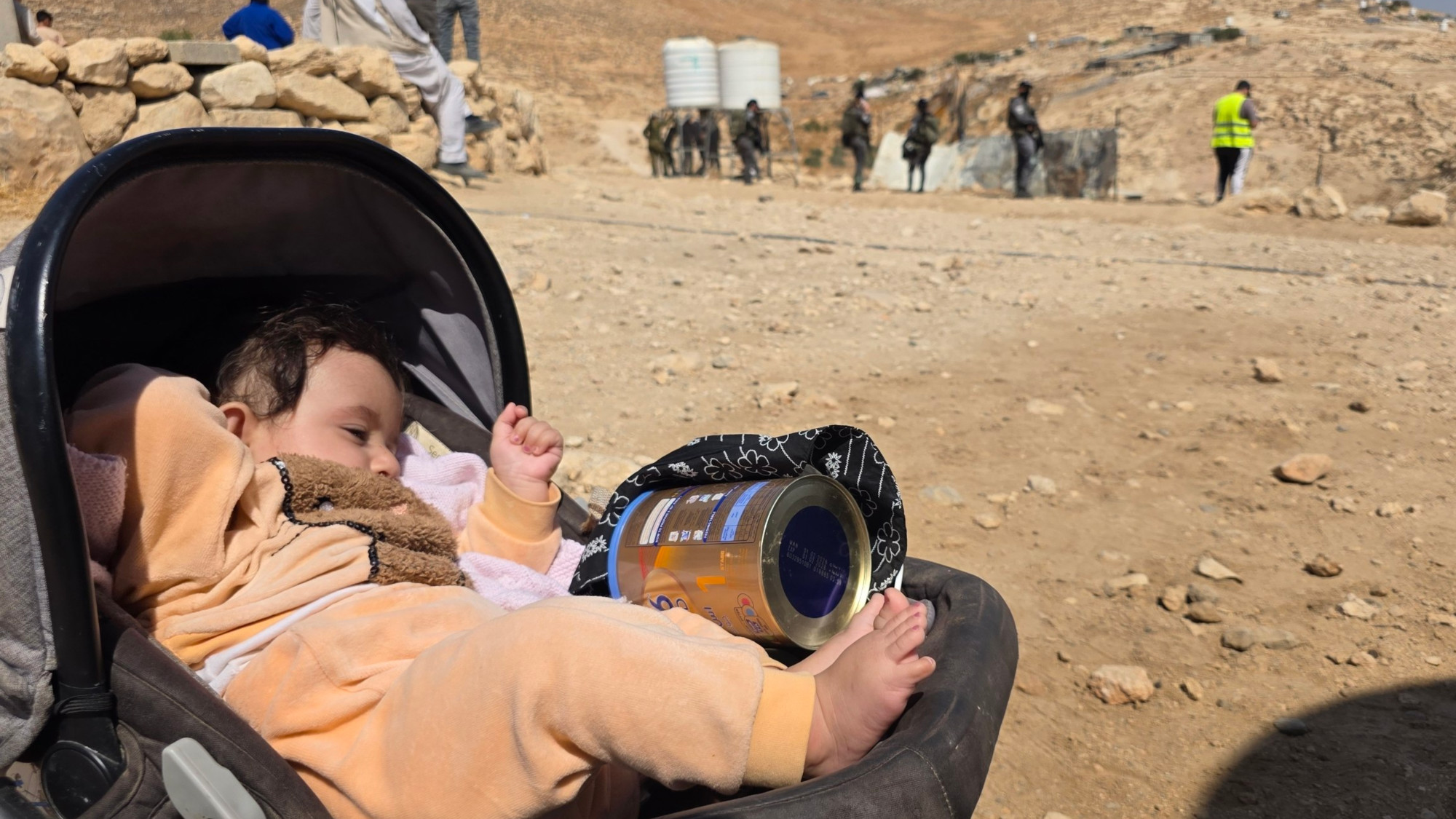
On Wednesday, Israeli military forces launched a large-scale demolition operation targeting residential and infrastructure in the village of Janba, located in the Masafer Yatta region of the occupied southern West Bank, leaving more than 170 Palestinians homeless, including 85 children.
According to documentation from leading Israeli human rights organization B’Tselem, military personnel and armored bulldozers entered the village before dawn on September 23, 2026. By the end of the operation, crews had destroyed 24 residential buildings, 16 agricultural outbuildings, 16 residential solar energy units, and 14 communal and residential water storage tanks. Beyond destroying standing structures, forces also sealed off natural caves that local residents had used for generations to store supplies, shelter livestock, and even as permanent family homes.
For residents like Najah Jabarin, the operation erased nearly every asset her family relied on. “We lost our home; we lost three rooms – the kitchen, the sheep shed and the bread oven,” Jabarin told Middle East Eye in an on-site interview. “We have nothing left.” Like dozens of other displaced families in Janba, Jabarin’s 11-member household currently has no alternative permanent housing, but she says the family remains committed to rebuilding on their ancestral land and refusing to leave the area.
This latest demolition is part of a sharp upward trend in forced displacement and home destruction across Masafer Yatta that has accelerated dramatically since October 2023. Just weeks earlier, Israeli forces carried out two large-scale demolition operations in neighboring communities in the region. On September 2, the military demolished almost the entire hamlet of Khirbet al-Taban, leveling 12 homes that held 70 residents, 28 of whom were children. One week after that, all five homes in Khirbet al-Fakhit were destroyed, displacing 32 additional people, alongside the loss of all local livestock pens, water access infrastructure, and off-grid solar energy systems that sustained the community.
Janba resident Nu’man Jabarin, a 57-year-old who was born in the village and has lived in the same cave compound his family has occupied for three generations, described the operation as a total erasure of his life’s holdings. “Today, they wiped out everything I owned,” he said. “I have no bathroom, no kitchen, no room and no cave left.”
In the days since the demolition, Jabarin’s two-month-old grandson has been forced to sleep in the open, with no shelter to protect him from the elements. “If you came to us at midnight, you would find our children out in the open, with no shelter,” he added. When Jabarin attempted to present Israeli military crews with official documents proving his family’s ownership of the land, he said soldiers dismissed the papers, declaring the entire area a closed military training zone. Soldiers explicitly ordered him to relocate elsewhere after destroying his home, but the lifelong resident says he has no intention of complying. “There is no alternative; this is my land. I was born here, and my father was born here. I have the documents and proof to show for it,” Jabarin said. “They don’t care about Palestinians anywhere. They want to displace us to Jordan, but I will not leave. I will die with my children in my village.”
Another Janba local, Nidal Jabarin, argues that the escalating demolitions are a deliberate strategy to make daily life unbearable for Palestinian residents, with the ultimate goal of forcing mass out-migration. He noted that these campaigns often intensify ahead of Israeli national elections, when the lives and rights of Palestinians become political collateral. Israeli political parties across the spectrum, he claimed, are competing to demonstrate increasingly harsh repression against Palestinians to win voter support. “They race to make people’s lives extremely difficult, to harm and destroy them, and to ruin everything in this village,” he said, adding that the demolitions target not just current residents, but the centuries-long historical and geographic connection Palestinians have to the land.
Janba is one of 13 small Palestinian communities that fall within the boundaries of “Firing Zone 918,” a 30,000-hectare area Israel designated as an exclusive military training zone back in the 1980s. This designation placed all Palestinian structures in the entire area under permanent demolition orders, leaving residents with no legal protection for their homes or infrastructure. The United Nations Office for the Coordination of Humanitarian Affairs (OCHA) estimates that roughly 1,200 Palestinians currently live in these 13 isolated communities. In May 2022, Israel’s Supreme Court upheld the military’s authority over the zone, removing the last legal barrier to large-scale demolitions and mass displacement of the area’s Palestinian population.
Nasr Nawajaa, a local human rights activist based in Masafer Yatta, called the Janba demolitions a clear case of ethnic cleansing. He emphasized that the current wave of destruction is timed ahead of Israel’s national election scheduled for October 27, with the military ramping up pressure on Palestinians through road blocks, infrastructure destruction, and home demolitions to appeal to right-wing voters. “The entire goal is displacement; dozens of homes have been demolished or damaged, and more than 180 Palestinians have been displaced, all for the sake of election campaigning,” Nawajaa said. “Even without the elections, the village is being subjected to ethnic cleansing.”
B’Tselem echoed this assessment, stating that the latest demolitions are part of what the group terms an “Elimination Project” Israel is implementing across the occupied West Bank to remove Palestinian presence from strategic areas. The organization reports that since October 2023 alone, Israeli forces and Jewish settlers have violently expelled more than 4,800 Palestinians from their home communities across the West Bank. “The demolitions and the expulsion of communities are part of a mechanism of ethnic cleansing and territorial takeover that Israel is using to dismantle the conditions that enable Palestinians to continue living on their land, while clearing the way for expanding Jewish-Israeli presence and control,” the group said in a statement.
Official data bears out the scale of the ongoing displacement crisis. Data collected by the Commission Against the Wall and Settlements shows that between January and August 2026 alone, Israeli forces carried out 492 separate demolition operations across the West Bank, destroying a total of 1,060 Palestinian structures. As of September 23, UN data confirms that more than 1,600 Palestinians have been displaced by these demolition operations across the occupied territory this year.