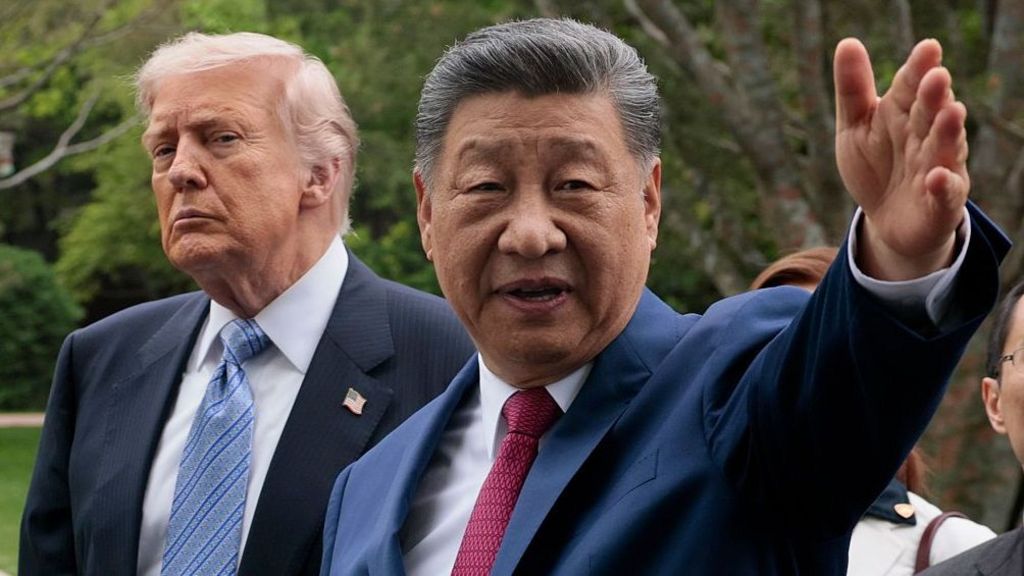
As the United States and China prepare for a high-stakes meeting between their respective leaders, few topics promise to shape the future of global technology as profoundly as the intensifying race for artificial intelligence supremacy. From investment strategies to regulatory frameworks, the two global AI powers have carved out distinct paths in their pursuit of leadership, with outcomes that will reverberate across every sector of the global economy.
U.S. President Donald Trump has left no ambiguity about his administration’s stance: the race for AI dominance is a zero-sum contest, and China is the clear primary competitor. “Whoever wins AI, WINS!” Trump has declared, dismissing warnings about existential risks posed by unregulated advanced AI development as nothing more than a “hoax.” While Chinese President Xi Jinping has not employed the same blunt rhetoric, analysts agree Beijing shares the view that AI is a core pillar of 21st century national power.
“China very much sees it as a race, they very much think China should be the leading force in AI – they see AI as a power maximiser,” explains Rebecca Arcesati, a China technology analyst at the Mercator Institute for China Studies. For more than a decade, AI has anchored Beijing’s long-term technological development strategy, regardless of how prominently it is featured in public remarks from top leadership.
In contrast to Washington’s framing of great power competition, China’s foreign ministry has pushed back against what it calls “narratives of threat” and zero-sum confrontation, arguing that collaborative global governance is the only way to ensure AI delivers benefits to all nations. Still, when Trump and Xi sit down for bilateral talks this week, AI will top the bilateral agenda, with implications for every region of the world.
Both nations indisputably lead global AI development, but measuring which holds an edge depends entirely on how success is defined. U.S. private firms currently dominate the development of frontier large language models: the top-performing systems on most independent industry benchmarks come from American companies including OpenAI, Google DeepMind, and Anthropic. That said, the gap is narrowing far faster than many analysts predicted a half-decade ago. Data from Stanford University researchers shows that in 2025, a model developed by Chinese AI startup DeepSeek briefly matched the performance of the world’s leading U.S. model, and as of March 2026, Anthropic’s top system held only a 2.7% performance lead over its closest Chinese competitor.
A large part of Washington’s current lead stems from the massive amounts of private capital flowing into leading AI labs, which are burning through billions of dollars to build the massive computing infrastructure required to train next-generation frontier models. The AI boom has also driven a U.S. stock market surge, with a significant share of recent U.S. economic expansion tied to the explosive growth and projected long-term profitability of leading AI companies – a key factor behind Trump’s framing of AI leadership as central to national success.
A major headwind for China’s AI sector has been sweeping U.S. export restrictions that ban American firms from selling the advanced cutting-edge microchips required for training large frontier models to Chinese entities. Despite these barriers, both nations continue to roll out new, more capable AI models at a pace of roughly one per month, and there remains no clear consensus on what “winning” the AI race would actually look like, or if a formal finish line even exists.
Unlike the U.S. focus on closed, proprietary frontier models, China’s AI industry has prioritized the development of open-weight models – systems that can be freely downloaded and modified by third-party developers, similar to open-source software. This approach has allowed Chinese AI firms to rapidly close the performance gap: independent benchmarks show China’s top open-weight models trail the leading U.S. proprietary systems by only a few months in performance. Standout models such as Moonshot AI’s Kimi K3 have gained popularity both inside China and among global developers, thanks to their near-frontier performance paired with free accessibility and customizability.
Lizzi Lee, a China analyst at the Asia Society Policy Institute, notes that Beijing’s core strategic focus is not on winning a symbolic race for the single most powerful model, but on widespread deployment of AI across the entire domestic economy. “AI isn’t the moon landing,” Lee argues. “The U.S. may lead at the frontier, while China could still gain enormous economic and geopolitical leverage by making capable AI cheap, open and ubiquitous.”
China also holds key structural advantages that are often overlooked in debates about model performance. AI training and deployment is extremely energy-intensive, and Chinese AI firms can access the large volumes of low-cost electricity required to run AI workloads far more cheaply than their U.S. competitors, Arcesati told the BBC World Service’s *Tech Life*. That cost advantage translates into sustained, long-term benefits for the country’s AI sector.
In AI-enabled robotics, a field many experts predict will transform global manufacturing and supply chains over the coming decade, China already holds a clear global lead. The International Federation of Robotics estimates that China is home to more than two million industrial robots, more than any other nation, making it the world’s largest robot manufacturer. Chatham House data adds that China also accounts for more than 90% of global humanoid robot shipments in the first half of 2026.
Analysts say Chinese AI developers have demonstrated remarkable innovation despite the constraints of U.S. chip export controls. “Chinese AI developers have showed ‘remarkable resilience and innovation’ in spite of the shortage of advanced American chips,” notes Lian Jye Su, a senior analyst at tech research firm Omdia. U.S. officials and industry leaders have alleged that some Chinese developers close the performance gap through model distillation, a technique that allows smaller models to learn from the output of more advanced proprietary platforms, a claim Beijing rejects. In response to such allegations, China’s foreign ministry says its AI development is driven by a vision of “extensive consultation and joint contribution for shared benefit.”
Beyond competing development strategies, the U.S. and China also hold starkly different approaches to AI safety and regulation. While leading AI voices in the West have warned that unregulated advanced AI could pose existential risks to humanity, Chinese researchers and policymakers have prioritized addressing other risks, including misuse of the technology and potential AI-enabled cyber conflict.
For his part, Trump has argued that the U.S. already has sufficient regulatory guardrails in place, joking that the only guardrail AI needs is a “high IQ” president. “We’re leading now over China by a lot, and everyone else, and we’re going to keep it that way,” Trump said in remarks ahead of the summit. “We’re not going to stifle the growth of something that will be bigger than the industrial revolution.” Jayant Dave, an information security officer at global cybersecurity firm Check Point Software Technologies, explains that Washington has deliberately prioritized innovation over strict regulation in order to preserve the U.S. lead over China.
Beijing has taken a markedly different, more centrally coordinated approach. Xi has repeatedly urged Chinese regulators to maintain close oversight of AI risks, requiring that the technology remain permanently under human control. Dave notes that China moved faster than most Western nations to introduce binding and non-binding guidance for data usage and algorithmic transparency, addressing many core public concerns early on. Jonathan Sim, an AI ethics lecturer at the National University of Singapore, adds that China’s framework of non-legally binding guidelines sets clear expectations for developers while still leaving room for iterative innovation.
Despite repeated calls for global cooperation on AI governance, there remains little shared understanding between the two powers about the nature of AI risks, making tangible progress on joint safety measures unlikely. The two nations successfully built cooperative frameworks to manage nuclear risks during the Cold War, but that cooperation relied on a shared understanding of the threat – a consensus that does not exist for AI today. Dave explains that “Washington worries about capability escaping control. Beijing worries about capability threatening domestic stability,” creating fundamentally different risk priorities.
Trump has already rejected calls from OpenAI CEO Sam Altman and other U.S. industry leaders for a coordinated global slowdown of advanced AI development, arguing that such a pause would only allow Chinese developers to close the performance gap. Still, there are small signs of incremental progress ahead of the summit: U.S. Treasury Secretary Scott Bessent and Chinese Vice Premier He Lifeng have already held preliminary talks to establish a bilateral notification mechanism for major, high-risk AI incidents.
Leia Wang, a policy analyst at the Carnegie Endowment for International Peace, notes that while Trump’s recent public rhetoric on China has grown more antagonistic, the fact that AI is formally on the summit agenda is a positive early step. Wang warns that allowing an unhealthy, all-or-nothing “race narrative” to escalate could deepen rivalry and increase the risk of miscalculation in one of the world’s most consequential technology sectors.