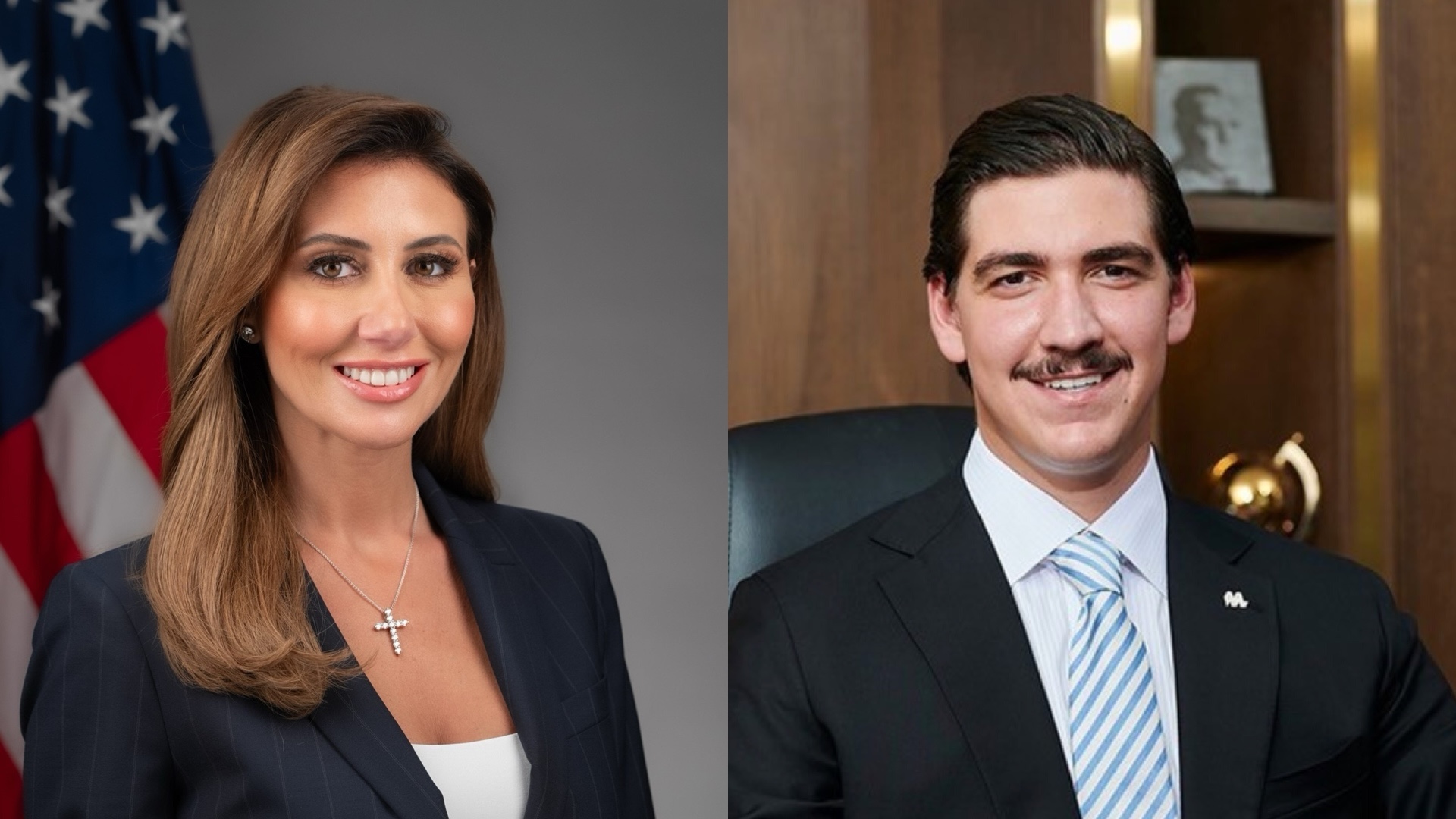
A high-profile upcoming marriage between one of former President Donald Trump’s closest legal advisors and a reclusive Turkish business leader is drawing widespread attention to overlapping global political connections and controversial commercial ventures stretching from central Africa to South America.
Alina Habba, the 42-year-old attorney who represented Trump in multiple high-stakes legal cases between 2021 and 2024, is scheduled to marry Turhan Mildon, the 29-year-old chief executive of Turkey-based family enterprise Miller Holding, later this week. Habba, who has long been considered a core member of Trump’s inner circle, was appointed by Trump as acting U.S. Attorney for the District of New Jersey in 2023, but a federal court later ruled the appointment unconstitutional, forcing her to step down in December that year. She has recently signaled openness to returning to a senior White House role if Trump returns to office, telling reporters last month she would accept the position of White House press secretary if asked to fill an expected upcoming vacancy.
Unlike his high-profile fiancée, Mildon has deliberately kept a low public profile for most of his career, rarely granting media interviews or making public appearances in his home country of Turkey. In a rare interview with Middle East Eye, he explained his choice to stay out of the spotlight, noting that his businesses do not sell directly to end consumers, making a public brand profile unnecessary. He also firmly pushed back against growing speculation that the upcoming marriage carries any hidden political agenda, stating plainly, “This marriage has no political motivation.”
According to Mildon, the pair were introduced several years ago by a mutual friend who serves as an ambassador based in the U.S., and the connection gradually developed into a romantic relationship. This will be Mildon’s second marriage: he was previously wed to Betul Gursoy, daughter of the late owner of the Gursoy Group, the construction firm that built Istanbul’s iconic Camlica Mosque, a major infrastructure project personally commissioned by Turkish President Recep Tayyip Erdogan. The pair divorced in late 2024. After his split from Gursoy, Mildon dated the daughter of Remigio Ceballos, a prominent Venezuelan admiral and long-time ally of former Venezuelan President Nicolas Maduro, who currently serves as Venezuela’s ambassador to China. Ceballos has held a series of senior roles in Venezuela, including interior minister, top military commander, and aide-de-camp to Maduro.
Mildon’s business empire spans multiple industries and has expanded far beyond Turkey’s borders over the past four years, anchored by major infrastructure projects in the Democratic Republic of Congo that began after a high-level introduction from Erdogan himself. Mildon told MEE that during Congolese President Felix Tshisekedi’s official state visit to Turkey, Erdogan personally connected him to the African leader, who subsequently invited him to Kinshasa in 2021, at a time when widespread political and economic instability left most international investors hesitant to enter the country. “People didn’t dare to invest in Congo, so we have taken certain risks,” he said.
Since entering the Congolese market, his construction and investment firm Milvest has secured roughly $1 billion in public and private contracts, and has expanded into the mining sector, bringing hundreds of millions of dollars in direct foreign investment to the country, per Mildon’s own account. Earlier this year, the firm won a $67 million contract to build an aerial infrastructure base in Kisangani, a project Mildon clarifies is limited to civilian construction of a runway, control tower, and aircraft hangars, with no involvement in defense operations. The project was completed several months ago, he added.
Not all of Milvest’s Congolese projects have proceeded without controversy. Two major contracts — the $400 million Kinshasa Financial Center, billed as the largest financial hub on the African continent, and the Arena, a planned indoor sports complex that will be the largest of its kind in Africa when complete — sparked public scrutiny in 2023 after local media reports accused former Congolese Finance Minister Nicolas Kazadi of mismanaging public funds allocated for the projects. Mildon says that as of yet, neither he nor his company have received any formal investigation or inquiry from the Congolese government, and he confirmed the financial center was completed on schedule in December 2023 after 21 months of construction. Kazadi has also denied any wrongdoing, arguing the combined $400 million price tag for both projects came in under initial cost estimates.
The Arena project has faced additional hurdles, after Congolese officials accused Milvest of improperly securing tax and import exemptions for construction materials. Mildon denies any wrongdoing, but says the dispute delayed construction by eight months and cost his company millions of dollars in avoidable losses. MEE attempted to reach Kazadi for additional comment on the controversies but did not receive a response before publication.
More recently, Mildon has expanded his business operations into the high-risk Venezuelan market, where he has navigated complex U.S. sanctions and local political disputes to launch a cement revival project through his firm Vancement. After visiting the country and being impressed by its people and landscape, Mildon says he followed legal advice to avoid sanctioned sectors including oil, rare minerals, and chemicals, and instead focused on reviving Venezuela’s idle state-owned cement factories. In 2023, Vancement reached a profit-sharing agreement with the Venezuelan government to restart 10 cement plants that were nationalized in the early 2000s and had been operating well below production capacity. The agreement was reached after lengthy negotiations with the state-owned cement firm Corporacion Socialista del Cemento and then-Industry Minister Alex Saab, a close Maduro ally, and Mildon says the structure of the deal allows his company to operate in Venezuela without triggering U.S. sanctions penalties.
The Venezuelan venture has also faced public pushback: local contractors have alleged Vancement has failed to pay hundreds of thousands of dollars in outstanding bills for work on the project, and Venezuelan legislative leaders have publicly criticized the company for sky-high retail cement prices that have strained working-class consumers. Mildon denies both sets of claims. He argues payment disputes stem from local business customs and misattribution of debt owed by third-party contractors, not any failure by Vancement to meet its financial obligations. On the topic of cement prices, he explains that Vancement sells each bag of cement to third-party resellers for just $3 to $5, but resellers mark up prices to between $20 and $37, for which his company bears no blame. He told MEE that Vancement has asked the Venezuelan government to create a regulatory task force to crack down on excessive resale markups, but no action has been taken to date.
As the couple prepares for their wedding this week, their union is expected to continue drawing scrutiny from political observers, who are watching for how the connection between a top Trump ally and a Turkish business leader with deep ties to Erdogan, Maduro, and Congolese government leaders could shape policy and commercial outcomes if Trump wins a second term in 2024.