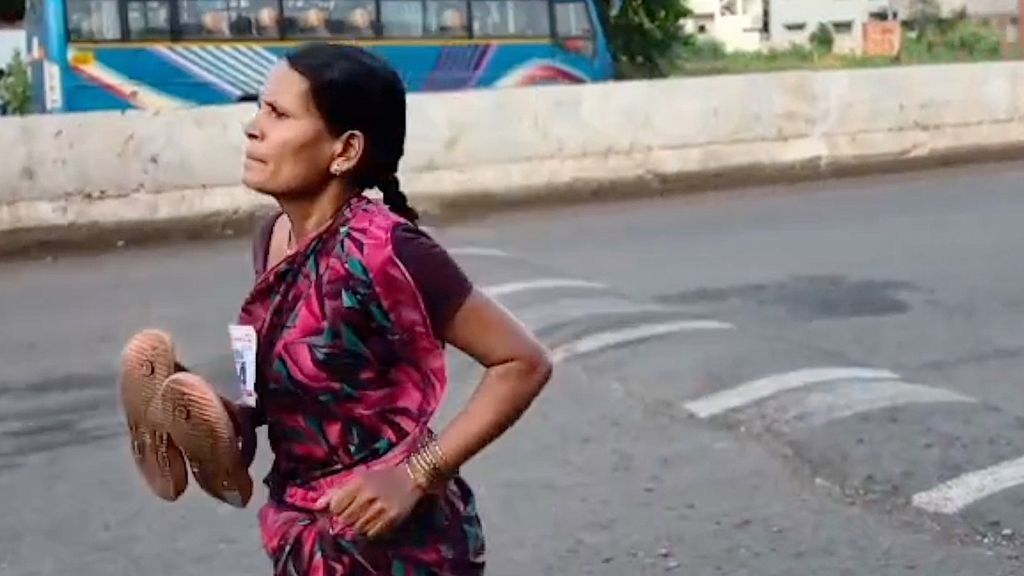
In August, a 47-year-old widow from Maharashtra, western India, achieved something extraordinary that captured the attention of millions across the country: Ramabai Ranveer won her first-ever 3km community sprint – and she did it barefoot, with no formal training and not even a pair of proper running shoes. Her story, which quickly went viral on social media and in national press, is far more than a simple tale of athletic victory; it lays bare the deeply personal sacrifices that millions of low-income Indian families make to secure an education for their children, while igniting a long-simmering debate about gaps in India’s public education support systems.
Ramabai’s motivation to enter the race grew out of quiet desperation. Since her husband’s passing in 2012, she has been the sole breadwinner for her family, taking on whatever casual manual labor she could find – from harvesting soybeans and chickpeas on local farms to processing and selling turmeric. Today, she works as a cook at a coaching center where one of her daughters prepares for a competitive police recruitment exam. She dropped out of school at age 13, and she has spent every year since determined to give her two daughters the educational opportunities that were denied to her.
The immediate catalyst for her race entry came when her younger daughter, Arati, who lives in Nanded, was unable to afford required textbooks. Ramabai could not scrape together the funds to help her, and the stress of that left the pair not speaking for eight days. When Ramabai’s elder daughter, Pooja, mentioned the local 3km run with cash prizes earmarked for education expenses, Ramabai made the split-second decision to compete. During the race, her flip-flops kept slipping off her feet, so she removed them entirely, gathered up her sari, and ran the rest of the way barefoot. She crossed the finish line first in the women’s 30-60 age category, taking home a 3,000-rupee prize (equivalent to roughly $31 USD or £23 GBP) that went directly to buying Arati’s books. Pooja also placed second in her own age group, but she has said her mother’s courage outshines any prize she won.
While the prize money covered the immediate cost of books, it barely makes a dent in the long-term expenses Ramabai faces. Both of her daughters are studying for competitive government recruitment exams – one for police service, the other for civil service – which are widely seen as the only path to stable, secure employment and social status in India. Preparing for these exams requires years of costly coaching classes and study materials, expenses that push many low-income families to the breaking point.
Videos of Ramabai’s barefoot run spread across Indian social media within days, striking a powerful chord at a moment when India’s education system is already facing intense public scrutiny. Millions of Indian families share Ramabai’s belief that education is the only way out of intergenerational poverty, but the system is plagued by growing frustration: repeated allegations of exam question paper leaks, administrative irregularities, and uneven access to affordable coaching and study materials have eroded public trust, sparking large student-led protests demanding systemic reform.
Public attention to Ramabai’s story has not only highlighted these broader systemic issues, it has also led to tangible support. Earlier this month, India’s Chief Justice Surya Kant ordered local authorities to provide Ramabai with one-time financial assistance of 50,000 rupees to cover her daughters’ educational expenses. But experts warn that one-off assistance cannot fix deeper structural gaps in government education outreach. Sukhadeo Thorat, former chairman of India’s University Grants Commission, argues that Ramabai’s struggle is a clear sign that existing government education support schemes are failing to reach the families that need them most. “Both the central and state governments run a variety of schemes. The problem is that implementation remains weak,” Thorat explained.
For Ramabai, however, the broader national debate is secondary. Her only priority remains ensuring her daughters never have to endure the same hardships she faced growing up and working to support her family. “I don’t want them to struggle through mud or travel under the scorching sun and rain,” she said. “Whatever I have suffered, I don’t want my daughters to suffer the same.”