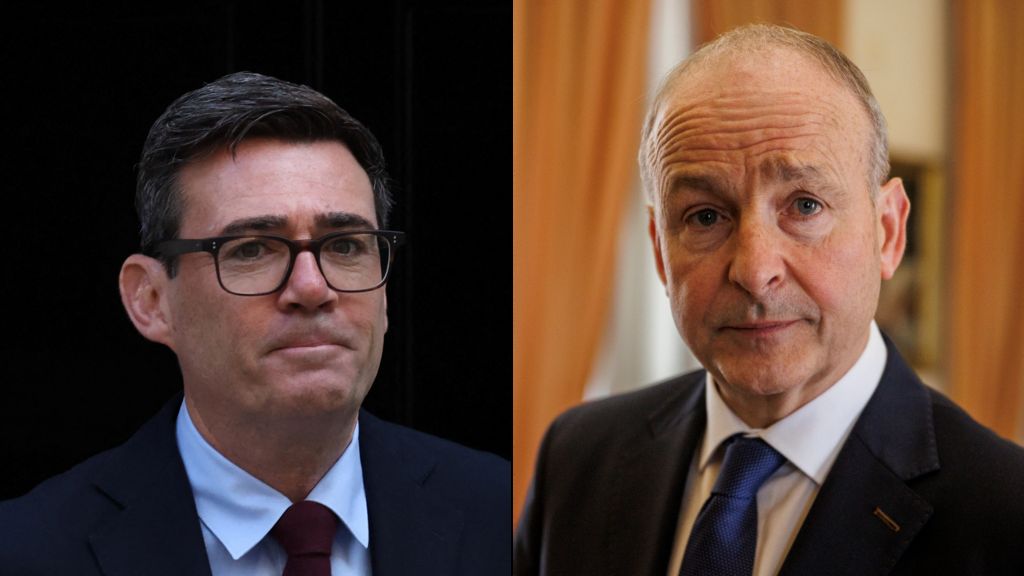
In a landmark moment for post-Brexit UK-Ireland relations, Irish Taoiseach Micheál Martin will become the first international leader to visit the UK’s newly established Number 10 North in Manchester on Friday, for his first official summit with British Prime Minister Andy Burnham.
The UK government confirmed the historic nature of the visit ahead of the scheduled talks, noting that the meeting will center on deepening collaborative ties between the two nations across trade, security, and joint engagement with the European Union. Following the closed-door summit, the two leaders will travel to a local Irish community hub in Greater Manchester to meet with representatives of the region’s large Irish diaspora.
In pre-summit remarks, Burnham expressed his enthusiasm for hosting Martin, framing the occasion as a milestone for both Manchester and the bilateral partnership. “Number 10 North exists to unlock new opportunities for working people across the UK, and our deep alliance with Ireland is core to that mission,” he said. “From our shared commitment to upholding the Good Friday Agreement to growing cross-border trade and collaborating with European partners to supporting Ukraine, we have an enormous shared agenda to advance. We are the closest of friends, and I am eager to build on that bond.”
The meeting comes amid heightened attention to Northern Ireland’s constitutional status, just days after former U.S. President Donald Trump made public comments expressing support for a unified Ireland. The topic has drawn renewed debate following controversial remarks Burnham made during his first visit to Northern Ireland last month, when he initially described a border poll on unification as “off the table.” Burnham later moved to clarify his position, reaffirming his full commitment to the terms of the 1998 Good Friday Agreement, the landmark peace deal that ended three decades of sectarian conflict known as the Troubles.
Martin outlined the full scope of the planned discussions in an official statement, noting that the agenda will include the UK-Ireland 2030 Strategic Cooperation Framework, ongoing reform of Northern Ireland’s Stormont devolved institutions, and progress on replacing the widely criticized Troubles Legacy Act. The two leaders will also turn to broader European and global issues, including Ireland’s ongoing presidency of the Council of the EU, preparations for the upcoming EU-UK Summit, and ongoing crises in Ukraine, Gaza and the wider Middle East.
Last week, Martin called for greater legal clarity around the conditions for triggering a border poll, arguing that leaving the decision solely to the discretion of the Northern Ireland Secretary is an unsatisfactory arrangement. Under the terms of the Good Friday Agreement, Northern Ireland remains part of the United Kingdom, and unification can only happen if a majority of voters in Northern Ireland support the change in a referendum. The agreement requires the Northern Ireland Secretary to call a poll if evidence suggests majority support for unification exists, but it provides no clear framework for how that assessment should be made, leaving the decision as an open-ended “judgement call.” Polls must also be held no more frequently than once every seven years.
Northern Ireland Secretary Sir Chris Bryant later clarified that the UK prime minister and the government “stand full square” behind all provisions of the Good Friday Agreement, including the legal right to a border poll. Speaking to BBC Radio Ulster’s *Borderland* podcast last week, Martin noted that Burnham had clearly affirmed his acceptance of the principle of consent, a core pillar of the 1998 deal. “Burnham made it very clear that he accepts that a referendum is permitted under the terms of the Good Friday Agreement,” Martin said. “It is true that the circumstances around triggering a poll were deliberately left ambiguous when the agreement was negotiated. There is no question we need to discuss this as part of a wider conversation between all parties, because all of us are co-guarantors of the peace. I also welcome his commitment to advancing legacy reform, and I share his view that the Stormont institutions need urgent reform.”
The 1998 Good Friday Agreement, also referred to as the Belfast Agreement, ended 30 years of sectarian violence that claimed more than 3,500 lives. It was approved by popular referendums in both Northern Ireland and the Republic of Ireland, and established a power-sharing devolved government for Northern Ireland that gives representation to both unionist, who support remaining part of the UK, and nationalist communities, who favor unification with the Republic of Ireland.