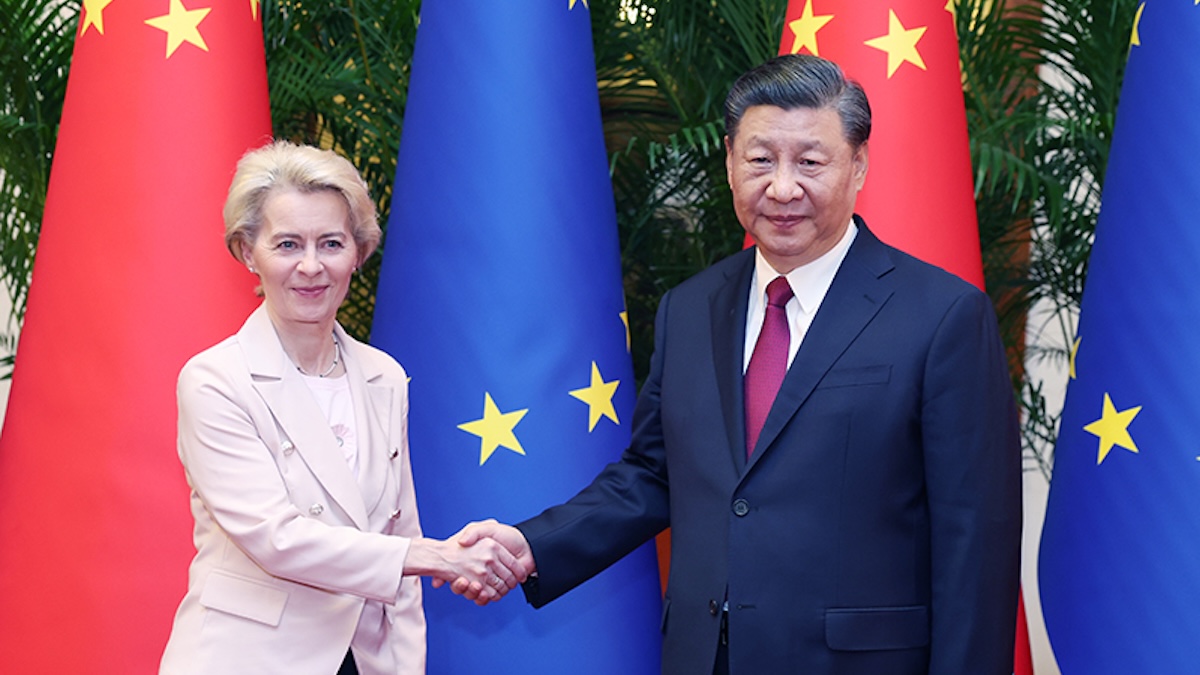
In her annual State of the Union address to the European Parliament last Wednesday, European Commission President Ursula von der Leyen sounded an urgent alarm over what she terms “China Shock 2.0”, arguing that rising Chinese high-value exports have already arrived and are threatening the bloc’s core industrial base, an outcome she calls unsustainable for European economies.
The original “China Shock” emerged after China’s 2001 accession to the World Trade Organization, when a flood of low-cost Chinese consumer goods including toys, textiles and basic electronics reshaped global supply chains and eroded Europe’s low-end manufacturing sectors. At the time, European economies adapted by shifting production up the value chain, focusing on higher-value goods and services to maintain competitive advantage. The new iteration of this trade dynamic, however, looks very different: today’s Chinese exports are concentrated in high-value sectors including electric vehicles, industrial machinery, chemicals and power generation equipment, meaning Chinese manufacturing has now closed the competitive gap that let Europe escape the first shock, leaving few untapped higher-value segments for European firms to retreat into.
Compounding this shift is the legacy of U.S. trade policy: tariffs imposed by the Trump administration on Chinese goods have reduced Chinese access to the American market, pushing the bulk of China’s export surplus toward the European Union, the world’s largest remaining open large economy. Von der Leyen emphasized that the EU’s daily trade deficit with China now hits 1 billion euros (US$1.15 billion), a level that has crossed a clear tipping point. “Some say the second China shock is looming, but it’s already here,” she said. “It shows in our communities and in factories across our Union. It leads to deindustrialization in the industrial heartlands of Europe. This is unsustainable.” She added that Brussels would deploy every policy tool at its disposal to rebalance the bilateral trade relationship, noting that “Words are good. But deeds are better.”
Von der Leyen also highlighted another key point of economic vulnerability: the bloc’s heavy reliance on Chinese critical raw materials, with China supplying more than 80% of the EU’s needs for many key inputs, and 90% of some rare earth minerals critical for clean energy and defense technology. To address this dependence, she announced the creation of a new European Critical Raw Materials Corporation to help the bloc build stockpiles of materials needed for electric vehicles, semiconductors, batteries and defense systems.
Just days before von der Leyen’s address, on September 9, the European Commission proposed an updated Public Procurement Act that would grant public authorities the power to reject bids for major infrastructure and service contracts if less than 50% of the contract’s total value originates within the EU. The proposed rules, which would govern the EU’s 2.5 trillion euro annual public procurement market covering national agencies, schools and hospitals, still require formal approval from the European Parliament and all EU member states to take effect. Industry groups including the International Road Transport Union and European Metropolitan Transport Authorities have already called for targeted adjustments to the draft rules, asking for grace periods for already purchased electric buses, aligned exemption frameworks and protections for operators from unexpected costs caused by manufacturer delivery delays.
In response to von der Leyen’s remarks, China’s Ministry of Commerce reaffirmed Beijing’s consistent stance on Thursday, emphasizing that China rejects confrontational “microphone diplomacy” and has no interest in escalating rhetorical disputes. Ministry spokesperson He Yadong said Beijing favors open communication and pragmatic problem-solving to address bilateral trade frictions.
The same day, EU Trade Commissioner Maroš Šefčovič held a virtual call with Chinese Commerce Minister Wang Wentao to discuss reciprocal market access and ongoing Chinese export controls on rare earth minerals. Šefčovič is scheduled to travel to Beijing on October 8 and 9 to co-chair the second session of the EU-China Trade and Investment Council, with the European Commission stating it hopes the visit will deliver tangible, credible progress on outstanding trade issues. EU member states will also debate the growing trade imbalance at the upcoming European Council summit scheduled for October 15-16, with the timeline made urgent by shifting U.S.-China trade dynamics: the one-year U.S.-China trade truce is set to expire on November 10, just one week after the U.S. November 3 midterm elections that could reshape Washington’s trade approach. U.S. President Donald Trump and Chinese President Xi Jinping are also set to meet in Washington on September 24, with prior media reports indicating Washington may announce an additional 7.5% tariff on Chinese goods tied to industrial overcapacity ahead of the summit, pushing the average U.S. duty on Chinese imports to roughly 20%.
Recent data underscores the scale of the EU’s growing trade imbalance with China. Eurostat reported in April that the EU’s full-year 2025 trade deficit with China widened to a record 359.8 billion euros, with EU exports to China falling 6.5% to 199.6 billion euros while Chinese imports to the EU rose 6.4% to 559.4 billion euros. The growing deficit has already split EU member states to some degree: in late May, a France-led coalition of five countries including Italy, Spain, the Netherlands and Lithuania called on Brussels to expand the use of anti-dumping and anti-subsidy investigations against Chinese imports in steel, automotive and clean technology sectors. Since that call, Brussels has moved toward drafting collective policy responses to the perceived trade challenge.
Beijing has pushed back hard against the “China Shock 2.0” framing, with Chinese officials arguing that growing Chinese industrial competitiveness should be recognized as a global opportunity rather than a threat. In a late July media briefing, Chinese Vice Minister of Commerce Yan Dong argued that the dynamic should be renamed “China Opportunity 2.0”, outlining four core arguments for this re-framing. First, China’s robust manufacturing base acts as a global anchor for supply chains, offsetting product shortages caused by rising protectionism and geopolitical conflict; between 2012 and 2024, China’s textile machinery exports topped $30 billion, helping Southeast and South Asian nations develop into major global manufacturing hubs. Second, China accelerates global technological innovation by rapidly scaling new technologies into affordable mass-market products, with its open-source AI models recording more than 10 billion downloads globally, expanding access to cutting-edge technology for developing nations. Third, China’s booming green manufacturing sector has driven dramatic global cost reductions for clean energy: data from the International Renewable Energy Agency shows that Chinese production has cut global costs for wind and solar power by between 60% and 80% over the past decade, with China’s green industry projected to exceed 20 trillion yuan (US$2.98 trillion) in size by 2030. Finally, China’s high-volume, low-cost industrial output has helped reduce living costs and curb global inflation, a benefit visible this summer in the strong sales of affordable Chinese-made air conditioners across Europe amid record heatwaves.
Chinese analysts note that Beijing holds a range of policy leverage if the EU moves forward with new restrictive trade measures, including potential adjustments to rare earth export policy, tariffs on European agricultural goods, luxury products and high-end industrial equipment, and restrictions on European service providers operating in the Chinese market. Many Chinese observers argue that full decoupling from China is simply not feasible for the EU. As a columnist for Chinese state-affiliated outlet Huanqiu.com put it, “Europe needs the Chinese market to absorb its high-end equipment, luxury goods and professional services, and needs a stable supply of critical raw materials, while China needs Europe’s technical standards, brand channels and regulatory experience.” The columnist added that framing China as a political scapegoat for Europe’s industrial challenges would only raise costs for European businesses and consumers, and that EU leaders should instead prioritize pragmatic engagement through existing bilateral communication channels.
Other Chinese analysts point out that the EU does not have fully unified trade interests when it comes to China: Southern European states like France and Italy favor stronger industrial protectionist measures to shield domestic manufacturers, while Northern European countries including Germany, which maintain deep economic ties with China, fear retaliation against their own firms that rely on access to the large Chinese market. As Guizhou-based analyst Sima noted, China is both a competitor and a critical export market for the bloc, meaning internal divisions will shape any unified EU policy. If the EU proceeds with new tariffs or market access restrictions, Sima noted, China has a range of potential response tools including trade remedies, export controls, an unreliable entity list, counter-sanctions and adjusted government procurement rules, and any retaliation would hit individual EU member states unevenly, exacerbating internal divisions. Sima added that Beijing will not sacrifice its core development rights in upcoming negotiations, and called on the EU to improve the competitiveness of its own domestic products and relax its own high-tech export restrictions to China as a more productive path to narrowing the bilateral trade deficit.