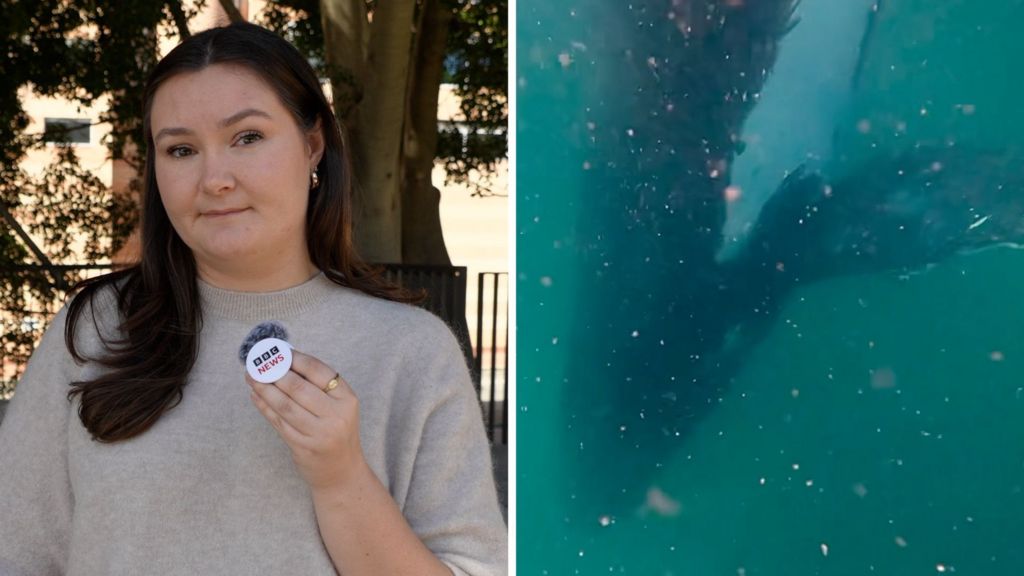
For decades, behavioral scientists have debated whether non-human animals are capable of experiencing complex, human-like emotions such as grief. Now, newly uncovered rare footage collected by marine researchers off Australia’s Gold Coast has added fresh fuel to this long-running conversation, offering compelling visual evidence that humpback whale mothers may mourn the loss of their calves.
The never-before-seen footage, collected during a recent marine research expedition, captured a humpback whale mother remaining closely alongside her deceased calf for an extended period. Rather than abandoning the body and continuing her migration as is typical for the species after a calf’s death, the mother was observed staying within meters of the calf’s body, slow swimming and repeatedly nudging the calf, behaviors researchers interpret as potential signs of mourning.
Humpback whales are known for their high levels of social organization, complex communication systems, and large brain structures that support advanced cognitive function, traits that have led many biologists to hypothesize that they possess a capacity for deep emotional experience. Prior anecdotal observations across multiple whale species have recorded similar lingering behavior around dead offspring, but this new, high-quality footage from the Gold Coast offers one of the clearest recorded examples of this behavior to date.
Marine biologists studying the footage note that while definitive proof of grief remains impossible to confirm without direct access to the animal’s internal experience, the consistent pattern of the mother’s abnormal behavior following her calf’s death strongly suggests an emotional response. This discovery not only deepens scientific understanding of cetacean cognition but also raises new questions about animal consciousness and the ethical responsibilities humans have to protect whale populations around the world.