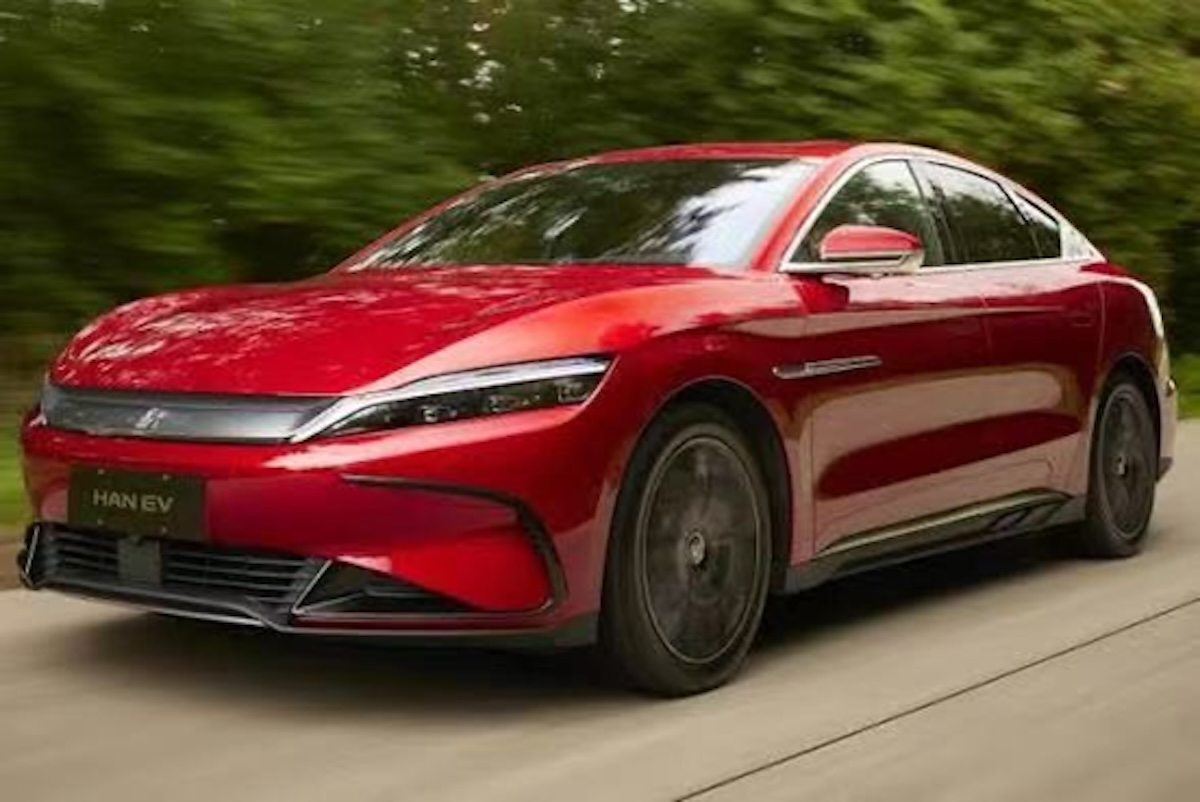
Four years have passed since 2022, when a first-hand observer moving from Hong Kong to Beijing first encountered a deep crimson BYD Han electric sedan, impressed by its generous dimensions, comparable performance to Tesla’s Model 3, and competitive pricing that undercut the Tesla by 10% and fell 22% short of equivalent U.S. market tags. Today, that 2022 BYD Han already reads as a dated, budget-oriented commuter vehicle – a stark marker of how rapidly China’s electric vehicle sector has evolved.
This period of rapid transformation mirrors another turning point in late 2022: just days before China lifted its strict zero-COVID public health measures, little-known U.S. startup OpenAI launched ChatGPT to the world, beating more conservative research teams at Google DeepMind to market and igniting a global arms race in large language models (LLMs). For years after that launch, the LLM space became a back-and-forth competition where OpenAI, Anthropic, and Google repeatedly one-upped each other, with smaller players like xAI trailing and Meta stumbling through multiple failed releases.
Today in 2026, BYD has pushed aggressively into the premium luxury sedan market long dominated by German legacy brands. The new 2026 BYD Seal 08 is significantly larger than the 2022 Han, with game-changing upgrades across every core specification: from battery capacity and horsepower to self-driving systems, air suspension, and rear-wheel steering. The even larger flagship DaHan (Great Han) has moved into the full-size D-segment, a category historically occupied by the Mercedes S-Class, BMW 7 Series, and Audi A8. Even more striking than the technical upgrades is the pricing: the top-trim Seal 08 retails for $35,500, a 25% discount to the 2022 Han’s top trim, while entry and mid-level trims cost 10-15% less at $29,300 to $32,300. The fully loaded D-segment DaHan is priced identically to the 2022 top-trim Han, at just $44,700. For comparison, equivalent premium EV sedans from BMW, Mercedes, and Audi cost three to four times as much in the U.S. market while delivering broadly inferior specs and performance.
This pricing gap has drawn open criticism from U.S. officials: in a September 2 speech at the Charlotte Economics Club, Treasury Secretary Scott Bessent complained that BYD vehicles are “the best $70,000 car $35,000 can buy – it is heavily subsidized.” A similar observation came from *The New York Times*, which tested a top-trim Geely M9 crossover in early 2026 and noted the $35,000 China-market price is less than half what a comparable vehicle from a U.S. showroom brand costs.
But claims that unfair subsidies explain BYD’s price advantage do not hold up to scrutiny. Analysis from the Center for Strategic and International Studies (CSIS) shows 79.4% of China’s EV subsidies go directly to consumer purchase incentives such as tax exemptions and government rebates, and historically, per-vehicle EV subsidies in China have been substantially lower than those offered by the U.S. and EU. The key difference is outcome: China’s policy framework has driven 49 million cumulative EV sales since 2009, compared to just 8 million in the U.S. and 12 million in the EU. China’s success stems not from excessive spending, but from aligning industrial policy with the maturation of its higher education pipeline: the country’s EV industry draws from a talent pool of nearly seven times as many new engineering graduates as the U.S. In just a few years, China launched more than 100 EV manufacturers and flooded the global market with over 300 distinct EV models, while the U.S., EU, Japan, and South Korea combined have struggled to field just a few dozen offerings. Even accounting for 2026’s average per-vehicle subsidy of just over $2,000 and 30% renminbi appreciation, the gap in production costs and pricing cannot be explained by government support alone.
The pace of improvement in China’s EV sector is unprecedented: since 2022, domestic manufacturers have delivered annual hedonic (quality-adjusted) improvement of 20% per year. Over four years, this means new Chinese EVs have more than doubled in effective quality: a 2026 EV with 2022-level specifications would cost less than half the 2022 price today, while a 2026-spec vehicle would have commanded more than twice the 2022 price four years ago. This rate of progress is almost unheard of in Western markets. The 2026 Tesla Model 3 is nearly identical to the 2022 version in core specs; while Tesla’s Autopilot has improved, Chinese self-driving systems have advanced even faster, and most include full self-driving capabilities in the base price, unlike Tesla’s paid subscription model. Even with a 7% price cut for the top-trim Model 3, Tesla has not kept pace. Honda’s 2026 Pilot is marketed as a new generation, with minor cosmetic changes and marginal gains in size and power, but no substantive improvements to core features or technology – yet the automaker raised prices by 9%.
This pattern of rapid hedonic improvement is not limited to automobiles: it can be seen across nearly all consumer and industrial sectors in China, from budget luxury travel accommodations to a nationwide wave of investment in restaurant design that has brought high-end aesthetic experiences to mid-range dining.
Parallel to China’s progress in physical manufacturing, the global AI industry has raced ahead, with OpenAI most recently launching its new Astra platform in September 2026. Just three days after Astra’s debut, OpenAI announced that an unreleased internal AI model had produced a solution to the century-old Navier-Stokes problem, sending the AI community into a frenzy over recursive self-improvement (RSI) and triggering existential anxiety that echoes the shock that hit chess and Go communities after AI defeated top human grandmasters. For practicing mechanical engineers, however, the fanfare is underwhelming: the Navier-Stokes equation has long been used as a simplified working model for fluid dynamics, and useful numerical simulations have been generated by commercial engineering software such as Ansys and OpenFOAM for decades. The mathematician-approved solution produced by OpenAI has no practical application in real-world engineering: real fluid behavior depends on hundreds of unaccounted-for variables, not the simplified framework used by mathematicians, and the solution would not improve the efficiency of a single airplane or the stealth of a single submarine.
This gap between AI hype and real-world impact frames a larger global divide. U.S. frontier AI labs have dominated headlines and led development of cutting-edge LLMs over the past four years, but that leadership has not helped U.S. legacy automakers like Ford and General Motors close the gap with Chinese competitors such as BYD and Geely – a gap that has only widened in recent years. So far, the complexity of the physical world has humbled frontier AI efforts: while labs have rushed to integrate physics, chemistry, engineering, and biology capabilities into LLMs, these advances have yet to deliver measurable gains in real-world applied science. Meanwhile, Chinese universities have expanded their lead in the Nature Index, and Chinese industries outcompete global rivals even when relying on lower-cost open-source LLMs.
To clarify the current state of AI development, a team of researchers from leading Chinese institutions including Tsinghua University, Bytedance, and Xiaohonghua outlined a five-stage framework for recursive self-improvement, the hypothetical process through which AI can improve itself without human intervention. At the lowest L1 stage, humans design the entire improvement pipeline, and AI only executes pre-defined steps. L2 sees AI autonomously select which components to improve, while humans still set core objectives and evaluation rules. At L3, AI identifies its own weaknesses and designs its own training curriculum to address gaps. L4 adds autonomous real-world feedback collection and self-updating during live deployment, without human curation. The highest L5 stage, full meta-improvement where AI can rewrite its own improvement algorithm, has not yet been achieved.
The researchers note that the biggest barrier to advancing RSI is the slow iteration speed required for physical science and engineering. Prototyping and testing new car parts, running clinical trials, and validating real-world systems take far longer than testing new AI code. Because of this “stopping power of the physical world,” all applied work in physical sciences and engineering remains stuck between L1 and L2. Even self-driving cars, one of the most high-profile AI applications, illustrate this limit: while geofenced level 4 robotaxi pilot programs operate in cities across China, the U.S., and the Middle East, consumer vehicles for general use still rarely advance beyond level 2, requiring constant human vigilance for most driving scenarios outside limited highway stretches.
This is not to dismiss the impressive achievements of modern LLMs, nor to downplay legitimate concerns about rogue AI and cyber warfare. But as the author, a former mechanical engineer, argues, AI researchers fixated on artificial general intelligence (AGI) often underestimate how much of economic and technological progress depends on work in the physical domain. For those caught up in AGI hype, the remedy is simple: step outside, engage with tangible physical work, and then return to recognize that real industrial progress depends on far more than breakthroughs in digital AI.