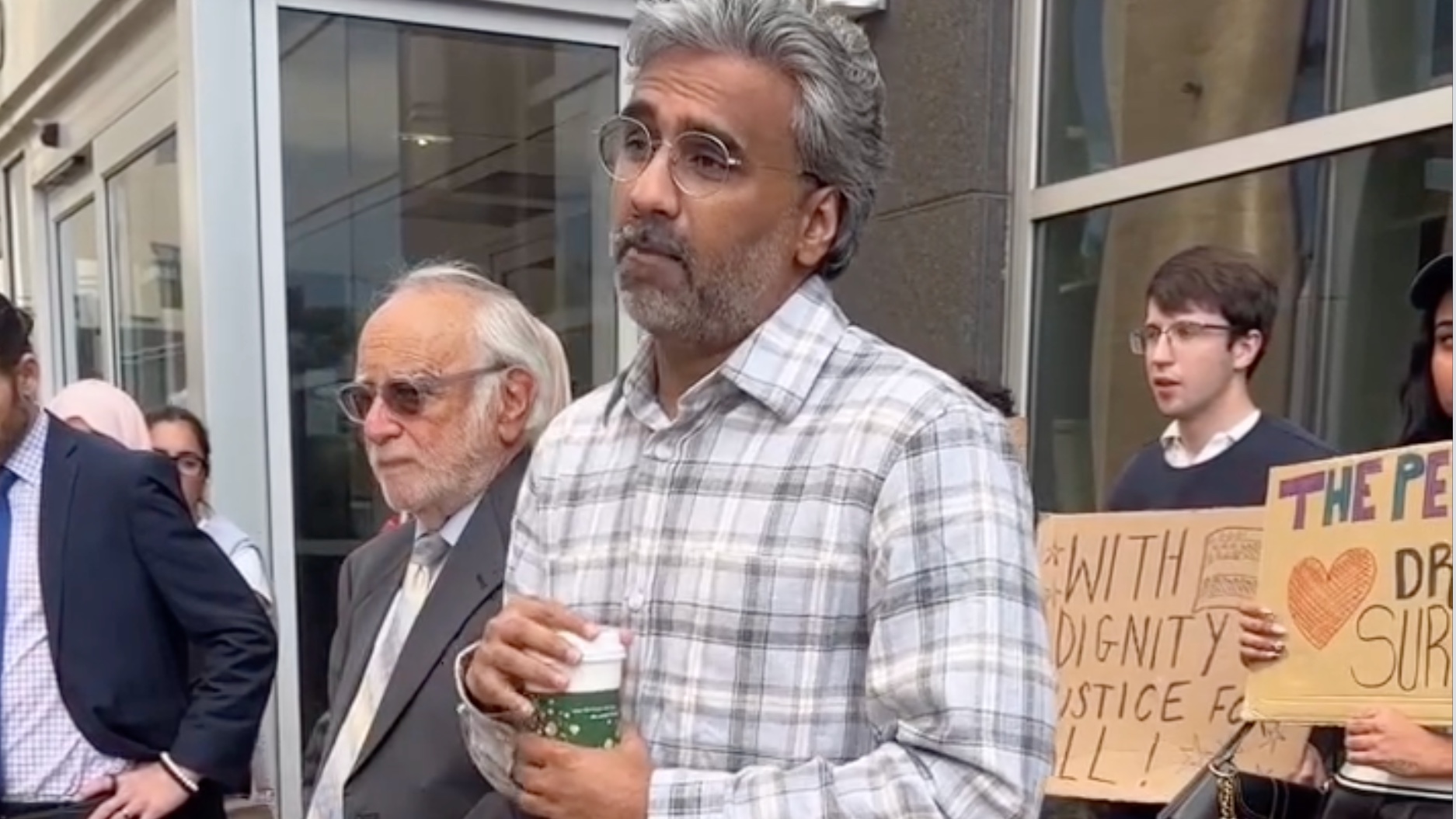
On a Tuesday hearing in a Virginia immigration court, Georgetown University scholar Badar Khan Suri delivered a sharp rebuke of the Trump administration’s legal arguments to justify his deportation, calling the government’s claims baseless, shallow, and rooted in political opportunism rather than factual evidence.
Suri, a legal permanent U.S. resident and Indian citizen married to a U.S.-born woman from Gaza, first became a high-profile target of U.S. Immigration and Customs Enforcement (ICE) 18 months ago, shortly after he publicly expressed support for Palestinian rights. What began as a routine immigration matter has since erupted into a global flashpoint over the weaponization of U.S. deportation policy to silence dissenting political speech.
Speaking to reporters outside the Annandale courthouse following Tuesday’s proceedings, Suri pushed back against the administration’s unsubstantiated claims labeling him antisemitic. ‘The government’s argument is very specious. It’s very shallow. They want to talk about something, but it has no roots,’ he said. ‘They are saying that I’m antisemite, I’m anti this or that, but they’re just saying it for the sake of some political agenda.’ Suri also highlighted that dozens of his Jewish supporters attended the hearing to stand with him, noting they reject the government’s effort to weaponize their religious identity for political gain.
Nader Hashemi, director of Georgetown’s Alwaleed Center for Muslim-Christian Understanding where Suri conducts post-doctoral research, framed the case as a clear example of the Trump White House’s deeply entrenched anti-Palestinian policy orientation. Hashemi, who was present in the courtroom for Tuesday’s arguments, told Middle East Eye that Suri would never have been targeted for deportation without pressure from extreme right-wing backers of Israeli Prime Minister Benjamin Netanyahu. He added that Suri himself is not the ultimate target of the administration’s action: because Suri’s wife, a Gaza native, is a U.S. citizen and cannot be legally targeted for political retaliation, officials have opted to harass her by going after her husband instead.
Records of the case lay out how outside pro-Israel groups laid the groundwork for Suri’s arrest. In late February 2025, the conservative pro-Israel organization Middle East Forum (MEF) announced it had uncovered that Suri’s wife, Saleh, is the daughter of Ahmed Yousef, a former senior political advisor to the late former Hamas leader Ismail Haniyeh – who has publicly criticized Hamas’s October 7, 2023 attack on southern Israel. Saleh was later added to the pro-Israel blacklist site Canary Mission, which cited her past work for Al Jazeera and Gaza City birthplace as evidence of purported Hamas ties. Just hours after news of Suri’s pending detention broke, MEF publicly took credit for pushing for his arrest.
On March 17, 2025, masked federal agents took Suri into custody outside his Washington, D.C. suburban home. U.S. Secretary of State Marco Rubio personally ordered the revocation of Suri’s visa, officially citing claims that the scholar had ‘spread Hamas propaganda and promoted antisemitism on social media.’ For two months following his arrest, Suri was held in an overcrowded, unsanitary ICE detention facility in Alvaredo, Texas, before a federal judge ordered his release on May 14, 2025, allowing him to return to his family in Virginia while his legal challenge proceeded.
The American Civil Liberties Union (ACLU), which is representing Suri in his legal fight, has previously outlined that the administration’s legal argument relies on a rarely invoked provision of the U.S. Immigration and Nationality Act. The provision allows deportation when the government claims an individual’s presence ‘compromises a compelling foreign policy interest’ – a standard that legal advocates say is being abused to target political dissent. In July, the U.S. Fourth Circuit Court of Appeals rejected the Trump administration’s bid to re-detain Suri, upholding the lower court’s ruling that granted him bail while his case moves forward.
Today, Suri is pursuing two parallel legal battles: a federal habeas corpus case defending his due process rights, and a separate immigration hearing overseen by an immigration court under the Department of Justice, which answers directly to the U.S. Attorney General. Habeas corpus, a legal principle dating back to 13th-century England, was created to prevent arbitrary detention by state authorities and today applies to all people on U.S. territory, regardless of citizenship status.
Suri, who has spent 20 years working to advance Middle East peace initiatives, says he remains prepared for the fight ahead and confident that justice will ultimately win out. ‘I know this is a tough thing. So I am ready for these challenges, and I am very hopeful that justice will prevail,’ he said.
Hashemi also expressed cautious optimism following Tuesday’s hearing, pointing to widespread public outrage over the Trump administration’s abuse of executive power in the case. ‘I’m feeling confident that there’s a lot of public outrage over the abuse of power that the Trump administration has engaged in, and this has drawn the ire of a lot of concerned American citizens,’ he said. ‘It’s not just about the rights of one post-doctoral fellow in Georgetown. His case now is about the future of democracy in the United States.’
As of Tuesday, the presiding immigration judge was expected to issue a ruling in the case as early as Tuesday evening local time.