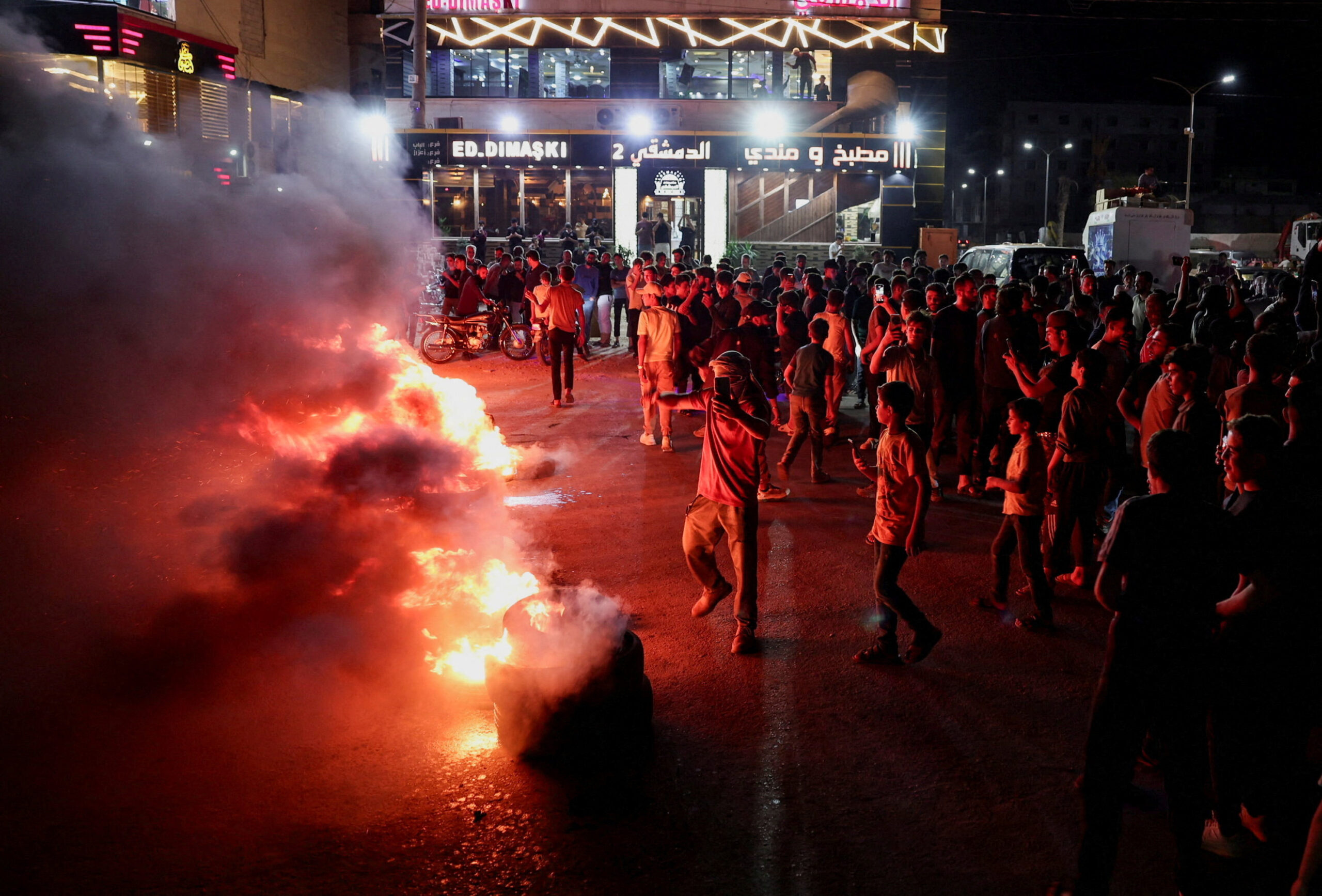
Widespread public demonstrations have broken out across multiple regions of Syria after the government implemented sharp, emergency increases to domestic fuel prices, with demonstrators blocking critical transportation arteries, setting tires ablaze, and demanding the immediate resignation of the country’s energy minister amid growing public fury over skyrocketing living costs. As of mid-September 2026, protests have been documented in major urban centers and rural areas including Idlib, Hama, Raqqa, Deir al-Zor, Hasakah, and the town of Khan Sheikhoun, with protesters blocking oil tanker access in multiple border and countryside locations.
The price adjustments were formalized by Syria’s Permanent Committee for Pricing Petroleum Products and Mineral Resources in a new temporary price order, which took effect at midnight on Sunday of this week. Under the new framework, 95-octane gasoline now retails at 195 Syrian pounds (approximately $1.60) per liter, while 90-octane gasoline costs 185 Syrian pounds ($1.52) per liter – marking a 28% jump from pre-hike rates. Diesel saw an even steeper proportional increase, climbing 40% from 125 Syrian pounds per liter to 175 Syrian pounds per liter.
One of the most high-profile disruptions occurred on the M5 international highway, the critical trade and travel route connecting Aleppo and Damascus, where footage shows protesters blocking the road for several hours, burning debris, and chanting for the government to reverse the unpopular price decision.
In an official public statement, Energy Minister Mohammed al-Bashir defended the price increase, attributing the move to a perfect storm of persistent international market volatility and crippling domestic supply chain constraints. Minister al-Bashir explained that Syria has a total national demand of roughly 300,000 barrels of crude oil and refined petroleum products per day, but domestic production only meets about one-third of that need, at approximately 100,000 barrels daily. As a result, the country is heavily dependent on imported fuel, with imports covering roughly 60% of the nation’s daily diesel consumption.
Syria’s reliance on foreign fuel has become far costlier in recent weeks amid ongoing geopolitical tensions between the United States and Iran, which have disrupted global energy supply chains and key international shipping lanes including Bab al-Mandab, the Red Sea, and the Gulf of Aden. Global crude oil prices have climbed above $100 per barrel amid continued shipping disruptions near the Strait of Hormuz, and repeated attacks on regional energy infrastructure and commercial vessels have amplified widespread concerns over fuel security across the Middle East.
Breaking down national diesel consumption, the Ministry of Energy reports Syria uses roughly 7.72 million liters of diesel per day: 4.63 million liters are imported, while only 3.09 million liters are produced domestically. Compounding domestic production shortfalls, much of the crude extracted within Syria is heavy crude, which is incompatible with the processing specifications of the country’s existing domestic refineries, further limiting the nation’s ability to replace imported fuel with local supplies.
Officials emphasized the price hike is a temporary emergency measure, and that rates will be re-evaluated regularly as global market conditions shift. They added that the current deficit has been worsened by scheduled ongoing maintenance at Baniyas Refinery, Syria’s largest fuel processing facility, which is expected to continue for approximately two months. Once the maintenance overhaul is completed, the refinery is projected to boost the country’s total domestic refining capacity, reducing long-term reliance on imports.
The widespread public unrest has pushed Syria’s national legislative body, the People’s Assembly, to summon Minister al-Bashir for a formal public hearing to answer questions about the fuel price decision. The hearing, requested by the chair of the Assembly’s Energy Committee, was approved under Article 30 of Syria’s constitutional declaration and Article 168 of the legislature’s internal rules. According to Syrian state outlet al-Ikhbariya, the hearing is scheduled for noon Thursday at the People’s Assembly headquarters in Damascus, where lawmaker will seek full clarification on the justifications for the increase and the policy considerations that shaped the government’s decision.