Four and a half years after Russia launched its full-scale invasion of Ukraine, the eastern European nation faces what a top United Nations official is calling its most challenging winter since the war began. With temperatures forecast to drop as low as minus 20 degrees Celsius, the country is in a desperate race against the clock to repair and reinforce its damaged power network before cold weather sets in, as renewed and intensifying cross-border airstrikes continue to target critical civilian infrastructure on both sides.
Alexander De Croo, head of the UN Development Programme and the UN’s third highest-ranking official, issued a stark warning during an on-the-ground interview with the BBC from Ukraine. He accused Russian forces of systematically targeting Ukraine’s energy and civilian infrastructure, a pattern of attack that he says puts millions of Ukrainian civilians at risk of a full-scale humanitarian catastrophe this winter. “This winter is going to be the toughest one since the war,” De Croo stated, adding that Ukraine enters the cold season from an already critically weak position. The former Belgian prime minister emphasized that there is no possible justification for the deliberate targeting of civilian sites, which have included not just energy transmission lines and power facilities, but also petrol stations, shopping malls, and commercial business centers.
De Croo’s warning comes amid a sharp escalation in aerial attacks from both Moscow and Kyiv that resumed just days after former U.S. President Donald Trump held diplomatic talks with leadership in both Russia and Ukraine. In recent weeks, Russia has ramped up its use of faster, harder-to-intercept jet-powered drones in near-continuous strikes across Ukraine, with the capital Kyiv facing particularly intense bombardment. On the Ukrainian side, Kyiv has launched repeated drone strikes deep into Russian territory, with most targeting oil and gas distribution facilities and commercial infrastructure.
Both sides have repeatedly denied intentionally targeting civilian populations and non-military infrastructure, despite mounting civilian casualties from the latest wave of attacks. Just this week, Ukrainian officials confirmed that five people were killed and another 67 wounded in a daytime Russian drone strike on a shopping mall in Pavlohrad, located in Ukraine’s Dnipropetrovsk region. Earlier in the same week, two separate Russian air strikes targeting shopping malls in Zaporizhzhia and Sumy left two people dead and 28 others injured. Additionally, two people were killed when Russian drones struck a border crossing between Ukraine and Moldova, a neutral country that has increasingly found itself pulled into the crossfire of the ongoing conflict.
Russia has also reported casualties from Ukrainian attacks this week. Overnight Wednesday, Russian officials said a Ukrainian seaborne drone strike on the Black Sea resort city of Sochi left 28 people wounded. Moscow also blamed three additional civilian deaths on Ukrainian attacks across border regions this week.
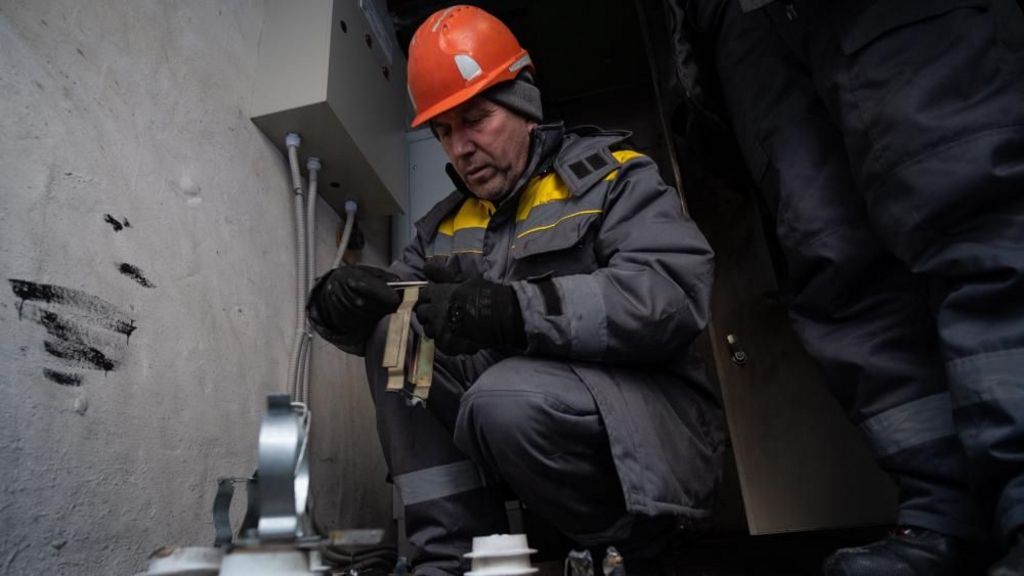
Against this backdrop of escalating violence, the United Nations Development Programme is leading international efforts to help Ukraine prepare for the harsh winter. Work is already underway to repair energy infrastructure damaged during last winter’s attacks, while the UN is also supporting the development of more decentralized, sustainable energy facilities that are less vulnerable to targeted airstrikes. Still, De Croo described the massive reconstruction effort as an almost impossible task, given the constant threat of new airstrikes that force workers to halt operations repeatedly during air raid alerts. “They are reconstructing these sites under constant, constant air alarms. And they know that they are working at a site which is a target,” De Croo said. “So you try to reconstruct, but part of your day you can’t work because it’s just too dangerous.”
In the worst-case scenario, widespread damage to Ukraine’s energy network would leave millions without access to heating during the deepest cold, and could knock out water and sewage systems across large parts of the country. De Croo warned that this level of disruption would create conditions that amount to a humanitarian catastrophe, with widespread human suffering that would extend across Ukrainian society.