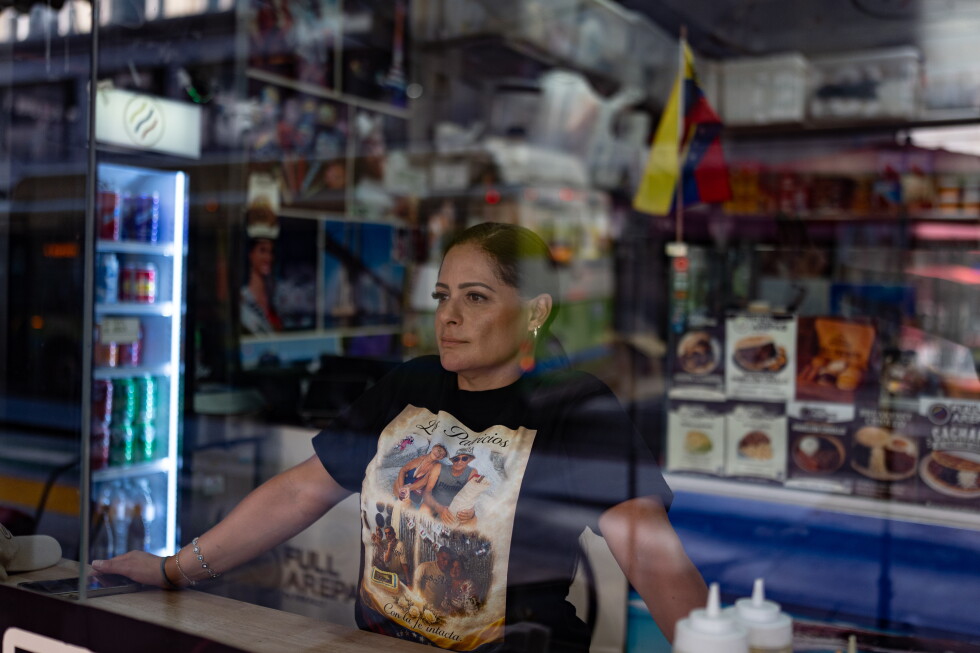
The June 24 back-to-back powerful earthquakes that rocked north-central Venezuela’s coastal region left more than 6,500 dead, thousands of structures destroyed, and countless families separated by borders and tragedy. For the more than 1.2 million Venezuelan immigrants living across the United States – a population that doubled between 2019 and 2024 as people fled persistent economic and political instability at home – the disaster unfolded thousands of miles away, leaving them trapped between crushing anxiety, survivor’s guilt, and a desperate drive to help from afar. Two months after the quakes, these four community members share how they have navigated loss, uncertainty, and grassroots action against a shifting political backdrop that has put their own right to remain in the U.S. in question.
# A Los Angeles Restaurant Owner’s Months-Long Search for Her Parents
When the first tremors hit Venezuela that June evening, Kelly Granado Montano, a 43-year-old Los Angeles restaurant owner, called her parents, Marina, 66, and Jesús, 80, repeatedly. The couple had been staying at their beach apartment in La Guaira, a coastal state that bore the brunt of the quake’s damage, and were last seen in the building’s underground parking garage preparing to leave their vacation. By the time news of the disaster spread, the 10-story building had collapsed completely, and Granado Montano got no answer.
It had been 11 years since Granado Montano last saw her parents, and immigration restrictions barred her from leaving the U.S. to join the search in person. With little support from Venezuelan authorities, coordinating search efforts with local relatives and volunteers from 3,000 miles away became what she calls “an odyssey.” She launched fundraising campaigns to cover search costs and pleaded for support on social media, as local teams spent thousands of dollars renting heavy equipment to move debris with little progress. It was only after a private donor supplied an excavator and a drone operator helped locate the wreckage of her parents’ van that the search yielded results.
Even before the recovery, Granado Montano transformed her restaurant, Full Arepas, into a community relief hub, packing shipping containers with donated goods to send to displaced quake survivors. “Knowing we are helping people who are going through something similar … it brings me a little relief,” she explained at the time. On the 57th day after the quake, August 19, she got word: her parents’ remains had been found inside their van, along with six other family members. The discovery was bittersweet: after months of not knowing, she had closure, but not the outcome she had prayed for.
Unable to travel to Venezuela for the family memorial, Granado Montano and her sister held a private service at a local Los Angeles church. Today, she stays busy running her restaurant and has launched a new foundation to continue supporting Venezuelan disaster survivors. “They were together for 45 years and into eternity,” she said of her parents. “Because they were found just as I had hoped they would be. Together.”
# A Texas ER Nurse Mobilizes Her Social Media Following to Ship Critical Medical Supplies
For Dariela Merchan, a 28-year-old emergency room nurse in Austin, Texas, the desire to help hit close to home. Merchan left Venezuela 14 years earlier, and an expired Venezuelan passport – a common barrier for the diaspora after Venezuelan consulates across the U.S. closed years ago – made it impossible for her to return to provide on-the-ground care. After confirming her father and sister in Venezuela were unharmed, she turned her attention to the country’s already teetering healthcare system, which was overwhelmed by a surge of injured patients after the quakes.
Long before the disaster, Venezuela’s healthcare network struggled with chronic shortages of medication, frequent power and water outages, and understaffing. When Merchan reached out to doctor colleagues in hard-hit La Guaira to ask what they needed most, their answer was simple: “Literally anything.” Merchan, who has built a large TikTok following with her nursing content that regularly earns millions of views, leveraged her platform to mobilize support.
She connected frontline Venezuelan medical workers with global networks of volunteer providers offering free telehealth services, and a single TikTok post drew more than 500 volunteer sign-ups. When she called on medical brands for donations, one medical apparel company sent 200 brand-new sets of scrubs. To avoid the risk of theft by corrupt officials, Merchan arranged for door-to-door shipping directly to a local health nonprofit working in La Guaira, covering half of the $1,200 shipping cost out of her own pocket after crowdfunding the rest. Between night ER shifts, she packs more donations – including electrolyte powder for first responders – and tucks handwritten notes into each box, thanking local workers and reminding them they are not alone. “We’re watching and we’re with you,” she writes, “from all over the world.”
# A Florida Student Grieves Lost Family While Facing an Uncertain Immigration Future
For Alejandro Marquina, a 22-year-old senior at Florida International University, the grief of losing five family members – including his aunt Yolanda – in the quakes has been compounded by persistent anxiety and survivor’s guilt. One week after his aunt died under the rubble of her La Guaira apartment building, Marquina found an unsent Instagram message from her, sent just before the quake, congratulating him on a recent professional achievement. He never got the chance to reply.
“I felt like a really bad person,” he said. “She was really proud of me. And now, she’s gone.” In the weeks after the disaster, Marquina struggled with recurring nightmares, panic attacks, and agoraphobia – he stopped driving, rarely left his home, and found it impossible to focus on classes. “I’m here having fun, but my family is dying,” he explained. “Many people in Venezuela, not even just my family, they’re fighting for their lives.”
Marquina and his family fled Venezuela for South Florida in 2015, settling in Doral – a Miami-Dade County city nicknamed “Doralzuela” for its large concentration of Venezuelan immigrants. Today, as the Trump administration tightens immigration rules and ends temporary protected status programs that have allowed more than 700,000 Venezuelans to live and work legally in the U.S., Marquina’s grief is intertwined with uncertainty over his own future. He began therapy after the quakes, which helped him process his trauma, but it was grassroots relief work that pulled him out of his darkest days. A journalism major, Marquina used his social media and digital communication skills to raise awareness and funds for quake survivors, including his own displaced relatives in Venezuela, and has collected more than $2,000 in donations to date. “I needed to do something,” he said. “I couldn’t just stay in my house.”
# An Arizona Former Athlete Sees Two Disasters Strike Her Split Family
Diana Ramos, a 27-year-old former college recruited athlete who lives in Tucson, Arizona, breathed a sigh of relief when she finally confirmed her parents and grandmother in Venezuela were unharmed, with only minor property damage after the quake. But as she sorted through the flood of fundraising campaigns and volunteer appeals, she looked for a specific, local need to support from afar. Thinking back to her childhood in Guatire, a city outside Caracas, she reached out to her former elementary school and learned the building had been heavily damaged and forced to close. Ramos raised $4,000 from friends and family to fund repairs, giving hundreds of local children a chance to return to class.
Weeks later, a second disaster struck close to her heart: a major earthquake hit Colombia, home to 2.8 million Venezuelan refugees – including Ramos’ older sister Duneida, who lives in hard-hit Cali. Both of Duneida’s workplaces were damaged, one completely destroyed, wiping out a large portion of her income and leaving her reeling. For weeks, Duneida was too overwhelmed to check in regularly, leaving Ramos coping with a new wave of anxiety.
“It just feels like I have my heart in two parts of two different countries,” Ramos said. “So that’s just been sad.” After more than two decades of political upheaval and economic collapse in Venezuela, she questions how much more hardship her community can endure. “All these things are accumulating without anything being solved,” she said. Even the recent U.S.-Venezuela oil deal, which supporters frame as an economic lifeline for the country and critics dismiss as an affront to Venezuelan sovereignty, has done little to ease her uncertainty. Still, Ramos holds onto her routine in Tucson and the hope of reuniting with her family soon. “The earthquakes put into perspective how life can go within a second,” she said.
This collaborative reporting project between the Associated Press, Caplin News (Miami) and Conecta Arizona (Phoenix) is supported by the AP Fund for Journalism, with additional support for AP’s philanthropy coverage through a partnership with The Conversation US, funded by Lilly Endowment Inc. The AP retains full editorial control over all content.