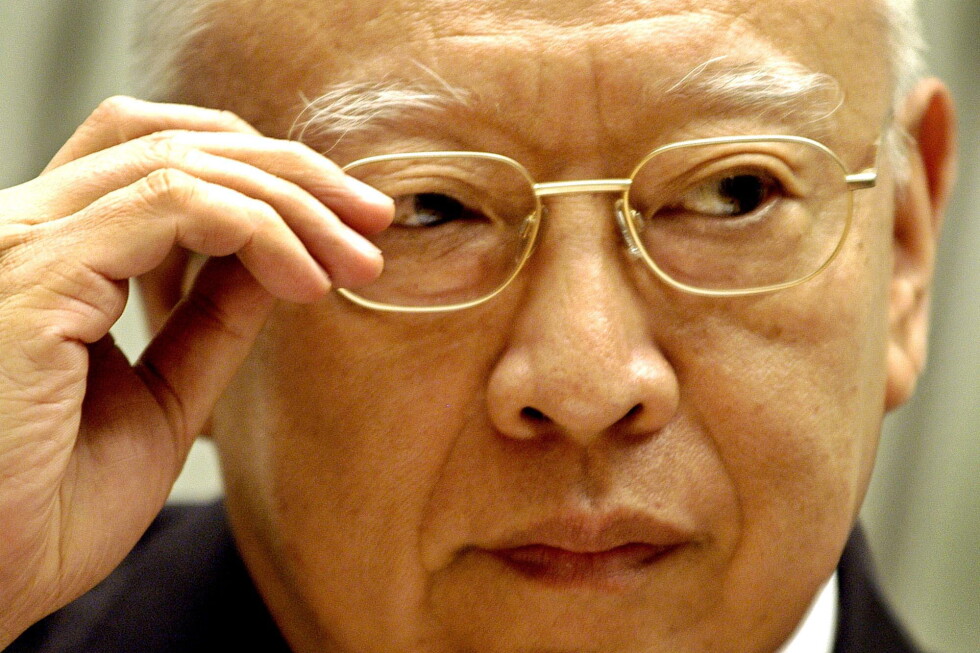
Tung Chee-hwa, the shipping magnate who made history as Hong Kong’s first chief executive after the territory’s 1997 handover from British to Chinese rule, has passed away at the age of 89. In an official statement released this week, his office confirmed that Tung died peacefully on Tuesday, surrounded by his immediate family.
Before taking the top post in Hong Kong’s new post-colonial government, Tung had virtually no formal political experience. A pro-Beijing panel of local elites selected him for the role ahead of the handover, a choice widely attributed to Beijing’s perception of him as a trusted loyalist who would align with the central government’s directives. His ties to Beijing ran deep: in the 1980s, state-owned Chinese banks stepped in to bail out his family’s struggling shipping firm, Orient Overseas Container Line, during a global industry downturn.
The early years of Hong Kong’s handover were an unprecedented, sensitive period. The framework of “one country, two systems” — which guaranteed the territory would retain its existing civil liberties and separate governing systems for 50 years, while Beijing reserved authority over constitutional change and foreign affairs — had never been put to the test when Tung took office.
While Tung earned praise for his relentless work ethic, earning him the affectionate nickname “7-11” for his habit of working 12-hour, seven-days-a-week schedules, his tenure was marked by repeated crises that eroded public support. His awkward political handling and perceived indecision during emergencies turned public opinion against him, and a less flattering, mocking nickname, “Old Dumb Tung,” began to circulate among residents.
Within months of assuming office in 1997, two major crises struck. Hong Kong reported the world’s first documented human cases of H5N1 avian influenza, followed quickly by the 1997 Asian Financial Crisis that sent the territory’s economy into a deep recession. Tung’s administration drew widespread criticism for its response to both crises, and his well-documented distrust of the media left him unable to rebuild public trust or rehabilitate his image. Frequent policy missteps also turned him into a common target of public jokes and satire.
Despite the deep unpopularity of his first term, Tung was re-elected unopposed in 2002 by a pro-Beijing electoral committee, the only body tasked with selecting the chief executive at the time. In 2003, he faced an even greater challenge when the Severe Acute Respiratory Syndrome (SARS) outbreak hit Hong Kong, killing nearly 300 people and bringing the city’s already fragile economy to a near-standstill. His government was widely accused of a slow, disorganized response that worsened the outbreak’s impact.
Later that same year, Tung sparked mass public anger when his administration introduced draft national anti-subversion legislation, known locally as Article 23. Critics argued the bill would erode Hong Kong’s core civil liberties guaranteed under the handover framework, prompting an estimated 500,000 Hong Kong residents to join a mass street protest against the legislation. The bill was eventually shelved in the wake of the public backlash.
In 2004, another large-scale pro-democracy rally was held to demand full universal suffrage for the selection of the chief executive and the entire Legislative Council. Tung aligned firmly with Beijing’s Communist leadership, which rejected the demand, and the rally became an annual tradition for pro-democracy activists for more than a decade. Political analysts widely view these mass demonstrations as a signal to Beijing that Tung had lost traction with the Hong Kong public and was no longer able to maintain political stability in the territory.
In March 2005, Tung announced his resignation from the post of chief executive, insisting that declining health was the sole reason for his departure, rather than pressure from Beijing. “If I continue as chief executive, I won’t be able to handle it,” he stated at the time. Many observers and residents remained skeptical of the explanation, as no obvious serious health issues had been reported in the months leading up to his resignation.
Born in 1937, Tung’s early life traced the trajectory of many prominent Hong Kong families. His family moved from Shanghai to Hong Kong in 1947, two years before the founding of the People’s Republic of China. He earned a bachelor’s degree in marine engineering from the University of Liverpool in the United Kingdom in 1960, then worked for General Electric in the United States and gained experience in his family’s shipping business before returning to Hong Kong permanently in 1969.
After stepping down as chief executive, Tung founded a pro-Beijing think tank in Hong Kong and remained a vocal loyalist to the central government through all major political turning points, including the massive 2019 pro-democracy protests and the subsequent national security crackdown. During the height of the 2019 protests, Tung was among 42 public figures awarded national medals and honors by Chinese President Xi Jinping at a Beijing ceremony, recognized for his contributions to advancing the implementation of the “one country, two systems” policy.
Following the passage of Beijing’s national security law for Hong Kong in 2020, the large-scale pro-democracy protests that defined much of Tung’s tenure were eliminated from the city’s public sphere. Earlier this year, Hong Kong’s current government finally passed the long-delayed Article 23 anti-subversion legislation first proposed during Tung’s tenure. Tung had not appeared at any public events in Hong Kong or mainland China for several years before his death.