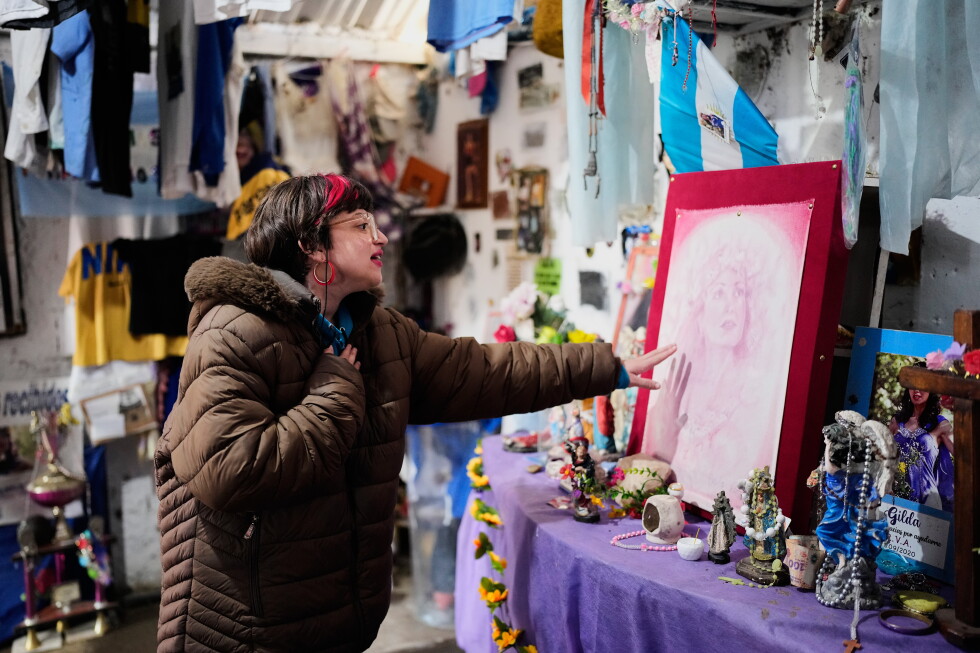
Thirty years to the day after a tragic highway collision claimed the life of one of Argentina’s most cherished cumbia performers, thousands of devotees gathered at the site of the crash to honor the artist who has grown into one of the nation’s most revered unofficial folk saints.
On Monday, crowds traveled to the remote memorial off the national highway along the muddy Paranacito River, roughly two hours north of Buenos Aires, to pay tribute to Miriam Alejandra Bianchi — known universally by her stage name Gilda, who died at 34 when her tour bus collided head-on with a truck. The wrecked frame of Gilda’s bus has been preserved as a permanent memorial, overflowing with fresh flowers, stuffed animals, lit votive candles, and handwritten notes begging for intercession. A small adjacent chapel is packed with offerings from followers whose prayers have allegedly been answered: wedding gowns from women who found love and marriage, sports trophies and jerseys from successful athletes, crutches left by people who regained the ability to walk, and even police uniforms from officers who earned promotions after praying to Gilda.
During her lifetime, Gilda rose to national fame as a cumbia artist, a propulsive, danceable fusion of Latin pop that holds massive cultural sway across Argentina. She won the devotion of working-class fans by performing in prisons and exchanging handwritten personal letters with followers, a accessibility that endured even as her celebrity grew. In the decades after her death, her fame has exploded: a posthumous album of her work earned double platinum status, and her best-loved tracks have grown from dance hall staples to national anthems capturing the universal experiences of heartbreak and longing.
Today, Gilda is venerated as a miracle-working folk saint, a status not recognized by the Roman Catholic Church, but widely embraced by millions of ordinary Argentines. Followers pray to Gilda to intercede with God on their behalf, seeking healing from illness, protection from hardship, and help achieving everyday life goals. For 63-year-old Julia Domínguez, Gilda’s intercession changed her life nearly 20 years ago, when she credits the singer with curing growths on her vocal cords, eliminating the need for high-risk surgery and allowing her to fulfill her dream of becoming a singer.
“For me, it’s about faith — putting everything in God’s hands and asking Gilda to intercede,” Domínguez said at Monday’s gathering. “That was a miracle. Today, I sing thanks to her.”
Gilda’s legacy is part of a centuries-old tradition of folk sainthood that remains deeply rooted in Argentine culture, even as institutional Catholicism’s influence wanes across the country. The rise of secularism and shrinking Catholic membership across South America — home to more than a quarter of the world’s global Catholic population — is a central challenge facing Pope Leo XIV, who is set to make his first papal tour of the region this November, with scheduled stops in Argentina, Uruguay, and Peru.
Across Argentina, shrines to unofficial saints dot the countryside, from red flags marking altars to Gauchito Gil, a 19th-century outlaw revered as a national Robin Hood, to piles of water bottles left at memorials to Difunta Correa, who legend says nursed her infant after dying of thirst in the desert. Even the nation’s beloved late soccer legend Diego Maradona has become an object of quasi-religious devotion for many Argentines.
Cleopatra Barrios, a scholar of popular religion at Argentina’s national scientific research body Conicet, explained that the devotion to folk saints fills a different need than institutional religion for many followers. “One of the most common things devotees tell us is that these saints accompany them every day of their lives,” Barrios said. “Miracles aren’t understood as they are from the institutional Catholic point of view, as something extraordinary. Here, they’re things that happen every day.”
Paola Martini, a 46-year-old organizer who coordinates group pilgrimages to Gilda’s shrine from across the country, said the singer’s relatability is the core of her enduring appeal. “With everything that happens, I always ask her, ‘Accompany me,’” Martini said. “Then, like magic, I feel her.”
The Catholic Church has not formally banned devotion to folk saints like Gilda, but it has sought to redirect worship toward God, rather than the unofficial saints. Two priests celebrated Mass at Gilda’s shrine this Monday, but did not acknowledge her status as a venerated saint, and urged attendees to center God in their faith. Even so, many devotees say they see no contradiction between their devotion to Gilda and their formal Catholic identity.
Facing declining membership across the region, Pope Leo has followed the approach of his Argentine predecessor Pope Francis, working to bring the institutional church closer to ordinary people, particularly low-income and marginalized communities. According to local Argentine church reports, Leo, a member of the Augustinian order which emphasizes service and community outreach, is expected to visit a Buenos Aires prison and a center for people living with disabilities during his November trip, though the Vatican has not yet officially confirmed the full itinerary.
For Domínguez and thousands of other devotees who gathered this Monday, the popular recognition of Gilda as a saint matters more than any formal declaration from the Vatican. “We’re waiting for Leo, we’re preparing for him,” Domínguez said. “In the end, sainthood isn’t always decided by the church. Sometimes, the people recognize it first.”