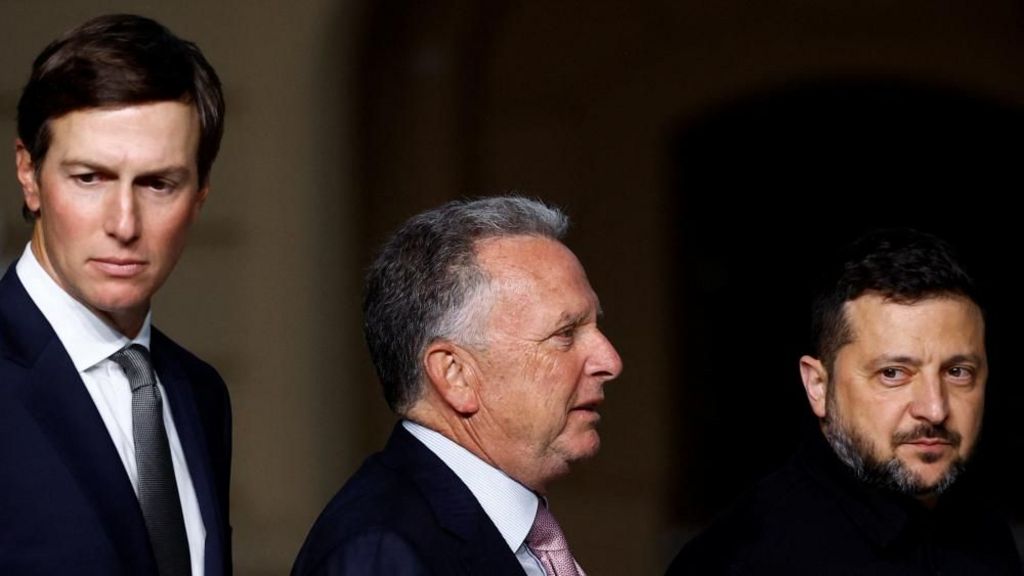
The first visit by envoys of former U.S. President Donald Trump to Ukraine since Russia launched its full-scale invasion carried layers of loaded symbolic meaning, opening a new, highly anticipated chapter of diplomatic outreach to end the devastating 3-year conflict. The delegation, made up of longtime Trump associate Steve Witkoff and the former president’s son-in-law Jared Kushner, made the journey to Kyiv by rail, a necessary precaution that highlighted the persistent danger of Russian drone attacks targeting travel across the country — a threat so severe that air travel remained too risky for the high-profile delegation, just hours after the pair held a closed-door meeting with Vladimir Putin in the Kremlin.
In a deliberate, pointed gesture loaded with historical and political subtext, Ukrainian President Volodymyr Zelensky chose to greet the delegation at Kyiv’s Saint Sophia Cathedral, an architectural and cultural landmark that anchors Ukraine’s centuries-long national identity. The choice of location was no accident: the cathedral stands just a short distance from the headquarters of Ukraine’s national security services, which was struck by Russian drones only three days before the meeting. The placement sent an unspoken message about Ukraine’s resilience amid relentless attacks, and its unwavering claim to its sovereign territory and history.
The discussions between the two sides stretched across several hours, before European national security advisers, including Britain’s top intelligence and security official Jonathan Powell, joined the talks to contribute to the diplomatic process. When the negotiations wrapped up, all participating parties described the discussions as substantive and constructive, with many expressing cautious optimism about reviving the past trilateral negotiation framework that brought together U.S., European, and regional stakeholders to work toward a ceasefire.
But beneath the positive public messaging, deep, fundamental divides separate the two warring parties, with no obvious path to bridging them in the near term. The U.S. delegation arrived in Kyiv straight from meetings in Moscow, where Putin told the envoys that Russian forces were continuing to make steady, tangible progress along the front lines. That narrative stood in direct contradiction to the account Ukrainian officials presented to the delegation: Ukrainian military officials reported that in August alone, their forces captured more territory than they ceded, while Russian forces suffered an estimated 42,000 dead and wounded casualties over the 30-day period.
Putin also laid out his core non-negotiable demands to the envoys, framing them as necessary to address what he calls the “root causes” of the full-scale invasion. His longstanding strategic requirements include Ukraine ceding control of occupied eastern territory to Russia, permanently abandoning its bid to join NATO, and reducing the overall size of Ukraine’s national military.
Following the Kyiv talks, Zelensky pushed back firmly against Russia’s terms, reiterating that Ukraine would only accept any peace deal anchored by strong, unambiguous security guarantees, including the right to maintain a robust, fully functional national army. He gave no indication that Ukraine would be willing to surrender any of its sovereign territory in the eastern Donbas region, calling the issue “difficult” in a measured, clear statement that left no room for misunderstanding of Kyiv’s position.
Witkoff, speaking to reporters after the meeting, said that tangible progress had been made during the diplomatic outreach, and that all the core elements needed for a final settlement were already on the table. But he acknowledged that both Russia and Ukraine would have to make major compromises to narrow their stark differences on core issues — a step that neither side has shown any willingness to take at this point in the conflict.
For now, officials and diplomats in Kyiv are bracing for continued fighting through the coming months, with expectations of another harsh winter of Russian attacks on energy infrastructure and civilian targets. While some diplomatic observers see a potential window for a breakthrough peace deal next spring, other analysts and policymakers are far less optimistic about the prospects for a near-term end to the war.
Zelensky did note one immediate, small benefit of the diplomatic push: both sides agreed to a temporary pause in air strikes to accommodate the high-level visit, giving Kyiv’s civilian population a brief respite from regular drone and missile attacks. But few observers expect that temporary lull in fighting to hold for more than a few days, as both sides continue to mass forces along the front and prepare for new offensive operations in the coming months.