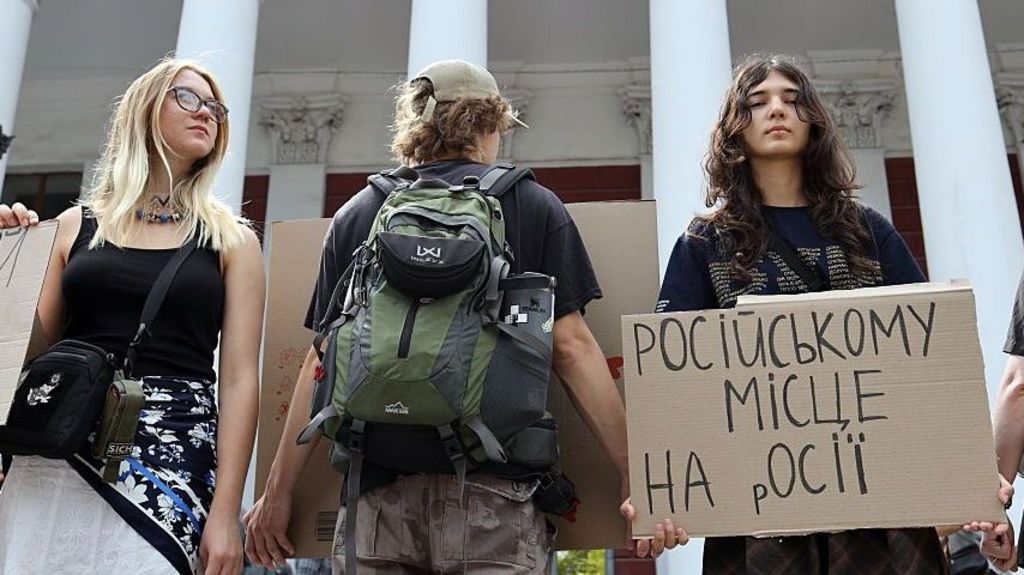
This week, a landmark and deeply divisive vote will take place in Odesa — Ukraine’s third-largest city, positioned on the country’s strategic Black Sea coast — to decide whether to enact sweeping new restrictions on the use of Russian in public arts and cultural spaces. The proposal under consideration by local city councillors would expand existing national-level restrictions on Russian, a measure that carries unique weight in a city where the vast majority of residents speak Russian as their first language. Critically, the draft legislation would only impact content and communication in public spaces, leaving private, everyday use of Russian completely untouched.
For millions of Ukrainians across the country, Russian is a native mother tongue, including for many frontline soldiers currently defending Ukrainian territory against Russia’s full-scale invasion. But Ukrainian holds status as the country’s only official state language, spoken by a national majority, and for many Ukrainians, Russian is seen as an instrument of ongoing Russian political and cultural influence. Even amid daily Russian drone and missile strikes that have devastated parts of the city, Odesa’s councillors are moving forward with the plan, which calls for a full removal of Russian-language content from public spaces including streets, parks, government institutions, and state-managed arts and entertainment venues. The proposal also includes a non-binding recommendation to extend the ban to privately owned public-facing spaces.
As a city long celebrated for its rich legacy of Russian-language literature, music and cultural production, the proposal has sparked fierce, impassioned debate across Odesa. If approved, the ban would even apply to beloved classic Odesa folk songs that have been widely known across the former Soviet Union for generations. In public libraries, all Russian-language books would be pulled from public display; under current rules, these works can be shown but not featured prominently.
Supporters of the ban frame it as a critical step in dismantling lingering Russian colonial influence over Ukrainian identity. Artem Kartashov, an Odesa-based lawyer who has advised local officials on a formal program to decolonize the city’s historic Russian cultural legacy, argues that Russian itself functions as a tool of Russian state power. “With Russian-speaking music and other things, Russians try to deconstruct Ukrainian identity and influence especially young people, because they grow up in a Russian-speaking environment,” Kartashov explained.
But opponents warn the ban divides Ukrainians who all share a deep commitment to defending their country, and erases a shared cultural heritage that transcends modern political conflict. Borys Barsky, one of Odesa’s most prominent comedic actors and the head of the city’s Mask Theatre, argues that the language is far more than a weapon of the Kremlin. “Russian isn’t [only] the language of Putin, it’s the language of [writers like] Dostoyevsky and Bulgakov,” Barsky said. “Who benefits from setting people against other people who love Ukraine just as deeply, only love it in a different language? Only Putin benefits from this.”
This debate comes amid context that Russian President Vladimir Putin has repeatedly and falsely cited the purported repression of Russian-speaking minorities in Ukraine as a core justification for his illegal 2022 full-scale invasion. Russian and Ukrainian are closely related but linguistically distinct; many Ukrainians regularly speak a mixed dialect of the two languages known as surzhyk. Notably, Ukrainian President Volodymyr Zelenskyy is a native Russian speaker, who relied heavily on the language during his 2019 election campaign but has since exclusively used Ukrainian for all public appearances.
National language policy has been shifting in Ukraine for years: a 2019 national law already mandates the use of Ukrainian in the vast majority of public and professional settings, including education, public administration, and customer service. Under the existing law, all public-facing workers from waiters to retail staff to doctors are required to greet clients and patients in Ukrainian first, though they may switch to Russian if the customer requests it. Barsky’s Mask Theatre has already been fined multiple times for violating these national rules, including for using Russian in promotional materials and keeping a cafe sign printed with the Russian word for coffee. Barsky has dismissed the enforcement as senseless, saying “This isn’t even like Orwell or Kafka, it’s just madness.” He has been allowed to continue performing in Russian for private audiences, as the current law does not restrict private performances.
The new Odesa proposal mirrors similar restrictions already implemented in Kyiv and other major Ukrainian cities. While the ban is not legally enforceable for private businesses and venues, Odesa’s official state-appointed language ombudswoman Anna Nerush, who conducts inspections for alleged language rule violations, says the proposal will create informal pressure for compliance. “All businesses interact in one way or another with local government. They rent premises, they need advertising permits, and so on. So for many entities it’s important to comply with a council decision, even if it doesn’t provide for sanctions for non-compliance,” Nerush explained.
Current national rules already ban public performances of songs by Russian citizens, with narrow exceptions for artists who have publicly condemned the invasion. Russian-language songs created or performed by Ukrainians are currently still permitted, but the new Odesa proposal would extend the ban to these works as well. Nerush emphasized that the ban would not target private conversation: a guest celebrating a birthday in Russian in a closed private restaurant room would not face any penalties, as the speech would not be audible to the general public. “But on the streets, [hearing] the Russian language can be a real trigger, for example to [former] prisoners of war and people who’ve come from occupied territories,” she noted.
In the years leading up to and especially following Russia’s 2022 full-scale invasion, many native Russian-speaking Ukrainians have voluntarily made the switch to Ukrainian. Natalia Mykhailenko, an Odesa-based photographer, switched decades ago and now leads public walking tours that highlight the city’s under-told non-Russian history, including landmarks like a Cossack cemetery that predates 1794 — the year Russian Empress Catherine the Great is traditionally credited with founding Odesa, a narrative that has been widely challenged by Ukrainian historians in recent years. Following a 2022 city council vote, a prominent statue of Catherine was removed from central Odesa’s main square, and dozens of streets have been renamed to honor Ukrainian writers and activists. “We must understand we were a colony,” Mykhailenko said. “And these [language] laws are very important. I understand it’s maybe sometimes not democratic. But without it, there will be no normal Ukraine in the future.”
Critics of the expanding restrictions, however, argue the policies undermine the very values of freedom and liberty that Ukraine is fighting to defend against Russian authoritarianism. Anthropologist Anastasia Piliavsky, a member of Ukrainian Cosmopolis, an organization that advocates for freedom of thought and speech in the country, says the policies push native Russian-speaking Ukrainians to be treated as second-class citizens stripped of their cultural heritage. “In Ukraine, the vast majority of people understand both Russian and Ukrainian. So the question is not really one of language, it’s one of liberty,” Piliavsky said. “Ukraine has been fighting for freedom. The point of this war is not to be under authoritarian rule. That’s what Russia has to offer. So when fines, or the threat of being fired [for breaking language laws] arrives, then people start wondering: what are we fighting for?”
As of this week, the level of support for the proposal among Odesa’s councillors remains unclear. The plan is openly opposed by an influential bloc of councillors tied to former Odesa mayor Hennadiy Trukhanov. Looking at broader national attitudes, a 2022 national poll found that 80% of Ukrainians supported Ukrainian becoming the dominant language in all spheres of public communication. Yet a more recent survey of Kyiv university students found that 82% still chose to speak Russian during informal break times, despite mandatory Ukrainian use in classrooms.
One high-profile Odesa resident who has found himself at the center of the national language debate is Pavlo Viktor, a physics teacher whose free online lessons have amassed millions of followers across the globe. Ukrainian language advocates initially criticized Viktor for publishing his lessons in Russian, his native language, though he later released Ukrainian-language versions. He faced additional backlash after saying he would speak to scared children in Russian during missile attacks if that was the language that made them feel most comfortable. Viktor advocates for a gradual, voluntary approach to expanding Ukrainian use across the country. Currently, only around 10% of Odesa residents speak Ukrainian in public street settings, Viktor noted. “But if we wait 50 years, maybe 90% will speak Ukrainian,” he said. “Ukrainianisation must be polite and soft… not to persuade children to move from Russian to Ukrainian, but to make an atmosphere when they want to do this. It’s the best way. And I hope that gradually we’ll move in that direction.”