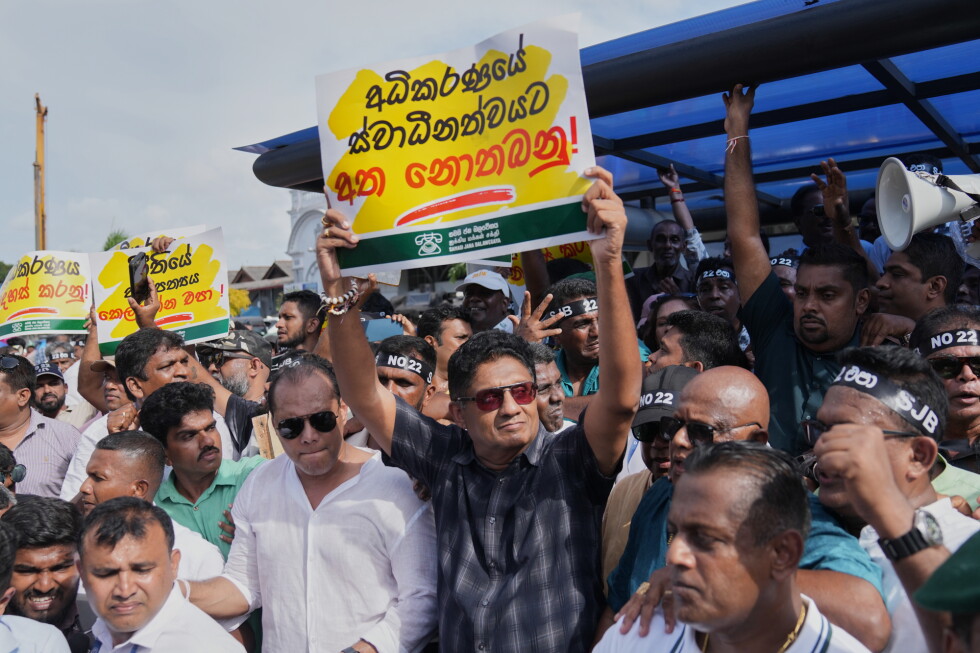
Hundreds of opposition politicians, legal professionals, labor organizers and human rights advocates marched through the streets of Sri Lanka’s capital Colombo on Thursday, rallying against a contentious constitutional amendment that would expand the nation’s highest courts and extend the mandatory retirement age for top judges. Protesters gathered at the city’s central railway station to voice their demands, waving placards and banners emblazoned with slogans including “Don’t touch the judiciary” and “Halt reforms that erode judicial independence.”
The demonstration comes 12 days after President Anura Kumara Dissanayake’s administration tabled the proposed judicial reform legislation in Sri Lanka’s Parliament, where the ruling National People’s Power (NPP) party has held an overwhelming two-thirds majority since national elections in 2024. Under the terms of the amendment, the retirement age for senior supreme and appellate court judges would be raised by two years, and additional judicial seats would be created on the country’s top courts.
Critics across the political and civil society spectrum argue the reforms are a deliberate power grab designed to stack the judiciary with government-aligned justices and undermine judicial autonomy. Opposition lawmaker Ajith Perera condemned the proposed amendment as a “draconian” overreach that ignores the will of the Sri Lankan people. Perera claimed the government drafted the legislation without any consultation with legal professionals, sitting judges or other key stakeholders, framing it as an attempt to manipulate the judicial branch for partisan political gain.
The NPP government has pushed back against these claims, arguing the changes are a core part of a broader effort to address chronic backlogs that have left millions of Sri Lankans waiting years for court rulings. Administration officials emphasize the reforms will not weaken judicial independence, and are targeted exclusively at improving access to justice for ordinary citizens.
No date has yet been scheduled for parliamentary debate on the bill, which requires a two-thirds majority vote to pass. With the ruling party already controlling more than that threshold, the amendment is widely expected to advance if put to a vote.
The current political standoff comes in the wake of a dramatic political shift in Sri Lanka. Dissanayake won a presidential election in September 2024, followed by a landslide parliamentary victory for his NPP that ousted the country’s long-dominant traditional political establishments. The 2024 election results were widely interpreted as a voter rejection of the old political order, after decades of mismanagement and corruption left Sri Lanka facing a catastrophic economic crisis in 2022 that left millions unable to access food, fuel and medicine.
Since taking office, Dissanayake’s administration has launched a sweeping anti-corruption campaign, opening new investigations into alleged graft and mismanagement by previous governments. Dozens of former senior political and government officials are currently the subject of these probes.