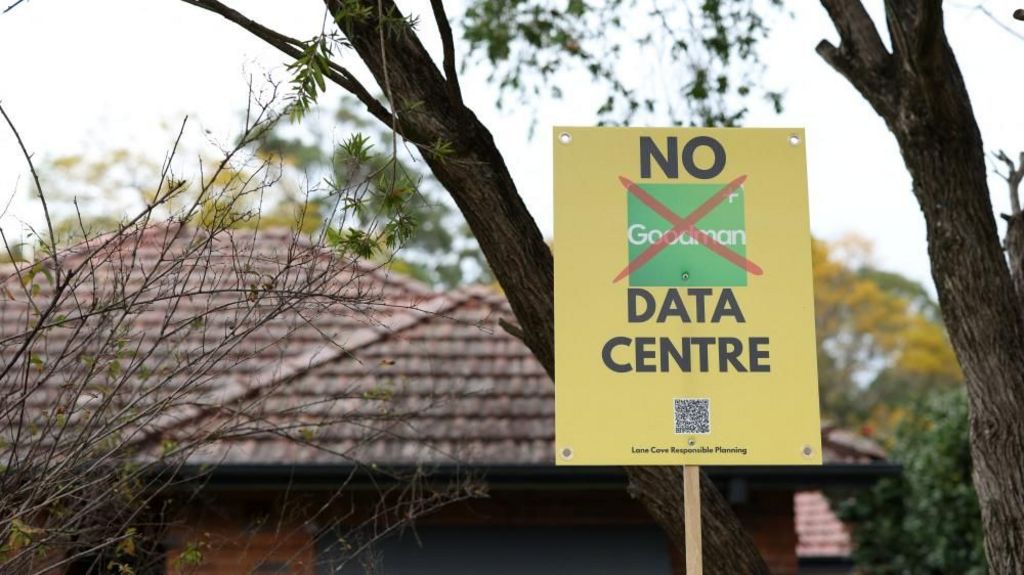
Nestled in Sydney’s desirable lower north shore, the quiet suburb of Lane Cove has become the frontline of a growing national debate: can Australia deliver on its ambition to become a global data centre hub, while protecting the quality of life for local residents and meeting its environmental targets?
For local mother Lucy, the reality of living near a data centre is already an unavoidable part of daily life. Just 350 meters from her front door, an existing facility emits a constant, low humming that seeps into her home every night as she tucks her child into bed. “I’ll hear it and think, ‘What is that? What is going on?’” she says. What Lucy and hundreds of her neighbors are now bracing for is far more disruptive: plans to build four additional large-scale data centres in Lane Cove’s local industrial park, which would turn the already affected suburb into one of Australia’s densest data centre clusters.
Australia’s rapid rise as a top global destination for data centre investment did not happen by accident. Global investors are drawn to the country’s abundant available land, political stability, skilled workforce, established Five Eyes security framework, and untapped renewable energy potential. The AI boom that followed ChatGPT’s 2022 launch supercharged this trend: OpenAI CEO Sam Altman noted earlier this year that Australia has all the ingredients to become the world’s data centre capital if it chooses to pursue that goal.
Right now, the country is moving full speed ahead to meet that demand. There are already 162 operational data centres across Australia, with 90 more in active planning stages, and more than AU$155 billion (£80 billion) in committed investment waiting to be deployed. If approved, a 1-gigawatt facility in western Sydney would become Australia’s largest single energy user and one of the biggest data centres on the planet. Just 100 meters from another western Sydney community in Marsden Park, the Southern Hemisphere’s largest data centre is already under construction.
Industry leaders argue this growth is non-negotiable for Australia’s future digital and economic prosperity. Belinda Dennett, CEO of Data Centres Australia, points out that modern digital services from robotic surgery to air traffic control to streaming platforms demand minimal latency, requiring local data storage and processing to avoid dangerous or frustrating delays. With 13.6 million Australian AI users every month – ranking the country sixth globally for AI activity – local data infrastructure will lower barriers for homegrown Australian AI companies to emerge and compete. “If we don’t build infrastructure here, we get none of the value chain,” Dennett says. “We are just importing tools from someone else and we become just a user.”
Leading business analysts add that the data centre boom has already been a critical economic buffer for Australia. Jon Whittle, a former digital research director at Australia’s national science agency CSIRO and a leading AI business advisor, notes that without the surge in data centre investment over the past two years, Australia would likely have slipped into recession. “There’s some very serious considerations around this, but my main message would be we need to lean into it,” he says. New South Wales Treasurer Daniel Mookhey echoes this view, arguing that data centre investment is driving a parallel boom in renewable energy development, helping the country phase out aging coal-fired power plants without passing the full cost on to households. “We don’t see the two as unrelated,” Mookhey says. “We see data centres allowing us to replace a lot of our old coal-fired power with clean, green renewable energy with the private sector picking up a large amount of the tab.” The investment, he adds, will create new industries that employ future generations.
But critics and local communities are pushing back hard, raising urgent alarms about the massive environmental, infrastructure and social costs of the current unregulated growth. The most pressing concerns center on energy: the Australian Energy Market Operator projects that national data centre energy demand will triple by 2030. The independent Climate Council warns that without massive new renewable generation and storage capacity, data centre demand could push electricity prices up by 26% in New South Wales by 2035. Because data centres require uninterrupted, consistent power that variable wind and solar cannot yet deliver at scale, many operators are turning to fossil fuels: a recent Greenpeace Australia Pacific report found no major data centre operator has adequately proven its claims of driving renewable growth. In the U.S., many operators have opted to build new gas-fired power plants rather than wait for renewable capacity to expand, and Australian firm Cloud Carrier is already planning three gas-fired stations to power its existing and future data centres 90 minutes outside Sydney. If the grid fails, most data centres, including the existing one in Lane Cove, rely on polluting diesel backup generators.
Water scarcity is an equally urgent concern in drought-prone Australia. Data centres require massive volumes of water to cool overheating servers, with some large facilities consuming up to 40 million liters per day – enough to supply 80,000 households. The Water Services Association of Australia already projects Sydney will need to expand drinking water supplies over the next decade to meet population growth, but Sydney Water estimates data centres could consume 25% of the city’s drinking water by 2035. If that happens, households will be forced to bear the cost of more expensive alternative water sources like desalination.
For Lane Cove’s local leaders and residents, these national concerns have become a local crisis. Deputy Mayor Rochelle Flood says the four proposed data centres would force 50% of existing businesses in the industrial park to relocate, taking thousands of local jobs with them. Felipe Tanaka, a local business manager who has already been told he must relocate to make way for a new data centre, says the disruption will have long-term impacts on local workers. “We never knew that something like this would happen,” Tanaka says. “Thousands of jobs are going to be gone from this area in the next few years. Most of our 300 to 400 workers here are locals. Having to move will probably see half of my employees gone.” While data centres create hundreds of construction jobs, they only employ around 100 full-time workers once operational, far fewer than the existing businesses they displace. One proposed facility sits just 16 meters from the nearest residential home and 160 meters from a local primary school, and residents say they were never consulted about the plan to turn their suburb into a data centre hub. Locals also fear the development will threaten nearby Lane Cove National Park and the Parramatta River, core natural assets for the community.
In July, Prime Minister Anthony Albanese announced new regulations that will require large-scale data centres to guarantee sufficient power supplies, cap water use, and cover the cost of any required new water infrastructure. But the legislation will not take effect until 2027, and will only apply to new proposals – leaving all currently planned and under-construction projects exempt. Community and environmental groups are now calling for a full moratorium on all new data centre development until stronger safeguards are in place.
“We’ve got the government rolling out the red carpet saying we want to be the data centre capital of the world,” Flood says. “But can we actually do that sustainably or is it going to set us back in terms of net zero and our water storage targets?” Critics add that beyond environmental costs, the public has little clarity on what the data centres will actually be used for, with much of the capacity powering low-value AI activity that delivers little benefit to Australian communities. “They’re telling us this is essential… that we need to have these centres in our neighbourhood but they’re not saying what it’s for,” Flood says. “When our drinking water, energy and land is being used for generative AI slop, that is not giving any value back.”