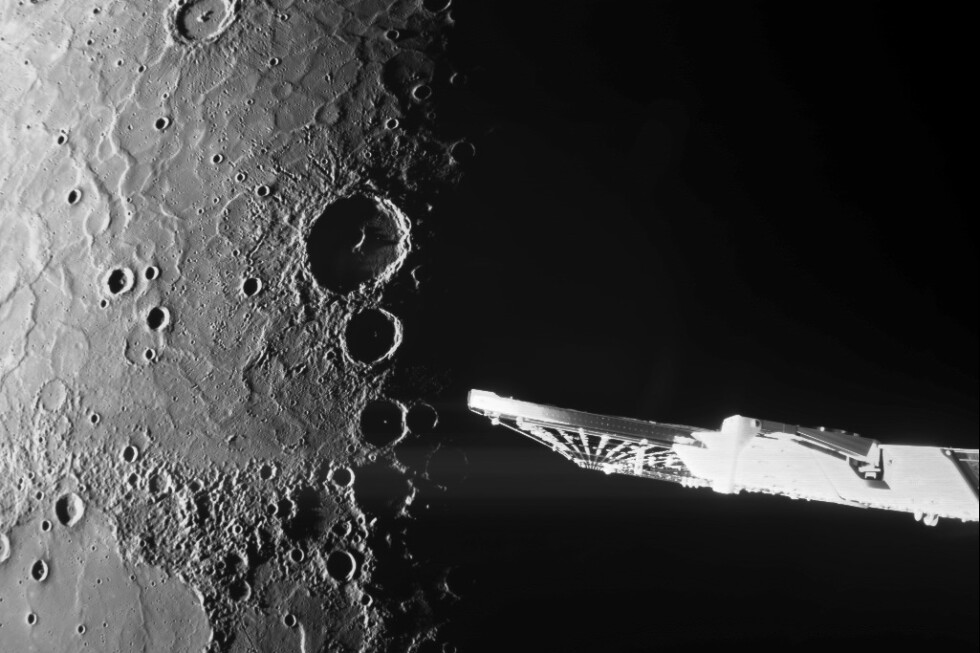
CAPE CANAVERAL, Florida — After nearly 10 years traversing more than 6 billion miles of interplanetary space, a joint European-Japanese mission to Mercury hit a major milestone Thursday: two integrated science probes separated from their shared cruise carrier, moving into the final phase of their journey to the solar system’s smallest and innermost planet.
The separation procedure, executed according to pre-planned timelines, left flight controllers at the European Space Agency’s (ESA) German operations center waiting two tense hours for radio confirmation of the successful maneuver, given the 124-million-mile (200-million-kilometer) communication delay between Earth and the spacecraft. The entire critical operation was streamed live to the public from the control room, drawing viewers across the globe eager to follow the historic planetary mission.
“This is a brilliant moment,” said Geraint Jones, the mission’s lead project scientist, following confirmation of the separation.
Known collectively as BepiColombo, the conjoined probe stack is on track to enter gravitational orbit around Mercury in December 2025, with the two individual craft set to split apart shortly after orbit insertion to begin their coordinated science campaign. As of Thursday’s separation, the mission still had 2 million miles (3.3 million kilometers) remaining before it reaches its target destination, with one final planetary flyby of Mercury scheduled for January 2025 — a maneuver that already delivered unprecedented, high-resolution images of the planet’s cratered surface and ancient volcanic plains during earlier passes.
First launched in 2018 from Earth, the BepiColombo mission honors Giuseppe “Bepi” Colombo, the Italian mathematician who made key contributions to NASA’s 1970s Mariner 10 mission, humanity’s first flyby mission to Mercury. To date, only one other spacecraft has ever orbited Mercury: NASA’s Messenger probe, which ended its mission in 2015 after four years of study. Even so, the small planet — barely larger than Earth’s Moon — remains one of the most poorly understood bodies in the inner solar system.
“How tiny Mercury is and still it holds some of the biggest mysteries of our solar system,” mission manager Santa Martinez noted earlier this week, ahead of the separation maneuver. Jones echoed that sentiment, adding, “There’s a huge amount still left to be learned.”
BepiColombo’s winding 6-billion-mile journey was designed to gradually slow the craft enough to be captured by Mercury’s gravity, requiring nine gravitational flybys of inner solar system planets to shed velocity. Once science operations begin next spring, the ESA-led Mercury Orbiter and the Japanese Aerospace Exploration Agency’s (JAXA) Mercury Magnetospheric Orbiter will operate from separate, distinct altitudes to map the planet’s surface, probe its unusually dense iron core, map its global magnetic field, and investigate unusual geologic features including shallow depressions researchers suspect form when solar radiation vaporizes volatile minerals directly from surface rocks.
Mercury is a world of extraordinary extremes: surface temperatures at the equator can climb above 800 degrees Fahrenheit (427 degrees Celsius), while permanently shadowed craters at the poles remain perpetually frigid and hold deposits of water ice. The harsh, radiation-heavy environment required specialized engineering to protect the craft’s sensitive instruments. Ignacio Tanco, ESA’s chief of mission operations, compared the thermal conditions the probes will endure to working with a searing hot pizza oven constantly positioned directly behind the spacecraft.
The $2 billion mission is primarily funded and led by ESA, with JAXA contributing the magnetospheric orbiter and supporting operations. Science data collection and analysis is set to begin in full by spring 2026, with researchers expecting to resolve long-standing questions about Mercury’s formation, internal structure, and unusual surface features.
This reporting, from The Associated Press, is supported by the AP Fund for Journalism and private philanthropic foundations, with AP retaining full editorial control over all content.