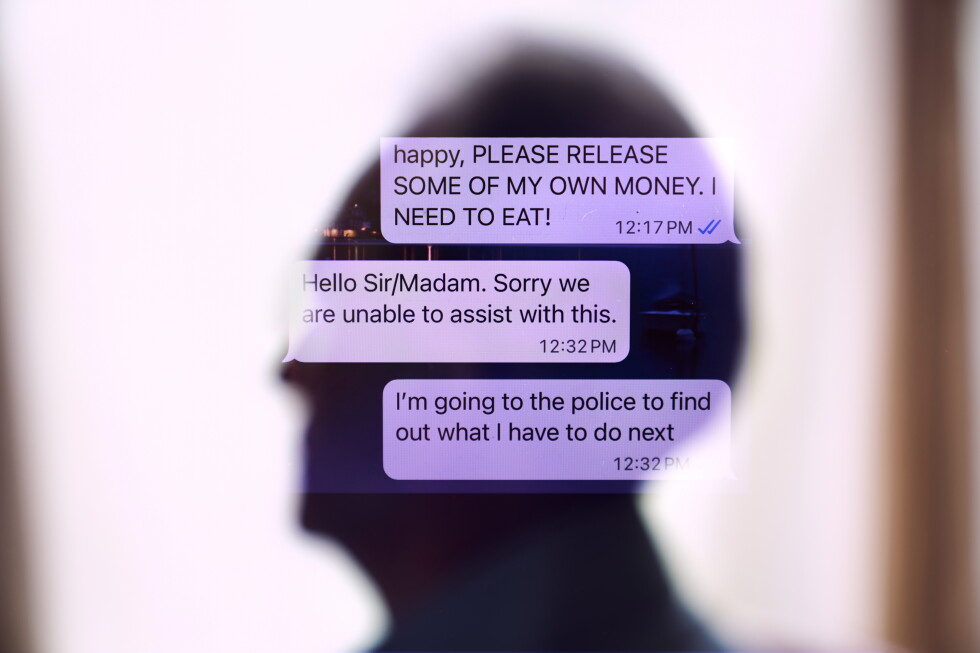
Grief opened the door for fraud in Simon’s life, after 43 years of marriage to his wife ended with her death. Overwhelmed by loneliness, he turned to online platforms searching for connection, just like thousands of other grieving widows and widowers across the United States. It took only a short time for him to connect with a woman calling herself Emily — a relationship that ended not with the companionship he craved, but with $800,000 stolen from his savings. What followed made the initial loss even worse.
Simon was left on the hook for $185,000 in loans he had taken out to send the scammer, plus tens of thousands in unexpected taxes on retirement funds he had withdrawn and lost. When he reached out to local police and the FBI to report the crime, his report went nowhere. He was then targeted by a second scammer, who demanded even more money in exchange for arranging help from the Secret Service to recover his lost funds.
Simon’s story is far from an anomaly. A joint investigation by The Associated Press and FRONTLINE has uncovered the full scale of a national crisis: scam targeting U.S. consumers has surged to all-time highs, inflicting hundreds of billions of dollars in annual losses, while systemic gaps in regulation, law enforcement response and government support leave victims with little to no recourse, and often facing further financial and emotional harm after the initial theft.
New exclusive polling from the AP-NORC Center for Public Affairs Research confirms that nearly all Americans — 98% — have been targeted by scammers in some form, with many facing daily attempts. Three in 10 survey respondents have already lost money or sensitive personal information to fraudulent schemes. In interviews with 58 scam victims across the U.S., ranging in age from 32 to 90 and spanning every income bracket and racial group, the investigation found that victimization rarely ends when the scammer cuts off contact.
Many victims told reporters that they faced stigma and mockery from friends and family, aggressive collection pressure from banks and lenders, unexpected tax bills, dismissive treatment from law enforcement, and inaction from a federal government that most Americans count on to protect them. “What happens after the scam might even be worse than the scam itself,” explained Erin West, a former prosecutor and founder of Operation Shamrock, a nonprofit that supports online scam victims. “It’s a travesty.”
The investigation even managed to trace the stolen funds from Simon’s case, using leaked documents and public cryptocurrency wallet data. The trail led directly to a large, notorious scam compound in Myanmar, a hub for transnational criminal networks that steal billions from global victims every year. Simon was shocked to see the fake profile “Emily” used, alongside hundreds of pages of his private conversations that he had assumed were encrypted. “What a fool I was,” he told reporters, requesting to keep his full name private out of overwhelming shame. Much of the Myanmar compound has since been destroyed by local authorities, but criminal operations simply relocated to new secret sites, and Simon has not recovered a cent of his stolen money.
“(The police) told me right away that, you know, ‘You have to kiss that money goodbye,’” he said, fighting back tears. “Already I experienced something very bad and now I have to pay for the consequences on top of it, and see my money evaporate all over again. You lose two ways.”
## Scams Have Become an Industrial-Scale Global Industry
Official data underscores the staggering growth of scam activity in the U.S. Last year, the Federal Trade Commission recorded a record $15.9 billion in reported losses from scams, a 25% jump from the year before. Regulators and investigators widely agree that this official number is a massive undercount, since most victims are too embarrassed to come forward and report their losses. The FTC estimates that real total losses for 2024 are closer to $200 billion — equal to $550 million stolen from U.S. consumers every single day.
Two technological shifts have supercharged this growth: breakthrough advances in artificial intelligence, and the rising popularity of cryptocurrency. AI has allowed scammers to operate at a scale and level of sophistication that was unthinkable a decade ago, enabling them to create convincing fake profiles, generate personalized phishing content, and even mimic the voices of loved ones to trick victims out of money. Cryptocurrency, the most common payment method for many modern scams, is a digital asset that is extremely difficult to trace, allowing criminals to move stolen funds across borders without leaving a clear paper trail.
No demographic is immune: the 58 victims interviewed by AP and FRONTLINE included doctors, IT specialists, academics with advanced degrees, and working-class people struggling to cover monthly bills. Individual losses ranged from a few thousand dollars to $4 million. All respondents reported feeling isolated and disoriented after the scam, and most said they felt abandoned by authorities when they tried to report the crime. Multiple victims said they had considered suicide, and two disclosed that they had attempted to take their own lives.
Only one of the 58 victims interviewed managed to recover any of her lost funds, through a rare legal settlement with her bank, not through law enforcement action against the scammers.
A particularly harmful secondary burden for many victims is unexpected tax debt. Under the 2017 Tax Cuts and Jobs Act, made permanent in 2025, personal financial losses from most common scams are no longer eligible for tax deductions. For many victims who drained tax-deferred retirement accounts to send money to scammers, that means the Internal Revenue Service still demands they pay income tax on money that was stolen from them.
Retired nurse Susan Bivins was tricked into draining her entire retirement savings to send more than $200,000 to a scammer pretending to be a federal law enforcement agent. After local police and the FBI declined to act on her case, she received a tax bill for $80,000. “I wanted to drive off a cliff,” she said. “I didn’t know how I was going to live.” Bivins was forced to sell her home and move into a small one-bedroom apartment, and she continues to pay off her tax debt by selling handmade quilts she sews.
Financial institutions often compound the harm, as well. Many banks blame scam victims for authorizing the transfers, rather than recognizing them as crime victims, and will freeze or close accounts, demand immediate repayment of loans, and charge steep legal fees. Debra Fox, a Colorado resident who lost $58,000 to a romance scam, said a representative at her local bank told her she would be held fully liable for any fraudulent activity linked to her accounts and forced to cover all associated legal costs. For 48 hours after the meeting, she was in shock, terrified that the small amount of savings she had left would be seized. “I thought, I have no control over this process,” she said. “The crime was horrific enough… but it’s what happened next that was really unbelievable to me.”
Under current U.S. law, financial institutions are rarely held liable for transactions that customers themselves authorize, even if the authorization was obtained through fraud. One rare exception is California’s elder financial abuse laws, which allowed 83-year-old Alice Lin to recover a portion of her stolen savings after a lawsuit against her bank, JPMorgan Chase. After her husband died, Lin was targeted by a scammer posing as a fellow widower, who convinced her to withdraw $720,000 in life savings to invest in fraudulent cryptocurrency platforms. Lin sued the bank for failing to flag the large, unusual transfers and protect an elderly customer, and the bank agreed to an out-of-court settlement for an undisclosed sum.
Ari Redford, global head of policy at blockchain analytics firm TRM Labs, explained that modern scams have become fully industrialized, with large criminal networks running dozens of different schemes simultaneously. Lin’s scammers, for example, took in at least $800 million from victims between January 2022 and September 2024, TRM data shows. “We have not built out systems in the U.S. in many respects to not only alert victims but to really do restitution in a meaningful way,” Redford said.
## Global Models Offer Clear Paths Forward That the U.S. Has Not Adopted
While the U.S. government has only recently begun to address the scam crisis, many other developed nations have already implemented far-reaching regulations to hold companies accountable and compensate victims. The AP-FRONTLINE investigation found that the U.S. lags behind peer nations in three key areas: requiring financial institutions and social media platforms to take responsibility for preventing fraud, holding bad actors accountable for unregulated cryptocurrency activity, and providing support for victims after a scam occurs.
Eight in 10 Americans across the political spectrum agree that the federal government is not doing enough to protect consumers from scams, a recent Gallup survey found. A majority of respondents to the AP-NORC poll also said that financial institutions, technology and social media companies, and the federal government all share responsibility for preventing scam activity.
Since late 2024, U.K. financial services firms have been required to reimburse customers who are tricked into sending money to scammers, creating a strong financial incentive for banks to invest in robust fraud prevention. The European Union has also implemented new rules that hold financial institutions liable for stolen funds if they fail to put adequate fraud protections in place, and the EU’s 2022 Digital Services Act requires social media platforms to quickly remove reported scam content and implement systemic changes to reduce online fraud. In the U.K., trained social workers are often sent to the homes of scam victims to provide support for the emotional trauma of fraud, a practice that eliminates the common stigma of blaming victims.
“You wouldn’t ever say to a victim, ‘Why did you fall for a mugging? Why did you fall for a burglary?’” explained Louise Baxter, a member of the U.K. Home Office Joint Fraud Task Force. “It’s secondary victimization, from a law enforcement perspective and a societal perspective.”
Australia and Singapore have gone even further. Australia’s new regulations require financial institutions, telecom companies, and digital platforms to prevent scams, and allow regulators to fine companies or force them to compensate victims if they fail to act. Singapore has the strictest framework in the world: under its Shared Responsibility Framework, banks and telecom companies must reimburse victims of phishing scams if they failed to implement required security safeguards. A 2024 anti-scam law allows Singaporean police to temporarily freeze suspicious transfers from potential victims, and staff from banks and e-commerce platforms work side-by-side with police in the country’s national anti-scam center.
In the U.S., by contrast, regulatory action remains piecemeal, and broad legal protections shield social media companies from liability for scam content posted on their platforms. Victims are almost never reimbursed if they willingly authorized a transfer, even if they were tricked by a sophisticated criminal.
Regulation of cryptocurrency also remains far weaker in the U.S. than in most other developed nations. China has banned all unregulated crypto-related business activity, while the EU requires mandatory licensing, strict consumer protections, and public disclosures for crypto firms. While the Trump administration has supported some limited crypto regulation, it has also moved to roll back aggressive enforcement to promote innovation. The GENIUS Act, signed into law by President Trump last year to regulate certain crypto sectors, does not require crypto companies to return stolen funds to scam victims — a gap that consumer advocates, prosecutors, and many lawmakers have openly criticized.
Law enforcement officials note that tracing, freezing, and recovering stolen crypto is extremely difficult, because traditional institutional banking safeguards do not apply to digital assets. Unlike bank deposits, crypto is not backed by federal deposit insurance, and transfers can be done without verifying the identity of the people involved. Most major crypto exchanges are registered offshore, outside the reach of U.S. law.
After Brian Glick lost $575,000 to a crypto scam, he spent months collecting evidence and working with the FBI to attempt to freeze his stolen funds held by crypto firm Tether. According to email exchanges shared with AP and FRONTLINE, the FBI requested that Tether freeze the funds, but the company refused. Tether CEO Paolo Ardoino said the company was unaware of Glick’s specific case, and noted that the firm has cooperated with law enforcement in hundreds of other cases, saying “there is no company, even in the banking industry, in the traditional financial industry, that is so helpful as us.” After receiving details of Glick’s case, Tether declined further comment. FBI and Secret Service officials confirmed that Tether does work closely with law enforcement, and a joint initiative between Tether, TRM Labs, and blockchain network TRON has frozen more than $450 million in illicit funds worldwide since 2024. Still, Glick has not recovered any of his money. “There are so many victims of these cybercrimes,” Glick said. “And we can’t get our money back.”
## Fledgling U.S. Efforts Fail to Keep Pace With Growing Crisis
The U.S. government has begun to recognize the scope of the crisis, and has taken limited steps to address it. Congress is currently considering more than a dozen separate anti-scam bills: one proposal would create a centralized national website for scam complaints, ReportScams.gov, while another would require mandatory disclosures for deepfakes and other AI-generated content used in scams. In November, the Department of Justice launched a dedicated strike force to cut off transnational Southeast Asian scam networks from U.S. financial infrastructure, pursue criminal charges, and seize stolen funds. The Treasury has imposed sanctions on scam hubs in Southeast Asia, and local authorities in Myanmar and Cambodia have carried out high-profile raids on known scam compounds.
The Justice Department’s strike force has announced that it has restrained $832 million in stolen cryptocurrency linked to transnational Chinese criminal networks, but a spokesperson told AP and FRONTLINE that the department cannot share details about individual seizures, where funds are being held, or how much has been returned to victims. President Trump also signed an executive order in March directing the attorney general to prioritize prosecuting scammers and develop a program to return stolen funds to victims.
“President Trump is unleashing every available tool to stop criminal networks that exploit vulnerable Americans through cyber fraud and scams,” the White House said in a statement to AP and FRONTLINE.
But advocates and government watchdog groups say these efforts are underfunded and fragmented, and cannot keep up with the rapid growth of scam activity. A 2025 report from the Government Accountability Office found that at least 13 different federal agencies handle different aspects of scam regulation and enforcement, with no unified national strategy. “There is no government-wide estimate of the money lost to scams, no common definition of scams, and no national strategy for combating them,” said Seto Bagdoyan, director of the GAO’s Forensic Audits and Investigative Service. He added that the current fragmented approach has resulted in a sluggish response that “falls short” of what is needed.
Rebecca Keithley, assistant section chief of the FBI’s Financial Crimes Section who retired earlier this year, acknowledged that tens of billions of dollars flow out of the U.S. economy every year through scams. The FBI’s Operation Level Up, which proactively contacts potential victims to intervene before they send money, has stopped roughly 8,500 scams in nearly two years — a drop in the bucket compared to the total volume of incidents. The FBI receives an average of nearly 3,000 internet crime complaints every day through its IC3.gov portal, and most complaints never receive a follow-up.
Chris Scott, an Arizona casino dealer who lost $400,000 to a dating site scammer, told reporters that she visited her local FBI office four times in person to beg for help, but was told all she could do was file a complaint through the IC3 portal. She filed the complaint, but never received any response, not even a confirmation that it had been received. Desperate for help, she hired three different companies that claimed to have connections to the FBI and promised to recover her funds, only to lose an additional $23,000 to these recovery scammers. She was forced to sell her home to cover her debts, and still pays off a $20,000 tax bill from her drained retirement account.
“I’m just a small fish in a big pond,” Scott said. “All I wanted was to talk to someone and get help, but I’m nobody to them.”
This report is part of an ongoing collaborative investigation between The Associated Press and FRONTLINE (PBS), including a new documentary “Scammed” premiering September 29 on PBS and streaming online.