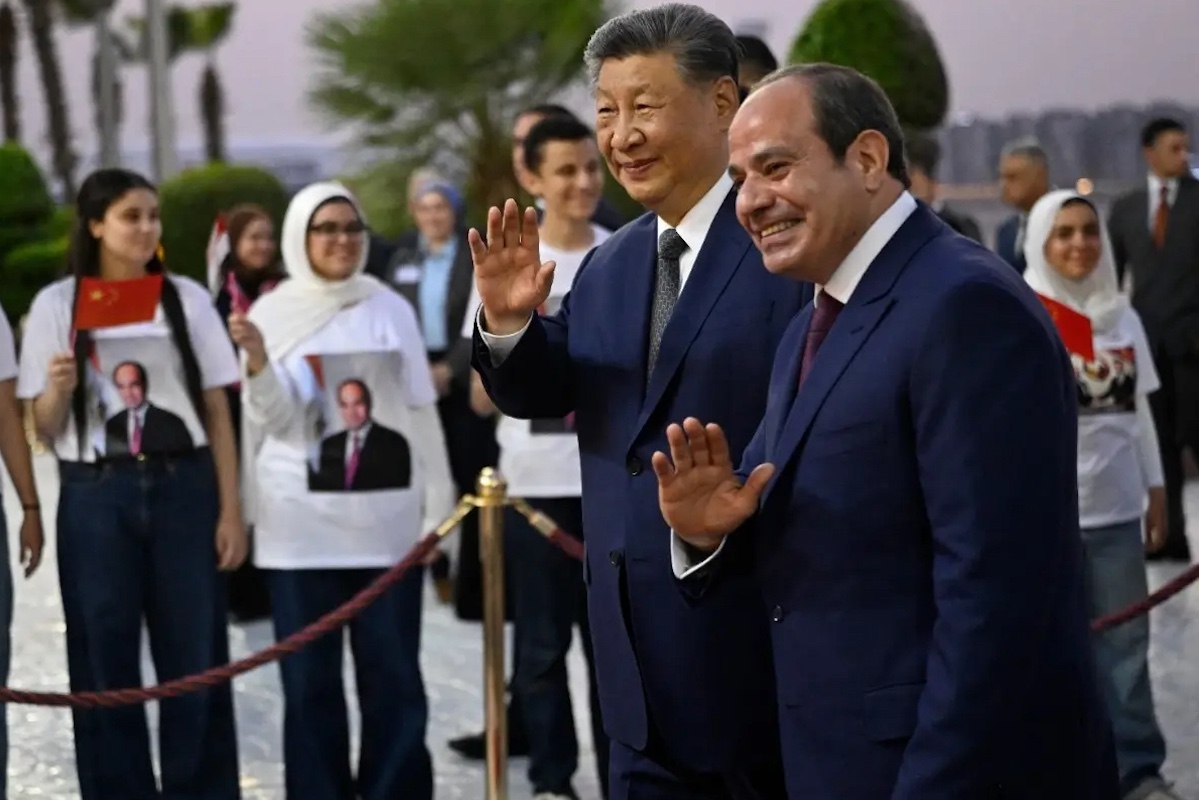
Ten years after his last state visit to Egypt, Chinese President Xi Jinping has arrived in Cairo, marking a new chapter in China’s evolving engagement across the Middle East and Africa. For decades, China’s policy in the Middle East has centered on Gulf energy supplies, robust trade ties with Saudi Arabia and the United Arab Emirates, and careful diplomatic balancing between Iran and Arab states. These relationships remain critical to Beijing’s regional strategy, but President Xi’s visit underscores a deliberate shift: China is expanding its footprint west and south, positioning Egypt as a strategic gateway to African markets, infrastructure networks, and political influence.
Ahead of the presidential visit, China deployed J-16 fighter jets, aerial refueling tankers, and early-warning aircraft on a 6,000-kilometer journey to Egypt for the second iteration of the “Eagles of Civilization” joint military exercise. While some observers frame this deployment as evidence that China seeks to displace the United States as the dominant security power in the region, that claim overstates current realities. Washington maintains extensive military basing, command infrastructure, and formal defense alliances that Beijing has yet to build, and Egypt continues to integrate military equipment from the U.S., France, Russia, and China simultaneously.
Rather than seeking to replace existing security arrangements, China is building a targeted, durable network of economic, technological, and limited security partnerships that do not require Egypt to abandon its other longstanding allies. The geographic core of this network is clustered around the Suez Canal, just east of Cairo. What began as Chinese construction contracts has evolved into a full-fledged manufacturing hub: by the end of 2025, the China-Egypt TEDA industrial zone in Ain Sokhna was home to nearly 200 companies, attracted over $3.8 billion in foreign direct investment, and created approximately 10,000 local jobs, according to data released earlier this year.
The zone already produces fiberglass, electrical machinery, consumer appliances, and industrial chemicals, with a large-scale tire manufacturing facility set to launch phased production in the near future. Cairo has also prioritized attracting investment in solar cells, battery manufacturing, and electric vehicle production, aligning with global clean energy transitions. This industrial base offers China a strategic advantage that its Gulf partnerships alone cannot provide: a permanent manufacturing foothold in Africa, positioned directly along the shortest maritime trade route connecting Asian production centers to European consumer markets. Egypt’s membership in the African Continental Free Trade Area (AfCFTA) also grants Chinese firms operating here access to integrated commercial networks across the Arab world and the entire African continent.
Chinese companies based in the Suez zone are not just geographically closer to sub-Saharan African markets; they can also leverage the cross-continental trade networks that Cairo has spent decades building, which Egypt now aims to expand under the AfCFTA framework. For Egypt, the partnership brings equally tangible benefits. Cairo is grappling with urgent needs for foreign currency inflows, job creation, and expanded export capacity, and it has long sought to address a lopsided trade balance with China. In 2025, China was Egypt’s largest non-oil trading partner, but official data shows Chinese exports to Egypt reached $19.9 billion, while Egyptian exports to China totaled just $819 million – a stark imbalance that Cairo is eager to correct.
A growing total volume of trade does not automatically translate to a healthier, more mutually beneficial bilateral relationship. The long-term success of the partnership will hinge on whether local Egyptian suppliers are integrated into supply chains, whether Egyptian exporters gain greater access to the huge Chinese market, and whether the partnership restructures Egypt’s economy rather than just increasing its import dependency. Technology transfer is emerging as the next critical test of this dynamic. Chinese tech giant Huawei has submitted a bid to build artificial intelligence data centers for the Egyptian government using 2,008 Ascend chips, while the U.S. State Department has coordinated a rival proposal backed by Nvidia, AMD, and Microsoft. As President Xi arrives in Cairo, this tender has turned Egypt into the site of an open competition between the two superpowers’ competing technology ecosystems.
Huawei has already outlined a 12-month construction timeline for its proposal, while the U.S.-backed consortium is expected to offer more advanced chips and access to a deeper global software ecosystem. For Egypt, this competitive dynamic puts Cairo in a uniquely advantageous position to negotiate favorable terms, as both blocs are eager to secure a foothold in the market. This pragmatic flexibility defines Egypt’s approach to military and diplomatic engagement more broadly: its air force operates American F-16s, French Rafales, and Russian MiG-29s, and now adds joint training with Chinese aircraft to its portfolio. Egypt joined the BRICS bloc last year and has deepened ties with Beijing, but it still receives substantial annual military assistance from Washington and maintains strong economic links with Europe and the Gulf states.
This flexible approach works to China’s advantage as well. Beijing’s low-profile, non-intrusive model of engagement allows it to deepen its regional presence without taking on the burdens of addressing every regional crisis, from the ongoing conflict in Gaza to security challenges in the Red Sea. Chinese firms can expand industrial capacity, sell cutting-edge technology, and strengthen defense cooperation, while Cairo retains primary responsibility for local security and regional mediation efforts.
That said, there are clear limits to the current scale of cooperation. While the TEDA industrial zone has created jobs and expanded production, Egypt’s trade imbalance with China remains stark. If Beijing is to frame this relationship as a model development partnership, it will need to ensure that more economic value is retained locally within Egypt. The joint military exercises also need to be kept in perspective: they offer Chinese pilots valuable operational experience in the region and give Egypt another option for security partnership, but they do not signal an imminent replacement of the existing regional security order.
China’s overall military and security presence in the Middle East remains far smaller than that of the United States. Chinese commercial shipping and companies still rely on the freedom of navigation provided by the U.S.-led regional security architecture – a system that Beijing has often criticized, but has not yet put forward a viable alternative to replace.
For these reasons, the true significance of Xi Jinping’s visit will not be measured in the warmth of public diplomatic statements, but in the tangible outcomes that emerge after the visit concludes. New factories will only deliver long-term benefit if they support the growth of local Egyptian supply chains. Technology agreements will only be meaningful if Egyptian workers and institutions are trained to operate, maintain, and govern these systems. Expanded bilateral trade will only benefit both sides if Egyptian exports to China grow significantly alongside Chinese exports to Egypt.
While the Gulf region will remain central to China’s Middle East strategy for the foreseeable future, Egypt offers Beijing an unprecedented gateway into the broader African continent. For Cairo, this strategic position allows it to negotiate more favorable investment terms that align with its own economic development goals. Once the visit ends, the real test will be how much of this expanding partnership is ultimately built, managed, and owned by Egyptians themselves.