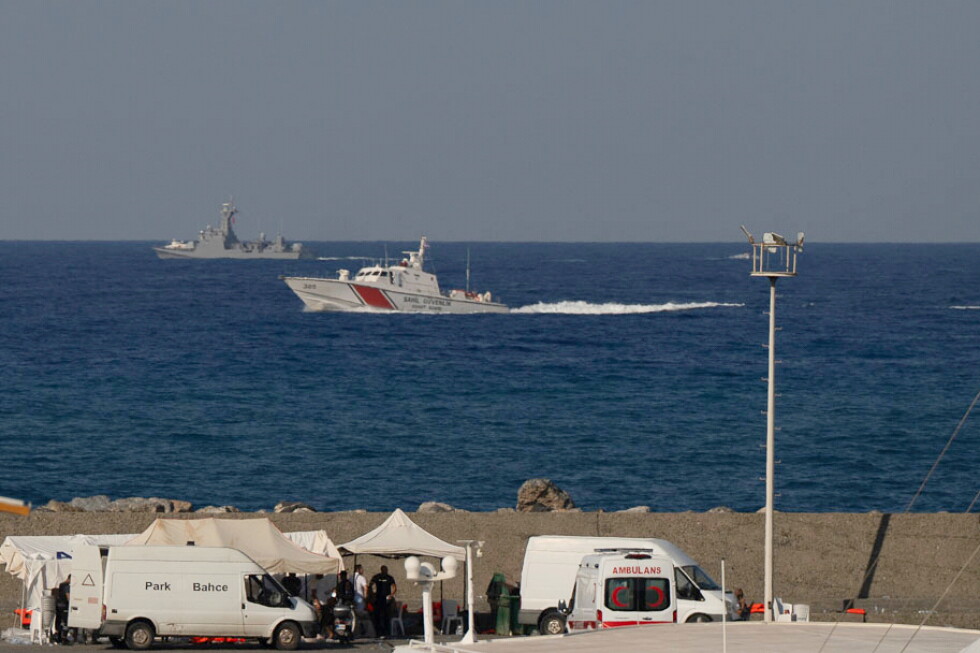
Two full days have passed since the passenger ferry Filo Jet capsized and sank off the northern coast of Cyprus, and search operations have entered a new critical phase with a specialized submersible deployed Tuesday to locate 20 people still unaccounted for. The disaster, which unfolded Sunday afternoon as the catamaran ferry departed the northern Cypriot port of Kyrenia (called Girne in Turkish) en route to Tasucu, Turkey, has already left eight people dead.
Carrying a total of 267 passengers and crew, most of whom were Turkish tourists returning from holiday, the Filo Jet quickly keeled over and sank after passengers reported hearing multiple loud bangs from below deck. Survivor accounts describe immediate panic as water rushed into the vessel, trapping dozens of people in the main passenger seating area as the ship tipped onto its side.
According to Unal Ustel, Prime Minister of the Turkish Republic of Northern Cyprus (TRNC), Turkey’s specialized search-and-rescue ship TCG Isin has now reached the wreck site, located roughly 7.5 kilometers off the Cypriot coast. The sunken ferry rests at a depth of more than 500 meters (over 1,600 feet), far beyond the range of standard diving operations. To address this extreme depth, the TCG Isin carries a remotely operated submersible capable of descending up to 1,000 meters (3,280 feet), fitted with high-resolution cameras to map the seabed and robotic arms to recover debris and evidence. The vessel also hosts a team of 15 specialized divers to support operations.
“Once the wreck is identified, salvage operations will begin at a significant depth of 500 meters,” Commander Ulas Cesur, head of the mission aboard the TCG Isin, told reporters. “Detailed search and investigation activities will be carried out around and on the wreck using a remotely operated underwater vehicle.”
Ustel emphasized that authorities are committing all available resources to the operation, backed by full support from the Turkish government. “We will continue our search and rescue operations and technical work uninterrupted for as long as needed,” he stated in remarks published by TRNC newspaper Kibris.
As search efforts press forward, three of the eight confirmed victims were laid to rest across Turkey on Tuesday. Fourteen-year-old Nisa Torer, who was returning from vacation with her widowed father and two younger brothers, was buried in the southern Turkish city of Gaziantep. Her father remains among the missing. Fifty-six-year-old Nihat Balyemez was also interred in Gaziantep, while 60-year-old Huseyin Ozdemir was buried in Silifke, Mersin province. Ozdemir had traveled to Cyprus for a family wedding; his wife is still missing, but their two daughters were pulled from the water alive.
Since the disaster was reported, a massive multi-domain search effort has been mounted. Overnight Monday, air and sea crews combed the area for any signs of surviving passengers, and to date, the operation has involved one fixed-wing aircraft, seven helicopters, five drones, and 17 surface vessels, according to Turkey’s state-run Anadolu Agency.
In the wake of the sinking, authorities have launched a formal investigation into the cause of the disaster. Eight crew members and a senior director of the ferry’s operating company, Filo Denizcilik, are currently in police custody. An additional five people, including other Filo Denizcilik employees and northern Cypriot port officials, remain under formal investigation.
The incident takes place against a long-standing geopolitical backdrop: Cyprus has been divided along ethnic lines since a 1974 Turkish invasion, following a Greek nationalist coup attempt. Turkish Cypriots declared independence as the TRNC in 1983, a move recognized only by Ankara, which maintains more than 35,000 troops on the northern portion of the island.