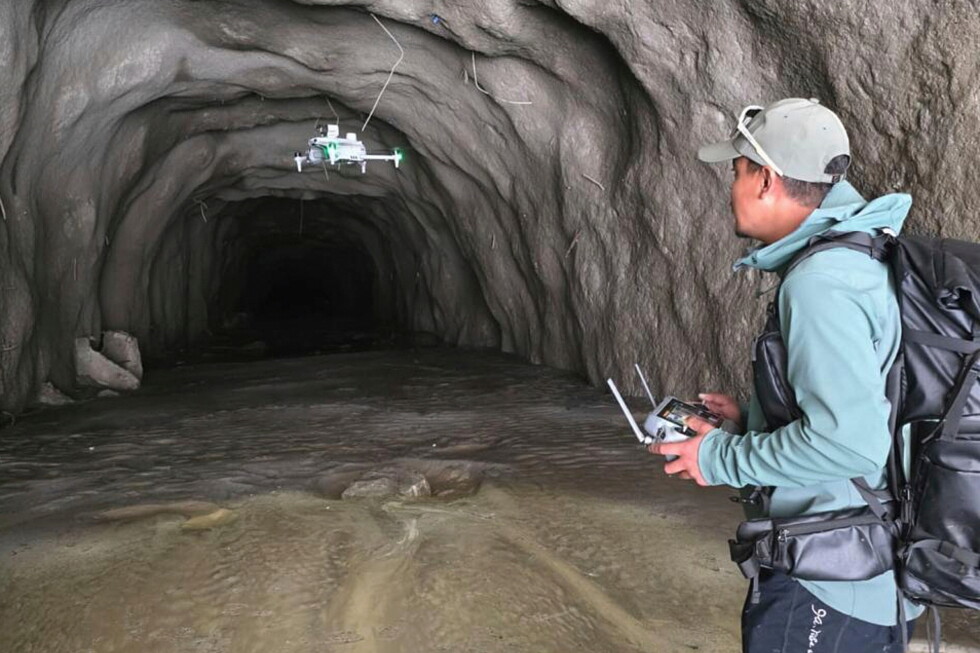
Just two days before a catastrophic glacial outburst triggered deadly flash floods across the Himalayan border region shared by Nepal and China, local Nepali filmmaker and professional drone pilot Manish Maharjan crossed back into Nepal via the Rasuwagadhi border checkpoint – the same crossing closest to the disaster’s origin. What he did not anticipate on his return home was that his specialized piloting skills would quickly become a critical asset for rescue operations along a route he has traveled extensively for work over the years.
When catastrophic flash floods struck on August 26, authorities across both countries immediately mobilized dozens of search-and-rescue and relief teams. One day after the disaster unfolded, Maharjan volunteered his expertise to embed with the Nepal Army’s rescue mission. The disaster has already claimed more than 1,000 lives across Nepal and southern Tibet, leaving thousands more unaccounted for.
Maharjan’s primary role has been operating thermal-equipped drones to support ground teams, with a core focus on locating nearly 900 missing workers from 12 regional hydropower projects that were completely buried under massive mudslides and debris. Of these missing workers, an estimated 500 are thought to have been trapped inside hydropower plant tunnels when the flood hit.
The drone pilot explained that unmanned aerial systems have proven remarkably effective for pinpointing survivors stranded on isolated hillsides and in hard-to-reach locations such as mountain caves. Beyond thermal imaging to detect body heat, Maharjan’s team adapted creative tactics to draw out trapped people. “We mounted microphone speakers to our drones to call out to anyone who might be stuck. In some areas, we even played music and waited for a response,” he shared. “That tactic actually worked in a handful of cases, and helped us locate survivors who could not be seen from the air.”
While drones have successfully helped extract stranded people from open terrain, searching the collapsed hydropower tunnels has presented an entirely unprecedented set of challenges, Maharjan noted. When teams have scanned tunnel entrances, they found the structures completely packed solid with mud, dense as toothpaste squeezed into a tube, with no hollow or empty space left inside for survivors to take shelter.
The disaster originated high in the Himalayas, when scientists analyzing post-event satellite imagery confirmed that a section of bedrock beneath a glacial formation collapsed, pulling a portion of the overlying glacier down with it. The scale of the rockfall was so massive that it registered as a magnitude 5.2 seismic event on global monitoring systems. The cascading rock and melted glacial water surged down into the river valleys below, creating a destructive wall of water that swept through communities and infrastructure across both Tibet and Nepal.
The torrent destroyed critical regional infrastructure, including the under-construction and operating hydropower projects, highways, residential buildings, and bridges. According to Mohan Kumar Dangi, president of Nepal’s Independent Power Producers’ Association, some workers inside the tunnels managed to place emergency calls for help when the flood hit, and workers who successfully escaped confirmed their colleagues remained trapped inside. To date, there has been no confirmed contact with the trapped workers since those initial distress calls.
As the clock ticks past the critical 72-hour window for rescue, search teams face rapidly dwindling odds of finding additional survivors. Survival experts emphasize that access to clean water and breathable air are non-negotiable for people trapped in disaster settings, and chances of survival drop sharply once the 72-hour mark passes without rescue.
At the Rasuwagadhi hydropower project, Maharjan successfully maneuvered his drone all the way to the end of the tunnel’s main corridor, scanning every inch for signs of life. No signs of survival were detected. “We checked the space repeatedly, but the entire tunnel was just filled with mud and debris,” he said. “Just looking at the extent of the blockage, you can only imagine the incredible force of the flood that did this.”
Tunnel search operations remain incredibly difficult beyond the full blockage at many sites, Maharjan added. The layout of most hydropower tunnels limits the ability of drones to operate effectively. “I can only safely and effectively fly drones in long, straight tunnel sections,” he explained. “Once there are bends, turns, or zigzags in the layout, controlling the drone and conducting a thorough search becomes exponentially harder.”