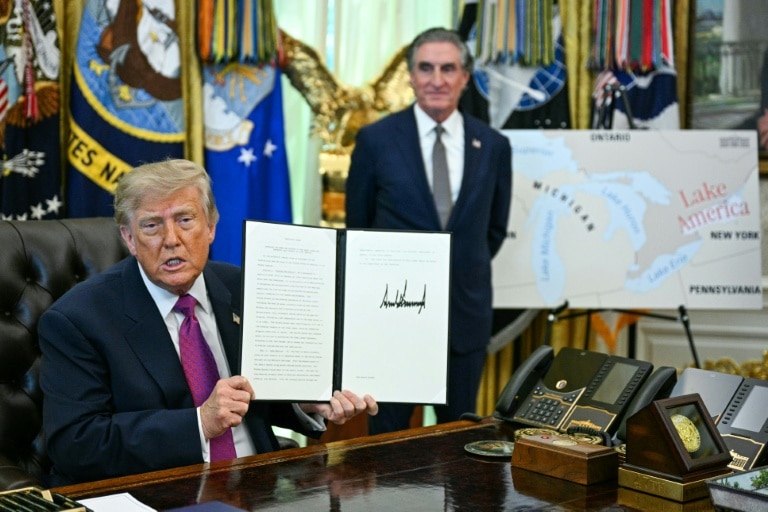
A surprising new flashpoint has emerged in the escalating trade war between long-time allies the United States and Canada, after former president Donald Trump’s administration moved to rename the shared Great Lake Lake Ontario to “Lake America,” prompting Google to roll out a geographically split labeling change on its popular mapping platform.
In an official update Sunday, the U.S. tech giant confirmed that users accessing Google Maps within U.S. borders will now see the water body labeled as “Lake America,” while Canadian users will retain the centuries-old Indigenous-derived name Lake Ontario that has been in use since the 17th century. Users based outside both countries will see both names displayed, the company added. Google explained the update aligns with its long-standing policy of reflecting changes to the U.S. Geographic Names Information System (GNIS), the federal government’s official database of domestic geographic names.
This unilateral naming change is not unprecedented for the current Trump administration: back in January 2025, Trump similarly unilaterally renamed the Gulf of Mexico to the “Gulf of America,” a move that the Mexican government swiftly and firmly rejected. Unlike Google, rival tech firm Apple has not updated its default iOS Maps app for U.S. users as of Sunday, retaining the original historic name.
The nomenclature dispute is the latest escalation of Trump’s signature “America First” policy agenda, which has already sparked a full-blown tit-for-tat trade war between the two North American neighbors. Washington and Ottawa have exchanged reciprocal tariffs on hundreds of billions of dollars worth of goods in recent months, and Trump launched a fresh rhetorical salvo against Canada Sunday, specifically targeting the deeply integrated cross-border auto manufacturing sector.
On his Truth Social platform Sunday, Trump lashed out, writing: “I don’t want Canadian cars, I don’t want Canadian parts, I don’t want Canadian anything.” He has followed through on this rhetoric by threatening to double existing tariffs on Canadian auto parts to 50 percent, a move that would upend integrated supply chains that currently see millions of Canadian-made components incorporated into vehicles assembled in U.S. factories. Even as Trump highlighted the output of the Ford Motor Company F-150 pickup plant near Detroit — one of the most popular vehicle lines in the U.S. — the vast majority of F-150 engines are actually manufactured just across the border in Windsor, Ontario.
Canadian officials have roundly condemned both the trade tariffs and the abrupt name change. Ontario Premier Doug Ford, speaking to ABC’s *This Week* Sunday, called the situation “absolutely backwards”, drawing a comparison to an absurd comedy sketch from U.S. television show *Saturday Night Live*. “No one’s going to call it Lake of America. It’s just so disappointing,” Ford said.
Ford warned that while the escalating trade war will cause economic harm on both sides of the border, the damage to the U.S. economy would be far more severe. Canada is the largest international buyer of U.S.-manufactured vehicles by a wide margin; if Canadian purchases of American vehicles dry up amid the tariffs, U.S. auto factories across the Midwest would face massive production cuts and layoffs. “A tariff on Canada is nothing more than a tax on American people,” Ford argued. “It’s probably the worst move you could ever do.”
Canada has already responded to Trump’s new tariffs by imposing counter-tariffs of 15 to 50 percent on a wide range of U.S. exports, deepening the rift between two nations that have enjoyed close economic and diplomatic ties for more than a century. Lake Ontario, the smallest of the five Great Lakes by surface area, sits squarely on the shared border between the Canadian province of Ontario and the U.S. state of New York.