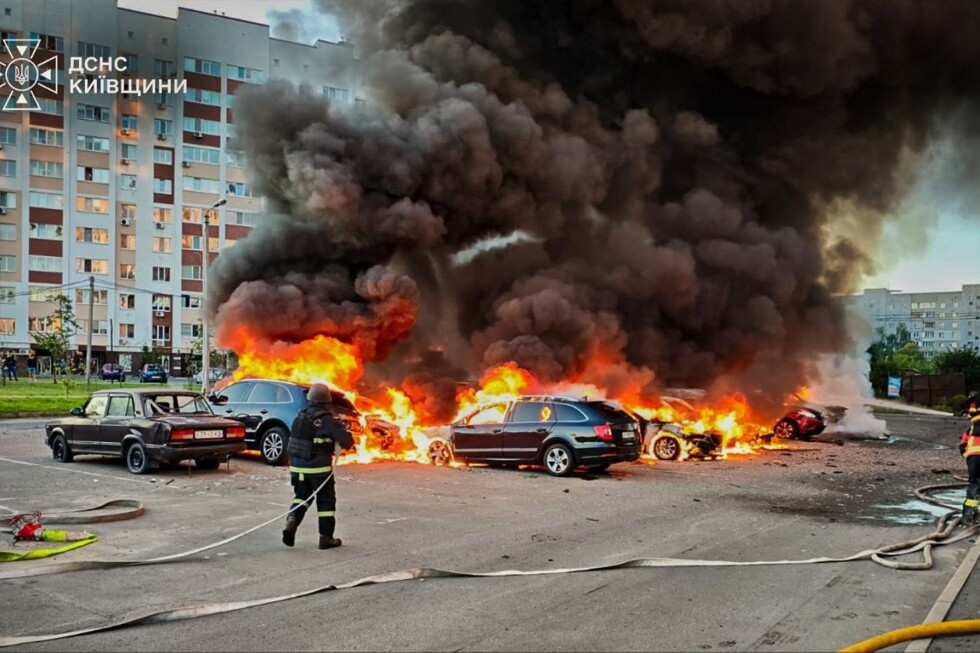
For the second consecutive day, Russian forces have unleashed a wave of drone strikes on Ukraine’s Kyiv region, leaving civilian infrastructure damaged and civilian life upended amid a broader escalation of aerial attacks that has spread to both Ukrainian and Russian territory four years after Moscow’s full-scale invasion.
Regional and national Ukrainian officials confirmed that the Friday assault damaged more than a dozen apartment blocks, 16 private residences, 14 storage facilities and 16 vehicles across Kyiv region. Emergency responders faced a deliberate secondary hazard: a second drone targeted the same site after first responders arrived, a tactic known as a “double tap” designed to kill rescue workers. As of Friday, the attacks had left one person dead and two injured in Kyiv region, with additional casualties reported across other parts of Ukraine.
The assault extended the disruption that began a day earlier, when a 15-hour air raid lockdown shut down normal activity across the Ukrainian capital. Ukrainian Foreign Ministry officials noted that such prolonged disruptions have become a daily reality for communities near the front lines, and the latest strikes have already inflicted lasting harm on civilian life and economic activity. Kyiv regional authorities also warned of degraded air quality following the strikes, urging residents in affected areas to stay indoors with windows closed and limit outdoor exposure.
Ukrainian defense and intelligence officials say the current wave of drone attacks follows a deliberate strategy: launching incremental waves of fast, jet-powered drones to exhaust Ukraine’s air defense systems and wear down civilian morale. “The goal is to exhaust air defenses and the population,” Andrii Kovalenko, head of Ukraine’s Center for Countering Disinformation at the National Security and Defense Council, wrote on social media Friday. This seasonal escalation aligns with what Ukrainian officials call Russia’s annual “weaponize winter” campaign, which targets the country’s critical energy infrastructure to force hardship on Ukrainian civilians ahead of the cold months.
The threat of prolonged winter outages is most acute in the southern Kherson region, 70% of which remains under Russian occupation. A Russian glide bomb strike this week already forced a key combined heat and power plant offline, and regional officials are warning of weeks or even months of total power and heating loss this winter. In a Thursday social media statement, Oleksandr Prokudin, head of the Kherson regional military administration, urged tens of thousands of remaining residents to relocate to safer parts of Ukraine, noting that Russian strikes on critical infrastructure have increased sharply in recent months. Since the start of July, Russian forces have dropped 170 glide bombs on the region — more than the total in the first half of 2024. Over the past two months alone, Russia has launched more than 1,700 attack drones against Kherson’s infrastructure, with more than 6,500 small drone strikes recorded in just the past week. Prokudin confirmed regional authorities will provide full support for evacuations, including transportation, resettlement and social services for residents who choose to leave.
Beyond the immediate human cost, the persistent Russian airstrikes are already dragging down Ukraine’s economic outlook. The Ukrainian Ministry of Economy has revised its 2026 GDP growth forecast downward, cutting the projected growth rate from an earlier estimate of 1.3% to just 0.8% due to persistent damage to energy and logistics infrastructure, as well as Russia’s ongoing blockade of Black Sea grain exports. Economy Minister Oleksandr Kravchenko told local news outlet Interfax-Ukraine that while Ukraine posted modest growth in the second quarter of 2024 following 0.6% expansion in the first quarter, further growth remains constrained by the persistent assault on critical infrastructure.
The latest escalation has not been limited to Ukrainian territory. Overnight into Friday, Ukraine’s air force recorded 164 Russian drones launched across Ukrainian territory. Separately, a Russian glide bomb attack on the northern Sumy region killed a 61-year-old man and wounded seven more.
In response, Ukraine has stepped up its own drone campaign targeting Russian energy infrastructure, continuing a months-long push to disrupt Russia’s oil and fuel production. Overnight, Ukraine’s General Staff confirmed a successful strike on the Slavneft-YANOS oil refinery in Russia’s Yaroslavl region, roughly 600 miles from the Ukrainian border, which sparked a large fire at the facility that produces gasoline, diesel, aviation fuel, lubricants and other petroleum products. Russian regional governor Mikhail Yevrayev confirmed the Friday morning attack left one person dead and 27 injured, including 10 who were wounded when drone debris hit a public bus.
Additional Ukrainian drone strikes were reported across multiple Russian regions on Friday. In the Moscow region, a drone hit a local supermarket, damaging the building and shattering windows at a nearby outpatient clinic, according to regional governor Andrei Vorobyov. In Sevastopol, the major port city on the illegally annexed Crimean Peninsula, a drone strike caused extensive damage to a five-story residential building, leaving four people wounded, Russian-installed regional governor Mikhail Razvozhayev reported. The Russian Defense Ministry claimed its air defenses shot down 512 Ukrainian drones overnight across 18 Russian regions, as well as over Crimea and Black Sea waters.
Moscow has not yet commented on the latest strikes on Kyiv beyond its initial statement confirming it hit a target in Kyiv region that it claimed stored Ukrainian cruise missiles and rocket fuel. Ukrainian officials have not verified this claim, and the Associated Press could not independently confirm the Russian assertion. Past Russian strikes on Kyiv warehouses have hit facilities storing food, books and other civilian goods, rather than exclusively military targets.