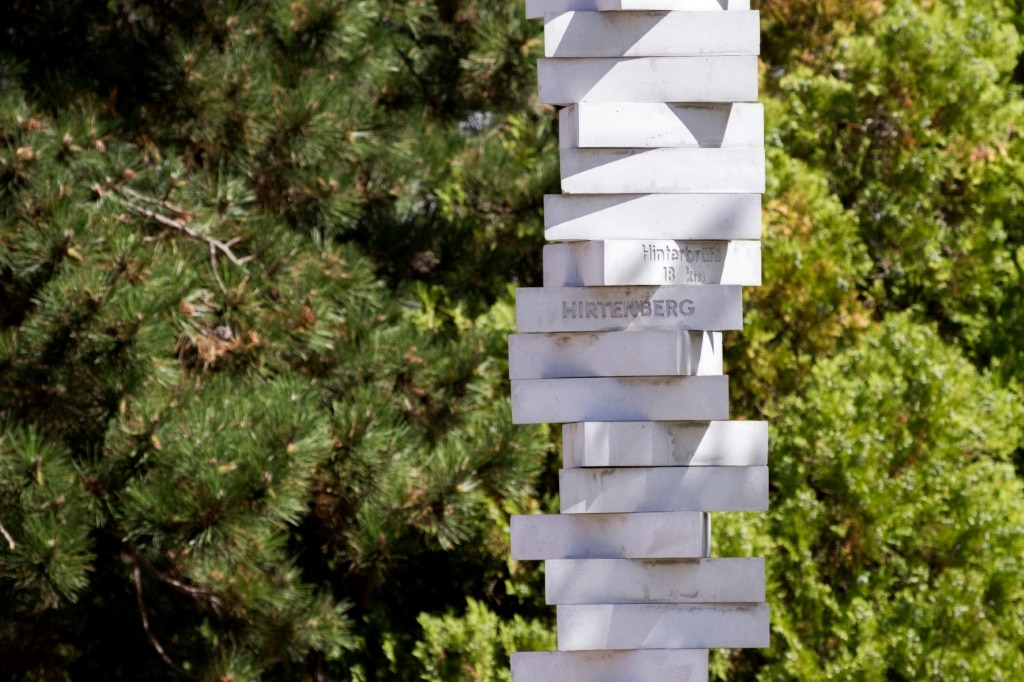
A decades-long reckoning with Austria’s Nazi history has reignited in the small town of Leobersdorf, where a planned commercial development on the grounds of a former Nazi forced labour and concentration camp complex has sparked widespread public outcry from historians, Holocaust remembrance groups, and local activists.
Today, only scattered crumbling concrete fragments hidden in overgrown meadows mark what was once the Weinberglager complex, a sprawling detention facility built shortly after Nazi Germany’s 1938 annexation of Austria. For years, the site held thousands of prisoners of war and forced labourers, and later operated as the Hirtenberg subcamp of Mauthausen, Austria’s second-largest concentration camp for women prisoners. Between September 1944 and April 1945, roughly 400 women—mostly from the Soviet Union, with smaller groups from Italy and Poland—were held at Hirtenberg and forced to produce infantry ammunition at a nearby arms factory. After the end of World War II, most camp structures were demolished, repurposed, or left to decay, leaving only faint underground and surface traces of the atrocities committed there.
In 2024, plans for a full business park on the 40-kilometre site south of Vienna—covering land that once made up the concentration camp, including a cold storage warehouse and a new outlet for German discount supermarket chain Lidl—were made public, immediately drawing sharp criticism. The Federal Monuments Office of Austria has ruled that surviving traces of the camp are not substantial enough to warrant official protected monument status, clearing the way for construction to begin, and bulldozers have already started preparation work on the site. Activists and international remembrance organizations have since ramped up calls to halt development and preserve the site as a historical memorial.
For Erich Strobl, who leads a local campaign to protect a portion of the site, the development amounts to sacrificing a site of traumatic historical memory to commercial interests. “For me, it’s a sad feeling, because a place burdened by history is being built over, sacrificed to the economy,” Strobl told reporters. The International Mauthausen Committee, the leading organization advocating for remembrance of the Mauthausen camp system, has taken a firm stance: “A former concentration camp must not be built over with new structures.”
Josef Pumberger, a board member of the Austrian branch of the Mauthausen Committee, called the ongoing work in 2026 a source of profound outrage. Standing at the site where concrete foundation columns already rise from the ground, Pumberger said he felt “grief, anger, rage, that something like this can happen in Austria in the year 2026.” He argues that the small stele memorial erected at the site in 2024 is insufficient for meaningful remembrance. Without tangible remains of the original camp structures, he says, memory becomes abstract: “It is very important to have tangible evidence of the buildings in which the Nazis imprisoned people, tortured them, killed them. Otherwise it becomes a virtual act of remembrance, or one that exists only in books and photos and films.”
Controversy has also been stoked by revelations that the land was previously owned by Leobersdorf mayor Andreas Ramharter, who sold the plot in staggered sales in 2022 and 2023 for more than €15 million ($17.5 million), according to local Austrian media. Ramharter declined to comment on the sale or the development when contacted by AFP. The project developer, Austrian firm TRA LEO GmbH & Co KG, has said it is willing to support the creation of a small on-site memorial to camp victims. Lidl has also pushed back against criticism, confirming its plans to open a store but emphasizing that its outlet will be built on an adjacent plot, not directly on the former concentration camp grounds.
The debate over the Leobersdorf development cuts to the heart of Austria’s ongoing, uneven reckoning with its Nazi past. In the decades immediately after World War II, Austria widely framed itself as an innocent victim of Nazi aggression, overlooking the widespread complicity of Austrian citizens in the Holocaust and Nazi war crimes. It was not until the late 1980s that the country—where Adolf Hitler was born—began a formal public examination of its historical responsibility.
Bertrand Perz, a leading Austrian historian specializing in the history of the Mauthausen camp system, notes that even a public debate like the one unfolding in Leobersdorf would have been unthinkable in the 1980s, reflecting growing societal sensitivity to the importance of preserving Nazi-era sites. But Perz also notes that this growing demand for remembrance now clashes with a competing cultural impulse: a growing push among segments of the public to “move on” from the discussion of Nazi-era history. This shift has been amplified by the rising political influence of Austria’s far-right Freedom Party (FPOe), a party founded by former Nazis that placed first in 2024 national legislative elections. Though the FPOe failed to form a national governing coalition, it holds power in five of Austria’s nine federal states as part of regional governing coalitions.
For many residents of central Leobersdorf contacted by reporters, the controversy has either flown under the radar or is a topic they prefer not to address. But for activists and historians, the fate of the Hirtenberg site is about more than just one development project—it is a test of Austria’s commitment to confronting its Nazi past amid shifting political currents that prioritize commercial growth and historical amnesia over remembrance.