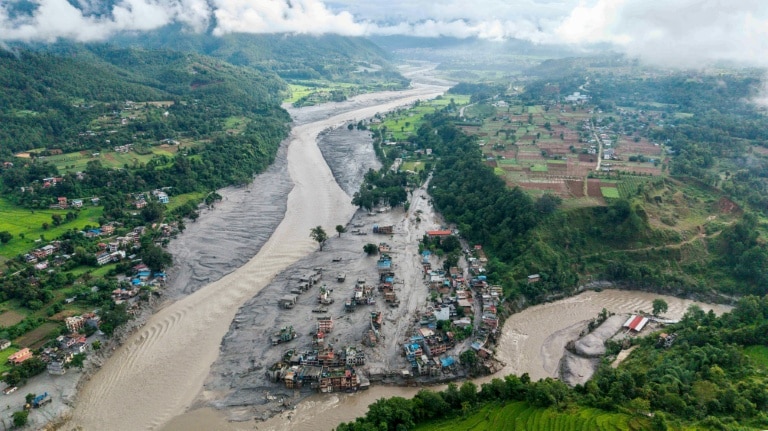
A catastrophic glacial collapse along the remote Himalayan border between Nepal and Tibet has triggered a devastating “inland tsunami” of freezing mud and debris that has killed at least 392 people, left more than 1,400 unaccounted for, and forced rescuers to navigate new, urgent flood risks as search efforts enter their third day.
The disaster, which struck on Wednesday, was initially misidentified as a magnitude 4.4 earthquake by global seismic monitors, but the U.S. Geological Survey (USGS) later confirmed it was caused by a sudden glacial collapse that sent a torrent of icy sludge cascading downstream across the border. The debris flow, which traveled roughly 170 kilometers south into Nepal, leveled entire villages, buried homes, crumpled bridges and dams, and swept vehicles away like discarded toys.
Among the missing are hundreds of foreign nationals, many of whom were either trekking through Nepal’s Himalayan trails or completing a sacred pilgrimage to Tibet’s snow-capped Mount Kailash. Nepal’s police force has confirmed 389 recovered bodies within its borders, with 910 people still out of contact—517 of whom are foreign tourists. Beijing adds that another 100 Chinese citizens missing in Nepal are not included in that count. Indians make up the largest group of missing foreigners, with 90 U.S. citizens also reported unaccounted for, alongside nationals from Australia, Britain, Malaysia, the Netherlands, Portugal, South Africa and South Korea. Across the border in Tibet, Chinese authorities report three deaths and hundreds more missing, while 555 stranded tourists and 499 local residents have already been evacuated from high-risk zones.
As emergency teams, soldiers, and specialized rescue units race against time to pull survivors from debris fields and locate remains of the missing, their efforts have been significantly complicated by new flood warnings. Enormous piles of landslide debris have blocked mountain valleys, trapping water that has formed new unstable lakes behind the rubble. On Thursday, Chinese state media warned that one of these newly formed lakes faces a “high risk of breaching” that would send a second destructive flood downstream. Nepal’s own Flood Forecasting Division echoed the alert, issuing a special warning that urged rescue teams and local residents to exercise extreme caution.
For survivors waiting in makeshift hospitals and relief camps, the days since the disaster have been marked by agonizing uncertainty. Kula Priya, a Nepali resident who lost three homes to the deluge and her eldest son who remains missing, told reporters “I don’t care for wealth. I just want my son back. We had three houses, all of which were washed away by the floods.” In Malaysia, 26-year-old Logadarrsiny Raman waits for news of her parents, aunt, and uncle, who were part of a 17-person pilgrimage group that lost contact minutes before the flood hit the area they were traveling through. “I’m very anxious,” she told AFP. “My only hope is to hear back from them that they are safe.”
Rescue operations have mobilized extensive resources across both sides of the border: Chinese authorities have deployed nearly 800 emergency workers, supported by sniffer dogs, speed boats, satellite imagery and drones to navigate the hard-to-reach mountain terrain, while Nepali soldiers are also using sniffer dogs to locate bodies buried under thick layers of mud. Nepal’s Prime Minister Balendra Shah, who called on the nation to unite in the immediate aftermath of the disaster, toured the hardest-hit regions on Thursday, ordering local officials to prioritize immediate relief for displaced families and clear blocked access routes to cut off affected zones.
Experts link the rising risk of such glacial disasters to the broader impacts of climate change, which is accelerating glacial melt across the Himalayas and around the world, increasing the frequency of glacial collapses and outburst floods from glacial lakes. Ruth Gamble, an environmental historian at Australia’s La Trobe University, described the sudden debris flow as “like an inland tsunami” that caught communities and visitors off guard. In a message of condolence, exiled Buddhist spiritual leader the Dalai Lama said he would pray for all those who had lost their lives in the disaster.