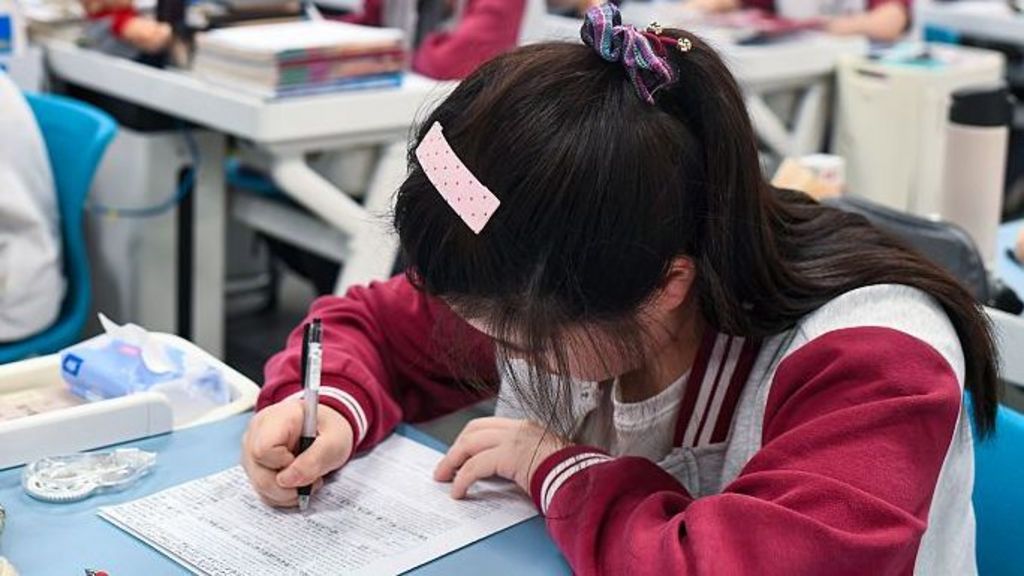
Against the backdrop of China’s intensely competitive academic culture, a growing number of teenagers are turning to unprescribed recreational use of pharmaceutical drugs to escape crippling study and exam pressure, a hidden public health crisis that has prompted warnings from authorities and experts alike.
The crisis is illustrated by the story of 14-year-old Xiaomei (a pseudonym to protect her identity), a high-achieving student from a coastal Chinese province who first turned to prescription cough medicine after an older peer suggested it would help her relax. Though the drug required a doctor’s prescription to access legally, she easily purchased it through online platforms. Initially experiencing mild dizziness, Xiaomei quickly grew dependent on the soft numbing effect, which offered a fleeting escape from the anxiety of upcoming high-stakes exams. When consumed in large doses, the medication can trigger severe harmful outcomes, including hallucinations and loss of motor control.
Over two years, Xiaomei moved between different unprescribed medications shared and recommended to her via anonymous social media chat groups – ranging from epilepsy treatments to neuropathic pain relievers. She sometimes took five pills at a time, occasionally more than 10 to chase the desired calming or intoxicating effect. “When I felt too much pressure from my studies, or I didn’t do well at exams, or even when I quarrelled with my parents, I would take these drugs,” she told the BBC. “I was running away from reality.”
Xiaomei’s experience is far from unique. The BBC collected dozens of similar accounts from teenagers across Chinese social media chat rooms, where young users collectively pursue what they call a “pharmaceutical high” to cope with uniform academic pressure. In one recorded interaction, a girl shared a slurred, incomprehensible voice note after overdosing on a neuropathic pain drug, saying “I feel my body doesn’t belong to me. I’m so dizzy.” Other users shared tips for accessing unregulated drugs, offered to forge prescriptions using family members’ old documents, and discussed alternate code names for controlled substances to avoid platform detection. For example, one user noted that a Parkinson’s tremor medication, which causes delirium and confusion in excessive doses, remains unregulated and easy to purchase.
Officially, it is difficult to measure the full scale of this trend due to limited public aggregated data, but the Chinese government has already acknowledged its severity. Two years ago, authorities launched a nationwide crackdown on the cough suppressant many teenagers like Xiaomei first used, reclassifying it as a controlled psychotropic substance that requires a formal prescription. That crackdown made the drug far harder to access online, but by April this year, regulators found teenagers had simply shifted to alternative unprescribed medications. Even after new controls were imposed on the new drug of choice, BBC reporters were still able to purchase it for less than $1.5 per gram via an anonymous online chat room.
A 2025 research paper from China’s Ministry of Justice Crime Prevention Institute explains why regulatory crackdowns on individual drugs have had limited success: “Non-regulated substances are easy to acquire and even when one drug is controlled by the authorities, young people quickly find alternatives.” As the world’s largest producer of active pharmaceutical ingredients, China has widespread, low-cost access to a huge range of prescription medications, and weak age verification on many platforms lets minors purchase them easily. Xiaomei told the BBC that purchasing a full box of cough suppressant only took a few clicks – she simply entered her national ID number (which clearly displays her underage status) and received the delivery with no additional checks, paying less than $1 for 50 tablets.
While official 2025 data shows a 41% drop in newly identified drug users under 35, the China National Narcotics Control Commission has issued explicit warnings that non-medical prescription drug misuse is growing rapidly, particularly among minors. Experts point to the uniquely intense pressure facing Chinese teenagers as the root cause of the trend.
Xiaomei, who attended an elite academic class with a strict elimination system – students who drop in rankings are removed from the advanced program – explains the stakes: “It is just so hard to pass exams and to stay in elite classes. When you fail, you feel like a failure, believing you have no chance in life.”
Renowned Chinese sociologist Xiang Biao, director of the Max Planck Institute for Social Anthropology, notes that decades of the now-ended one-child policy left many families with a single child who carries all of their household’s future expectations, compounding that pressure. “What makes Chinese teens different is their isolating environment,” Xiang explains. “They spend at least nine or 10 hours in school. They have very few chances to develop social relationships, very few opportunities to witness what life is really like.” Xiang also links rising prescription drug misuse to a documented increase in teen self-harm, a trend the BBC observed in chat rooms where users encouraged one another to self-injure “to feel something”.
For Xiaomei, the misuse of drugs took a severe physical toll. As the critical high school entrance exam approached, she switched to a new epilepsy and pain management drug to numb her anxiety, and quickly experienced rapid memory deterioration, living in a constant mental fog. After being advised to switch to another pain reliever, she eventually overdosed on 50 tablets, becoming severely ill and forced to confess to her parents. Unlike many families, Xiaomei’s parents responded with empathy rather than anger: “They mostly expressed how heartbreaking it was for them to see me like that. They didn’t scold or criticise me. Their approach was gentle.” This shift in support, she says, changed everything.
Xiang notes that this lack of emotional validation is a common gap for Chinese teens: “Many children receive lots of attention but the type of attention they want is to be asked how they feel. Do they feel lonely or stressed? Often in China parents brush that away and say you just have to be stronger.” Experts argue that rather than focusing solely on cracking down on illegal online drug sales – a strategy they compare to playing whack-a-mole – policymakers should address the underlying teen mental health crisis driving the trend. Recent data underscores the scale of that crisis: a 2023 China Mental Health Blue Book study found that nearly 95 million people in China live with depression, and over 30% of that group are under 18.
The Chinese government has acknowledged the need for expanded mental health support for teenagers, and has announced plans to roll out counselling rooms in all schools, add psychiatric services to at least one hospital per county, and train more mental health professionals, with a goal of building a national psychological support and crisis intervention system by 2030. To date, 92% of primary schools and 95% of junior secondary schools have employed on-campus counsellors, and major cities including Beijing have integrated mental health education into standard school curricula. However, the system still faces a critical shortage of specialized child and adolescent psychiatrists: a 2020 study published in *The Lancet* found only 500 qualified child psychiatrists across the entire country, most concentrated in major urban centers.
Wider social and economic shifts have also amplified teen and parental anxiety. The China that Xiaomei’s parents grew up in followed a clear social contract: hard work and strong grades guaranteed stable success. Today, even high grades and a university degree do not guarantee a secure future, particularly after the COVID-19 pandemic left China’s economy struggling to recover, with youth unemployment reaching 20% in recent estimates. “People have become more pessimistic in general,” Xiang says. “Parents feel confused and anxious because they see a problem in their children, but they don’t see an alternative. If my child has a problem, it’s the end of the world. I think we should pay more attention to parents as well as children.”
For Xiaomei, her parents’ new willingness to listen helped her recover, and she ultimately performed well on the entrance exam that had caused her so much anxiety. “I am lucky to have their support,” she says. But not all teens have access to that kind of support, which is why 22-year-old Lu Jingchan, a former prescription drug user who overcame addiction after four years and four overdoses, now advocates against teen misuse on social media. “The drugs drove me to the brink of madness. You risk sinking into an abyss of addiction, destroying your health,” he says. His message to teens struggling with the pressure he once faced is direct: “I hope you can face life head-on, without needing medicines to numb yourselves. If you are overdosing, I want to give you the courage to stop. I believe your lives will improve. I believe you will all find happiness.”