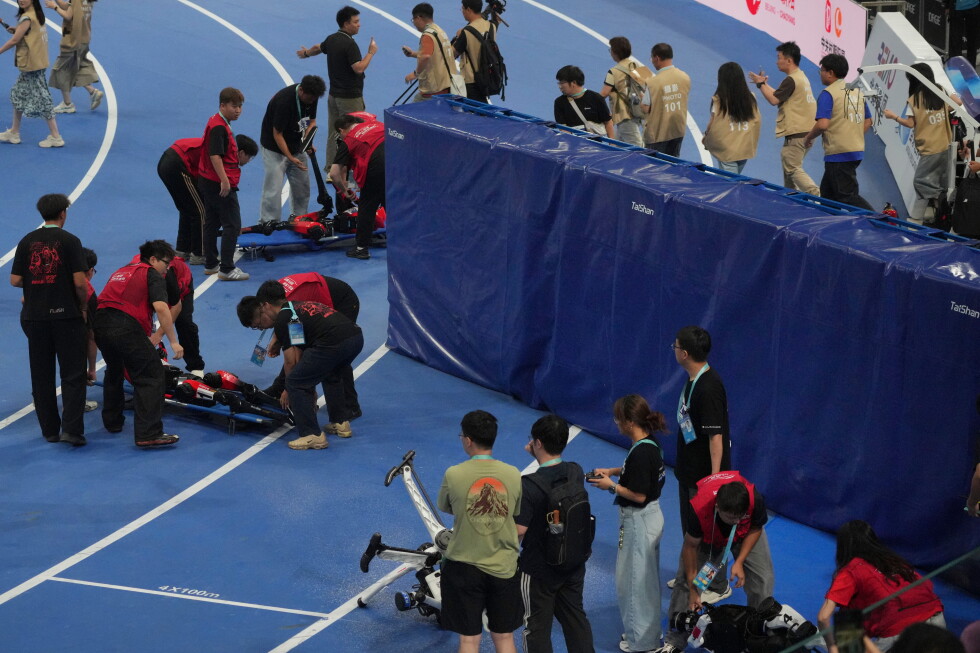
BEIJING – In a milestone that underscores China’s breakneck progress in humanoid robotics development, a domestically developed humanoid robot shattered records on Tuesday by clocking a 100-meter sprint time of 8.86 seconds in Beijing. The astonishing result not only outpaces every previous robot competitor in the event, but also beats the all-time fastest human 100-meter world record held by legendary athlete Usain Bolt.
The record-setting run took place during the second annual World Humanoid Robot Games, an Olympic-style international robotics competition hosted in Beijing. Beyond being a showcase of athletic (or mechanical) skill, the event serves as a public display of China’s rapidly advancing robotics ecosystem, emerging at a time of intensifying global technological competition between China and the United States.
The new benchmark comes just three days after the last robot sprint record was set. On the preceding Saturday, another competitor posted a time of 9.39 seconds, marking how quickly performance in humanoid robot locomotion is improving. For context, the men’s 100-meter world record for human athletes has stood at 9.58 seconds since Jamaican sprinter Usain Bolt set it in 2009 – nearly a full second slower than the robot’s new mark.
After crossing the finish line, the record-breaking robot experienced a minor mishap: it lost balance and crashed into a padded safety barrier, with sparks visible from its midsection. Even so, the finish solidified its place in robotics history.
This year’s iteration of the World Humanoid Robot Games brings together more than 2,000 robots competing across 1,300 matchups and 51 distinct events. The competition schedule blends traditional Olympic-style athletic events like sprinting, long jump, table tennis, and even ballroom dancing, with unique categories that test practical real-world capabilities absent from conventional sports competitions.
Unlike traditional Olympic events, many of the Games’ challenges pair robots in team competitions designed to test their ability to complete everyday tasks: common household chores, customer service roles in hotels, and coordinated emergency response operations, all of which mirror the use cases developers are targeting for future commercial humanoid robot deployments.
In a commentary published Monday by China’s state-run newspaper People’s Daily, industry development was framed as a work in progress. “‘Housekeeper’ and ‘caregiver’ robots are still in the pilot and validation phase,” the outlet noted, adding that “challenges are precisely where the focus of development lies.” The commentary confirmed that China’s broader robotics industry is continuing to evolve toward higher quality outputs and more breakthrough innovation, aligning with the country’s long-term goals to lead in next-generation advanced manufacturing and artificial intelligence.